
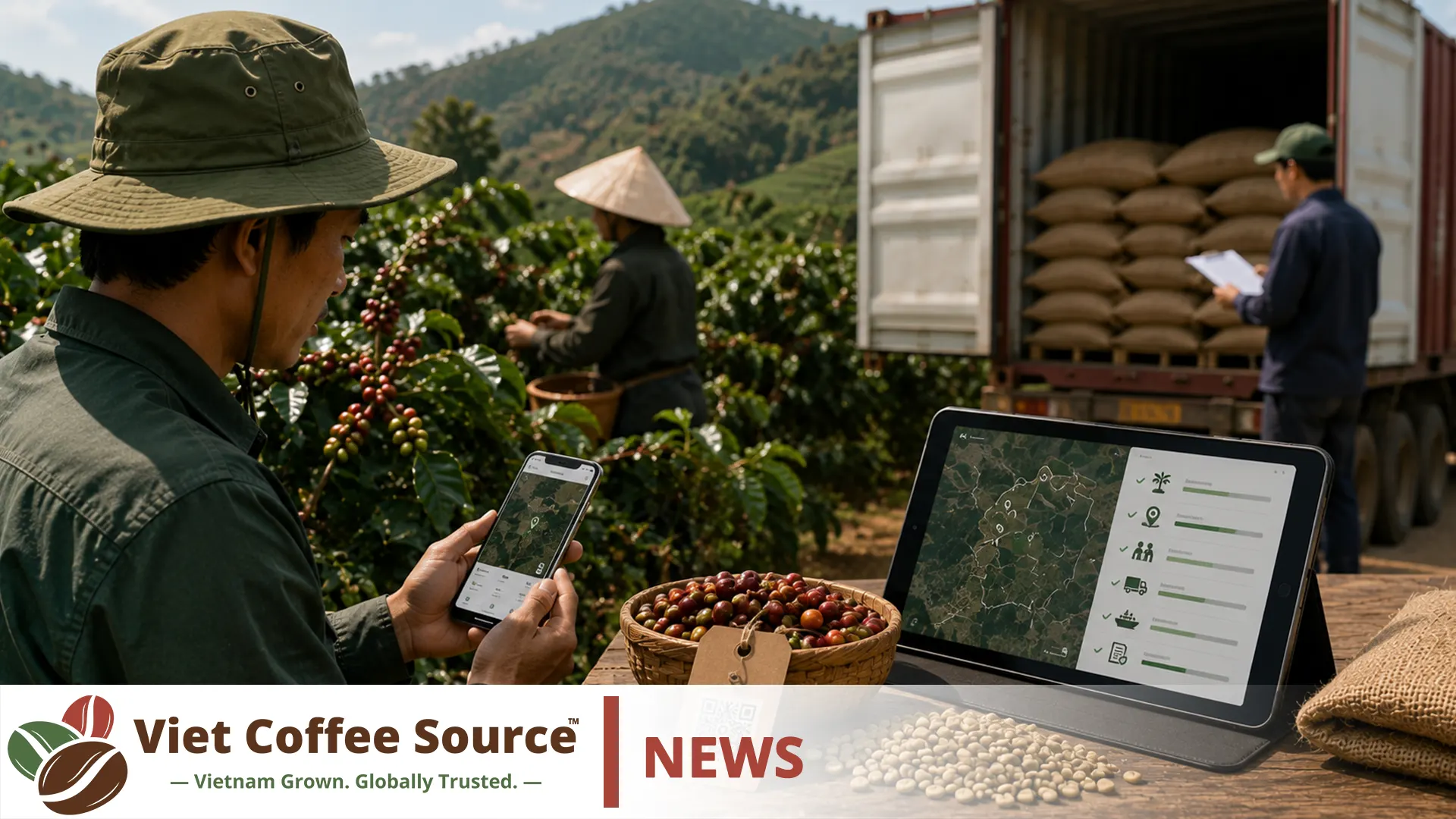
Vietnamese Coffee Exporters Accelerate Farm-Level Traceability Before EUDR Enforcement
Vietnamese coffee exporters are accelerating farm-level traceability programmes as the European Union Deforestation Regulation approaches its application date for large and medium-sized operators on 30 December 2026. The preparation involves far more than adding a traceability statement to export documents. Exporters are mapping coffee farms, verifying land records, connecting individual production plots with purchasing batches and checking whether the underlying data can withstand review by European buyers and competent authorities.
The EUDR places the principal legal due diligence responsibility on the operator that first places a covered coffee product on the European Union market. Vietnamese producers and exporters may not be the party submitting the final due diligence statement in every transaction, but they must provide the farm, origin, legality and chain-of-custody information that enables the EU operator to complete its obligations.
As the deadline approaches, commercial readiness is increasingly being measured by the reliability of production data rather than the number of farms appearing in a database. A large dataset has limited value if farm coordinates are inaccurate, plots are duplicated, farmer identities cannot be verified or exported coffee cannot be linked back to the recorded production areas.
For Vietnamese coffee businesses, farm-level traceability is therefore becoming both a compliance requirement and a competitive capability. Exporters that can provide verified plot data, controlled lot records and clear shipment connections may be better positioned to retain European buyers and participate in higher-value sourcing programmes.
The current EUDR timeline places the main deadline at the end of 2026
The European Union amended the EUDR timetable in December 2025. Under the current framework, the principal obligations begin applying to large and medium-sized operators on 30 December 2026.
Most micro and small operators receive a later application date of 30 June 2027, while certain businesses previously covered by the EU Timber Regulation remain subject to the earlier date.
The additional preparation period does not remove the need for exporters to act. Coffee harvested, purchased, processed and stored before the deadline may later form part of shipments placed on the EU market after the regulation begins applying.
Exporters therefore need traceability systems to operate during procurement and inventory formation, not only when a European customer requests final shipping documents.
EUDR readiness begins at the production plot
The EUDR requires relevant coffee to be connected with the plots of land where the commodity was produced. This makes the farm or production plot the starting point of the traceability chain.
A general statement that coffee originated in Dak Lak, Lam Dong, Gia Lai or another province does not identify the specific plots included in a commercial shipment.
Exporters need to know which producers supplied the coffee, where their plots are located, when the coffee was produced and how those deliveries moved through collectors, cooperatives, processors, warehouses and export lots.
The system must preserve that connection even when coffee from many small farms is combined into a larger commercial batch.
Geolocation data must describe the actual production land
Geolocation under the EUDR is based on latitude and longitude coordinates describing the land where the relevant commodity was produced.
For production plots larger than four hectares, the regulation requires polygons with sufficient coordinate points to describe the perimeter. Smaller plots can generally be represented by at least one latitude and longitude point using the required coordinate precision.
Many exporters and sustainability programmes collect polygons for smaller farms as well because boundaries can provide more useful information than a single point.
Whatever method is used, the coordinates must correspond to the real production area. A point placed at a farmer’s house, village centre, collection station or roadside location does not reliably identify the coffee plot.
Farm polygons are becoming commercial assets
A digital farm polygon defines the geographical boundary of a production area. When correctly collected and verified, it can be compared with forest reference layers, land-use information and satellite imagery.
The polygon can also support production estimates, farm inspections, sustainability monitoring, greenhouse gas calculations and agronomic services.
Nestlé Vietnam has reported plans to collect more than 40,000 coffee-farm polygons through the Nescafé Plan programme by the end of 2026.
This scale illustrates how major supply-chain participants are treating farm mapping as long-term infrastructure rather than a one-time administrative exercise.
Data quality is more important than the number of mapped farms
Exporters are increasingly finding that collecting coordinates is only the first stage. The information must be checked for duplicates, misplaced boundaries, impossible farm sizes and conflicts with other records.
A farmer may supply more than one exporter or participate in several sustainability programmes. The same production plot can therefore appear in multiple databases under slightly different names, codes or geometries.
Vinh Hiep, one of Vietnam’s major coffee exporters, has emphasised field verification, removal of duplicate records and improvement of growing-area data before expanding its database further.
A smaller verified dataset can be more commercially useful than a much larger collection of unconfirmed coordinates.
Duplicate farm records can create compliance risk
Duplicate records may cause the same farm area or estimated production volume to be assigned to several supply chains at the same time.
This creates a risk that the recorded coffee volume exceeds the realistic output of the mapped land, particularly when different companies claim deliveries from the same producer.
Duplicates may also produce conflicting farmer names, plot boundaries, land-use histories or sustainability statuses.
Exporters need procedures for identifying overlaps, reconciling records and determining which data version is current and supported by field evidence.
The December 2020 cut-off requires historical land information
EUDR compliance is not based only on the condition of the farm when the coffee is exported. Relevant coffee must be produced on land that has not been subject to deforestation after 31 December 2020.
Current satellite imagery alone may not establish the land condition at the end of 2020 or explain changes that occurred after that date.
Exporters and their partners may therefore need historical forest maps, multi-date satellite imagery, land records, cultivation histories and field verification.
The objective is to determine whether the plot was already being used for agriculture at the cut-off date or whether forest was subsequently converted to coffee production.
Vietnam is developing a national 2020 forest reference map
Vietnam is accelerating the development of a forest-boundary dataset reflecting conditions at the end of 2020.
The initiative combines provincial forest-status information, remote-sensing analysis, multi-temporal satellite images and international reference datasets.
Local verification is important because global forest maps may not always reflect Vietnam’s land classifications or agricultural conditions accurately.
A reliable national reference layer can help exporters and European buyers assess coffee plots using information adapted to Vietnamese production landscapes.
Shade-grown coffee can be misclassified by satellite systems
Coffee farms in Vietnam may include shade trees, windbreaks, fruit trees or other vegetation integrated into the agricultural landscape.
Satellite-based forest-cover systems can sometimes interpret dense tree cover on an established coffee farm as forest.
This creates a risk that legitimate agricultural land is flagged for further investigation even when no forest conversion occurred after the cut-off date.
Local land records, historical imagery and field evidence can help explain these cases and distinguish agroforestry or shaded coffee systems from natural forest.
Mapping results can identify areas requiring additional verification
Vietnam’s developing forest-reference approach groups mapped areas according to the consistency of different data sources.
Areas where the available datasets agree can be treated differently from locations where national maps, international layers and satellite analysis produce conflicting results.
In reviewed data from 13 provinces, approximately 54.2% of the mapped area was reported as consistent, around 45% required further verification and about 0.8% was classified as a higher-risk zone requiring direct attention.
This type of classification does not automatically determine the compliance of an individual coffee shipment, but it helps authorities and businesses prioritise field checks and supporting evidence.
Vietnam’s low-risk classification does not eliminate traceability
Vietnam was included in the European Union’s list of countries classified as low risk under the EUDR country-benchmarking system.
This status may allow EU operators sourcing from Vietnam to use simplified due diligence in eligible circumstances.
Low-risk classification does not mean that coffee can enter the European Union without production information. Operators must still collect the required information, including product details, country of production and geolocation of the relevant plots.
The low-risk status should therefore be viewed as a procedural advantage supported by reliable data, not as an exemption from farm-level traceability.
The EU operator remains responsible for the final due diligence decision
Under the revised EUDR framework, responsibility for submitting the due diligence statement generally rests with the first operator placing the relevant product on the EU market or exporting it from the Union.
That operator must determine whether the product meets the applicable requirements and whether any identified risk is negligible.
A Vietnamese exporter can support the process by providing verified farm data, production dates, legality information, chain-of-custody records and shipment references.
The exporter should avoid promising that a shipment is automatically EUDR compliant when the final legal assessment and submission belong to the relevant EU operator.
European buyers are requesting information earlier
Importers and roasters are increasingly requesting farm data before confirming contracts rather than waiting until the coffee reaches the port.
They may ask for sample geolocation files, producer counts, mapped area, traceable volume, forest-risk screening methods and the supplier’s process for handling flagged plots.
Some buyers may also review whether the exporter can connect an approved sample and commercial lot with the same verified production base.
Early data review reduces the risk of discovering missing or inconsistent information after coffee has already been purchased, processed or loaded.
Farm identity must be connected with plot identity
A geolocation file without a verified producer record may not provide sufficient traceability.
Exporters commonly need information such as farmer or household identity, internal producer code, plot code, village, commune, district, province, farm area and production estimate.
The name in the traceability database should be reconciled with contracts, cooperative registers, purchasing receipts or other supporting records.
When a household manages several separate plots, each production area should be identified clearly rather than treated as one undefined farm location.
Land-use legality is a separate requirement from deforestation status
The EUDR requires relevant products to be deforestation-free and produced in accordance with the relevant legislation of the country of production.
A plot can appear free from post-2020 deforestation but still raise questions involving land tenure, permitted land use, taxes, labour obligations or other applicable legal requirements.
The exact legality evidence may vary according to the producer, location and sourcing model.
Exporters should establish which documents or official records can support lawful coffee production without demanding unnecessary paperwork that smallholders cannot realistically provide.
Unclear land tenure can exclude otherwise productive farms
Smallholder coffee production in Vietnam may involve inherited land, informal transfers, boundary disagreements or incomplete documentation.
These conditions can make it difficult to confirm which household controls a plot and whether the recorded boundaries match legally recognised land information.
Training programmes in Gia Lai have highlighted land use, unclear tenure and land disputes as important EUDR-related risks for coffee farmers.
Exporters and cooperatives need procedures for escalating unclear cases and helping producers correct records where possible instead of automatically assigning questionable data to an export lot.
Smallholder fragmentation increases the operational workload
Vietnam’s coffee sector depends heavily on small farms, particularly in the Central Highlands.
A single export container can contain coffee originating from a large number of small production plots, collectors or village-level delivery points.
Every additional source increases the amount of data that must be collected, checked and preserved through processing and storage.
The challenge is therefore not only technological. It requires field teams, farmer communication, cooperative coordination and disciplined purchasing procedures.
Training local organisations is essential
Farmers cannot supply reliable information if local staff, cooperative leaders and purchasing agents do not understand what must be recorded.
Training-of-trainers programmes are being used to build local capacity in coffee-producing areas such as Gia Lai.
These programmes cover traceability, legality, risk mitigation, land use and sustainable production practices while preparing local trainers to guide farmers.
Repeated practical training is generally more effective than distributing one technical document shortly before a buyer audit.
Collectors and buying stations are critical control points
Farm-level information can be lost when coffee passes through collectors or buying stations without clear delivery records.
Each delivery should be connected with the supplier, date, weight, coffee type, plot or approved producer group and receiving location.
If compliant and unverified coffee are combined without controlled records, the exporter may be unable to identify the production plots represented in the final batch.
Collectors included in an EUDR-oriented supply programme therefore need agreed procedures, training and periodic verification.
Traceability must survive aggregation
Commercial coffee is often aggregated because individual smallholder deliveries are too small for direct export.
Aggregation is not automatically incompatible with EUDR requirements, provided all contributing production plots are identified and the chain of custody is maintained.
The exporter must know which verified deliveries entered a warehouse lot, processing batch or export allocation.
Unknown or unverified coffee should not be added to a traceable lot simply because it has similar physical quality.
Warehouse controls connect farms with export batches
Warehouse systems should record receiving lots, movements, blending, processing losses, stock balances and final allocations.
A lot code should remain linked with the farmer or producer-group data that supported its creation.
When lots are combined, the system should preserve the list of all contributing sources rather than replacing them with only a new warehouse code.
Regular stock reconciliation can identify impossible balances, double allocation or traceable volume that exceeds verified procurement.
Processing records must preserve origin data
Dry milling, cleaning, polishing, grading and screen separation can transform one incoming batch into several finished products.
Traceability records should show which input lots were processed, the date, output grades, processing losses and resulting warehouse positions.
A commercial Screen 18 or polished Robusta lot may originate from multiple verified inputs, each of which must remain connected with the final output.
Processing efficiency and quality information can be recorded without breaking the link to the original farms.
Traceable volume must be commercially realistic
The production claimed from a mapped plot should be compared with farm area, crop conditions and reasonable yield expectations.
Unusually high volumes may indicate duplicate allocation, incorrect farm size, purchases from unrecorded sources or errors in data entry.
Yield checks do not need to assume that every farm produces the same amount, but they can identify records requiring additional review.
Reliable volume control protects both the exporter and the buyer from purchasing more traceable coffee than the verified supply base could have produced.
Samples must represent the traceable commercial lot
An exporter may provide a high-quality sample before the final EUDR-related production base has been confirmed.
If the approved sample comes from one warehouse lot but the final shipment is prepared from another group of farms, the buyer must be informed and may require a new approval.
Commercial discussions should clarify whether the sample represents a specific existing lot, a planned blend or a general quality specification.
A structured quality and compliance process can connect sample approval, physical specifications, traceability records and pre-shipment inspection.
Farm data should be linked with the correct coffee origin
Vietnam’s coffee regions differ in production systems, climate, varieties, harvest periods and supply-chain structures.
A buyer sourcing coffee described as originating from a particular province or district may expect the geolocation records to support that statement.
Exporters should not apply a broad origin name to coffee whose production plots fall outside the claimed area.
Buyers can review relevant Vietnamese coffee origins to understand how regional production conditions correspond with product and traceability requirements.
Data-cleaning must be continuous
Farm databases change as land is transferred, boundaries are corrected, farmers join or leave a programme and new production areas are registered.
Exporters should maintain version control and record when information was collected, reviewed or changed.
Old coordinates should not remain active if a corrected polygon has been approved.
Regular cleaning is particularly important before allocating farms to a new purchasing season or responding to a buyer’s data request.
Field verification remains necessary
Remote mapping can identify coordinates and potential land-cover concerns, but some cases require direct field inspection.
A field visit can confirm the farmer, farm boundary, current crop, neighbouring land use and reasons for differences between satellite layers.
Photographs, inspection notes and signed confirmations may support the record, although the required evidence should be proportionate to the issue being investigated.
Higher-risk or conflicting records should receive more attention than plots where reliable data sources already agree.
Exporters need a process for yellow and red flags
A traceability system should not merely collect data. It should identify records that cannot yet be accepted for an EUDR-oriented supply chain.
Potential warning signs include coordinates inside protected forest, recent land-cover change, overlapping polygons, disputed ownership, implausible production or missing purchasing records.
Exporters need rules for suspending the plot, requesting additional evidence, conducting a field check or excluding the related coffee.
Resolving a warning before procurement is generally less disruptive than removing coffee after it has entered a processed export lot.
National traceability infrastructure is expanding
Vietnam officially launched its national agricultural product traceability system in July 2026 as part of a wider digital transformation programme.
By mid-June, the developing system had been deployed in 26 provinces and cities and covered 18,500 products across 112 product categories.
It managed hundreds of product batches, farming households, cultivation areas and enterprises, with additional commodities expected to be added as implementation expanded.
A national platform can improve interoperability, but exporters still need coffee-specific systems capable of connecting farm records with commercial procurement and shipments.
Different databases must be able to communicate
Farm information may be stored by government agencies, cooperatives, certification bodies, exporters, multinational buyers and technology providers.
When these systems use different farmer codes, map formats or product definitions, transferring information becomes difficult.
A unified or interoperable structure can reduce duplicate collection and make it easier to update verified information.
Exporters should nevertheless confirm that data received from an external platform is accurate, authorised for use and connected with the coffee being purchased.
Data ownership and farmer consent need attention
Farm coordinates and producer identities can be commercially sensitive information.
Farmers should understand why the data is collected, how it will be used and which supply-chain participants may receive it.
Exporters need internal access controls and procedures for sharing only the information required by the buyer or regulatory process.
Commercial agreements should clarify whether detailed producer data may be transferred, stored or reused outside the original transaction.
The EUDR Information System is not a farm database
The European Commission operates an Information System through which the relevant EU operators submit due diligence statements and associated geolocation information.
The system does not replace the exporter’s internal records, farmer database, purchasing system or evidence archive.
Exporters must maintain the upstream information needed to create the geolocation files and support the statements provided to the buyer.
API functionality and updated technical rules can help larger companies transfer information, but the source data must still be complete and accurate.
File formats and technical compatibility matter
European buyers may request geolocation information in formats suitable for mapping systems or upload into compliance platforms.
Exporters should confirm accepted file types, coordinate systems, decimal precision, polygon structure and naming conventions before preparing a large dataset.
Farm codes in the geolocation file should match the identifiers used in purchasing and shipment records.
Technical conversion should not alter plot boundaries or separate coordinates from the farm identity and commercial lot they represent.
Buyers may use different EUDR platforms
Importers, traders and roasters may manage EUDR information through different commercial software systems.
One buyer may request complete polygon files, while another may ask the exporter to upload records through a supplier portal.
Some systems may require additional fields beyond the minimum regulatory information, including certification status, farm area, production volume or risk-screening results.
Exporters should define the buyer’s data template early and avoid rebuilding the same dataset manually for every shipment.
Contract terms should define traceability responsibilities
Coffee contracts increasingly need to address the information that the exporter must provide and the stage at which it is due.
The parties may define geolocation format, producer information, legality documents, deadline for data delivery and procedures for replacing a rejected plot or lot.
The contract should also clarify what happens if the buyer identifies a substantiated concern after the coffee has been purchased.
Clear allocation of responsibilities reduces disputes and prevents broad compliance promises that cannot be measured.
EUDR-related claims should remain lot-specific
An exporter may have one supply chain with strong farm-level data and another conventional purchasing channel with limited traceability.
Success in one programme does not mean every coffee held by the company is automatically suitable for an EUDR-oriented order.
Claims should identify the actual lot, sourcing programme, production period and available evidence.
Buyers should confirm the traceability status of the offered coffee rather than relying only on a general statement about the exporter’s capabilities.
Certification does not automatically replace EUDR evidence
Sustainability certifications can provide useful farm records, audits and chain-of-custody controls.
However, certification standards and EUDR requirements are not identical.
A certified coffee programme may still need additional geolocation detail, 2020 forest screening, legality evidence or shipment-level connections.
Exporters should compare the information available through each certification with the specific data requested by the European operator.
Uncertified farms can still be included if the required evidence exists
The EUDR does not require every coffee farm to hold a voluntary sustainability certificate.
A farm may be suitable for a compliant supply chain if its location, land-use history, legality and chain of custody can be demonstrated.
This creates opportunities for exporters to develop verified programmes involving farmers who are not part of a certification scheme.
It also places greater responsibility on the exporter to establish credible internal controls and evidence.
Traceability costs must not exclude small farmers
Mapping, data collection, field inspection and system maintenance create costs throughout the supply chain.
Smallholders may lack smartphones, digital skills, formal land documents or time to complete repeated information requests from several buyers.
If every exporter builds a separate closed database, farmers may be asked to repeat the same mapping and registration process many times.
Cooperation among authorities, cooperatives, exporters and buyers can reduce duplication and help prevent small producers from being excluded solely because they cannot manage complex digital procedures.
Cooperatives can organise farm-level information
Cooperatives and producer groups can serve as practical links between individual farmers and exporters.
They can maintain member registers, coordinate mapping, collect production estimates and organise purchasing records.
A cooperative system is effective only when information is updated and the coffee delivered by members is kept connected with the appropriate records.
Exporters should review the cooperative’s controls rather than assuming that membership alone proves the origin of each delivery.
Traceability can support greenhouse gas measurement
Farm polygons and verified production data can be used for purposes beyond deforestation screening.
They can support estimates of fertiliser use, irrigation, yields, shade cover, land management and greenhouse gas emissions.
Nestlé Vietnam has indicated that its farm-level polygon database will also support emissions measurement within coffee production.
These additional uses can help exporters respond to broader buyer expectations involving low-carbon farming and environmental performance.
Farm data can improve agronomic support
When farm boundaries, production history and crop information are reliable, exporters can target agronomic services more effectively.
They can identify areas requiring soil improvement, irrigation support, replanting, shade management or disease monitoring.
Better agronomy can improve productivity and quality while reducing pressure to expand coffee cultivation into new land.
This connection between traceability and farm performance can turn compliance expenditure into a longer-term supply investment.
Traceability can strengthen price negotiations
Verified production data can give exporters greater confidence when discussing supply availability and sustainability with international buyers.
A buyer may value a lot more highly when the farm base, volume, quality and documentation are clearly defined.
Traceability does not guarantee a premium, and the market price will still depend on coffee quality, supply and contract conditions.
It can nevertheless help distinguish a controlled product from coffee offered only with a broad regional origin statement.
European market access remains commercially important
The European Union is one of the most important destinations for Vietnamese coffee, particularly Robusta used by roasters and soluble-coffee manufacturers.
Losing access to established European buyers because of incomplete traceability could affect exporters, processors, cooperatives and farmers.
Preparation is therefore not only a regulatory issue but a market-retention strategy.
Businesses that begin too late may find that the coffee in their warehouses cannot be connected retrospectively with all the required farm information.
Export preparation must connect data with documents and cargo
Farm data becomes commercially useful only when it can be connected with the actual export shipment.
The purchase order, specification, warehouse lot, processing record, packing list, invoice and transport document should refer to a consistent product and quantity.
The traceability file should identify the production plots represented in that shipment rather than the exporter’s entire supplier database.
Viet Coffee Source can help coordinate relevant supplier discussions through its export preparation support when buyers require Vietnamese coffee with defined origin, quality and traceability conditions.
Container changes can affect the traceability package
Last-minute changes in quantity, lot composition or container allocation can require updates to the information prepared for the buyer.
If part of a lot is replaced with coffee from another warehouse position, the associated plots and records may also change.
The exporter should therefore complete final traceability reconciliation after cargo allocation and before the buyer submits its due diligence statement.
Document control is needed to prevent an earlier data file from being used for a modified shipment.
Audit readiness requires organised evidence
Exporters should be able to retrieve the records supporting a shipment without searching across disconnected spreadsheets, messaging applications and paper files.
An organised evidence package may include farm data, geolocation files, purchasing records, processing history, risk-screening results and explanations for any corrected information.
The information should be understandable to a buyer who was not involved in collecting it.
Consistent records also help the exporter respond if a buyer, auditor or authority asks how a particular plot was approved.
Internal responsibility must be clearly assigned
EUDR preparation often involves procurement, sustainability, quality, legal, information technology, warehouse and export-documentation teams.
If responsibility is not defined, each department may assume another team has verified the data.
Exporters should determine who approves farms, who controls purchasing, who manages the geolocation files and who confirms the final shipment allocation.
Management oversight is necessary because a compliance failure can affect contracts, customer relationships and market access.
Management systems must continue after the deadline
Farm mapping completed in 2026 will not remain accurate indefinitely.
New farms may enter the supply chain, land boundaries can change and seasonal procurement may involve different producers.
Exporters need annual or risk-based update procedures, not a one-time project ending when the regulation begins applying.
Long-term readiness requires maintained systems, trained staff and regular verification.
Buyers should distinguish readiness from marketing language
Terms such as EUDR ready, deforestation free and fully traceable are increasingly used in coffee offers.
Professional buyers should ask what those claims mean for the specific lot being quoted.
Useful questions include how many farms are included, whether all plots have valid coordinates, which forest reference data was used and how the lot is connected with the farms.
A clear technical answer is more valuable than a general sustainability statement.
Exporters should avoid guaranteeing the buyer’s legal compliance
A Vietnamese supplier can provide information and contractual assurances about the coffee it supplies.
It cannot control every aspect of the EU operator’s due diligence system, risk assessment or submission.
Commercial wording should therefore describe the available evidence and support rather than offering an unlimited guarantee covering another company’s legal obligations.
Both parties should obtain appropriate professional advice for their roles in the transaction.
Early buyer engagement can reduce unnecessary work
Different buyers may apply different internal risk policies even when sourcing from the same low-risk country.
An exporter can save time by confirming the buyer’s data fields, acceptable evidence and review procedure before mapping additional farms or preparing a shipment.
This also helps determine whether the buyer needs a single-origin programme, a controlled multi-farm lot or a larger segregated supply base.
Early alignment supports realistic pricing, volume planning and delivery schedules.
Farm-level traceability is becoming part of coffee specifications
Traditional coffee specifications focus on species, grade, screen, moisture, defects, processing and cup profile.
European sourcing programmes increasingly add traceability fields such as producer count, mapped area, plot coordinates, harvest period and deforestation-screening status.
These elements should be defined with the same care as physical quality because they affect whether the buyer can use the coffee.
A lot that meets the cup and defect specification may still be commercially unsuitable if its production information is incomplete.
Vietnam’s preparation can create a competitive advantage
Vietnam’s low-risk classification, expanding digital infrastructure and large organised coffee sector provide a potentially strong foundation for EUDR-oriented supply.
The advantage will depend on whether national systems, exporter databases and farm records can be connected reliably with individual shipments.
Companies that invest in verified data and controlled procurement may gain greater access to buyers seeking stable, scalable and transparent Robusta supply.
The same systems can also support Arabica, Fine Robusta, specialty coffee and sustainability programmes requiring more detailed origin information.
Traceability must remain connected with farmer value
A system focused only on buyer documentation may become difficult to sustain at farm level.
Farmers are more likely to continue participating when mapping and recordkeeping provide clearer market access, technical support or stable purchasing relationships.
Exporters should communicate how the information is used and avoid creating repeated requests without visible benefit to producers.
Long-term traceability depends on trust between farmers, cooperatives, exporters and buyers as much as it depends on digital technology.
The final months before application are a period for testing
Exporters can use the remaining preparation period to test complete traceability flows from farm registration to a simulated or actual shipment.
A pilot should reveal whether coordinates can be exported correctly, purchasing volumes reconcile and buyer data requirements can be met on time.
Testing can also expose weak points involving collectors, warehouse coding, processing records or document updates.
Correcting these issues before the main application date is generally less expensive than resolving them during a delayed commercial shipment.
Professional buyers should define the required supply programme
Importers and roasters planning Vietnamese coffee purchases should specify whether the coffee is intended for the EU market and which EUDR-related information they require.
The inquiry should identify product, quality, volume, origin, harvest period, packaging, destination, shipment timing and preferred geolocation format.
The supplier can then determine whether an existing verified lot is available or whether a dedicated sourcing programme must be developed.
Importers, roasters, distributors and manufacturers seeking Vietnamese coffee with defined farm-level traceability can submit a wholesale inquiry describing their product, quality, volume, destination, shipment and compliance requirements.