
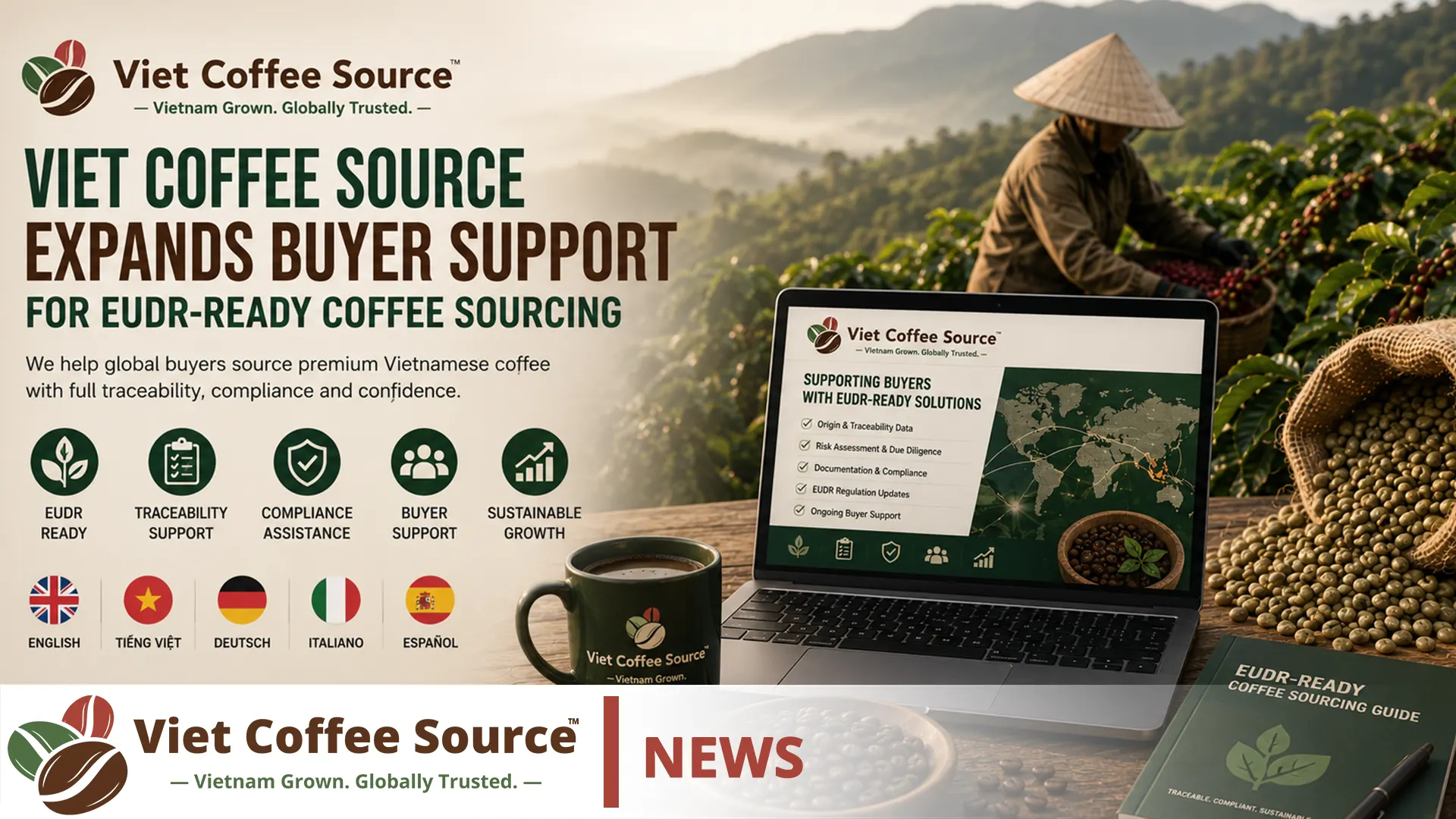
Viet Coffee Source Expands Buyer Support for EUDR-Ready Coffee Sourcing
Viet Coffee Source has expanded its buyer-support services for international companies seeking EUDR-ready coffee from Vietnam. The expanded support is designed to help importers, roasters, distributors, manufacturers and private-label brands coordinate product sourcing with the farm, supply-chain and shipment information required for their own due-diligence procedures.
The service covers Vietnamese green coffee, roasted and ground coffee, soluble coffee, custom blends and private-label products. Support can be adapted according to the buyer’s product specifications, destination market, supplier structure, required traceability level and position within the European supply chain.
The expansion responds to a practical challenge facing coffee buyers: identifying a commercially suitable product is no longer enough for shipments intended for regulated markets. Buyers may also need to determine which producers and plots supplied the coffee, whether the available quantities are plausible, how material moved through processing and storage, and whether the approved source information remains connected to the final export shipment.
Buyer support now begins before supplier selection
Viet Coffee Source is encouraging buyers to define EUDR-related requirements at the beginning of the sourcing process rather than requesting additional traceability documents after a coffee lot has already been selected or prepared for shipment.
The initial inquiry can include product type, customs classification, destination country, intended use, buyer role, required traceability level, preferred geolocation format, legality-document requirements, certification expectations, order quantity and target shipment period.
These details help determine which supplier networks and coffee lots may be suitable. A supplier capable of producing the required physical quality may not necessarily have the producer records, plot data or warehouse controls needed for the buyer’s due-diligence process.
Early clarification also reduces the risk of arranging samples from coffee that cannot later be allocated to an EUDR-related contract. The objective is to align commercial quality and traceability requirements before significant time is invested in sampling, negotiation and export preparation.
EUDR-ready sourcing is treated as a process rather than a certificate
The expanded buyer-support model does not treat EUDR readiness as a single certificate, supplier declaration or sustainability label. It approaches preparation as a structured process involving information collection, supply-chain mapping, risk review, lot control and shipment-level documentation.
A certification may provide useful information about a farm group, management system or production practice, but it does not automatically establish that a specific commercial shipment satisfies every EUDR requirement. The certificate holder, covered farms, validity period, products and sites must be reviewed against the actual order.
Similarly, a geolocation file does not by itself prove that the coffee in a container came from the listed plots. The farm data must remain connected to purchasing records, processing lots, warehouse movements and the exact coffee allocated to the buyer.
Viet Coffee Source therefore coordinates several connected forms of evidence rather than relying on one document as a complete compliance solution.
The EU timetable is increasing preparation pressure
The principal EUDR obligations are scheduled to apply from 30 December 2026 for large and medium-sized operators and from 30 June 2027 for most micro and small operators. Companies already purchasing for contracts that will be placed on the European market after these dates may need to establish compliant sourcing procedures well before the formal application deadline.
The Regulation requires relevant products to be deforestation-free, produced in accordance with applicable legislation in the country of production and supported by the required due-diligence process.
For coffee supply chains, required information may include the country of production, product description, quantity, production period, identities of suppliers and producers, geolocation of the relevant plots and evidence supporting legal and deforestation-free production.
European operators remain responsible for evaluating the collected information, conducting the required risk assessment, applying risk mitigation where necessary and completing formal submissions through the designated EU Information System.
The service distinguishes support from legal responsibility
Viet Coffee Source coordinates information collection and communication between buyers and selected participants in Vietnam’s coffee supply chain. It does not issue regulatory approvals or automatically certify a shipment as compliant with European law.
The responsible importer, operator or trader must determine whether the available information is sufficient for its legal role and transaction. That company must also decide whether the identified risk is negligible and whether additional verification or mitigation is required.
This distinction is important because EUDR obligations depend on factors including the product classification, company size, transaction structure and position of each business in the supply chain.
Support services can improve access to relevant information and help organise the records, but they do not transfer the legal responsibility of the company placing the product on the European market.
Supply-chain mapping identifies every material movement
One component of the expanded support is detailed supply-chain mapping. The process identifies the companies, producer groups, facilities and material movements between the coffee plot and the export shipment.
A supply-chain map may include the producer, cooperative, local collector, collection point, wet mill, dry mill, warehouse, processor, trader, exporter and importer. Each participant may create different records and may change the identification code used for the coffee.
The map should explain what activity each participant performs, which documents are created, how lot codes change and which party is responsible for maintaining the information.
This process can reveal gaps that are not visible in ordinary commercial documents. Coffee may appear traceable at the exporter level while the connection between an earlier collector and the underlying producers remains incomplete.
Producer and plot records require coordination
Vietnam’s coffee sector includes a large number of smallholder producers. Coffee can be aggregated through cooperatives, collectors and purchasing stations before reaching a processor or export warehouse.
Viet Coffee Source can coordinate requests for producer identities, farm references, plot information, production periods and available geolocation data through selected supplier structures.
Producer lists should use consistent identifiers so that one farm is not registered under several different names or codes. Plot information should also be reviewed for duplicates, incomplete coordinates and locations that do not correspond with the declared production region.
The availability and quality of these records vary among origins, suppliers and producer networks. Buyers requiring plot-level traceability should communicate this requirement before supplier and lot approval.
Geolocation files must be technically usable
Farm geolocation information may be provided as coordinates or polygons depending on the size and structure of the production plots and the buyer’s required format.
Technical review can identify common problems such as invalid coordinate formats, points located outside Vietnam, overlapping polygons, duplicate plots or files that cannot be uploaded to the buyer’s information system.
Corrections should be made through the responsible supplier or data-collection organisation. Coordinates should not be altered merely to pass a technical check without confirming the actual location of the production land.
Viet Coffee Source can coordinate the collection and preliminary review of geolocation files, while the buyer remains responsible for applying its required geospatial and deforestation-risk analysis.
Production volumes must be commercially plausible
Quantity reconciliation is an important part of EUDR-ready sourcing because traceability information must correspond with a realistic amount of coffee produced and delivered by the identified farms.
The review may compare plot area, expected local yield, estimated production, producer deliveries, cooperative purchases, processing yield, warehouse inventory and final sales.
A small plot attributed with an unrealistically large volume may indicate a data-entry mistake, duplicate allocation or the addition of coffee from an undeclared source. Similar inconsistencies can arise when the same producer volume is allocated to several customers.
Viet Coffee Source can help coordinate volume-reconciliation requests with suppliers and processors so that material quantities are reviewed before a lot is confirmed for the buyer.
Lot mapping connects farms with commercial coffee
Farm data becomes commercially useful only when it can be linked with the actual lot being sampled, purchased and exported. Lot mapping records how coffee moves from producer deliveries into aggregated purchasing lots, processing batches, warehouse positions and export allocations.
The mapping may include producer codes, collection receipts, supplier lots, processing codes, storage references, bag numbers and final export-lot identifiers.
When codes change during cleaning, grading, roasting, extraction or packaging, the records should retain a documented connection with the previous material lot.
This requirement is especially important for processed coffee. A finished roasted, ground or soluble product must remain connected with the green-coffee lots used in its manufacture when the product falls within the applicable regulatory scope.
Segregation can protect verified coffee
Facilities may handle coffee with complete EUDR-related information alongside coffee for which the origin records are incomplete or unavailable. Without physical and administrative controls, material can be mixed and the verified lot can lose its traceability.
Segregation measures can include separate receiving codes, designated warehouse locations, marked bags, controlled processing schedules, restricted transfers and separate finished-product references.
Inventory reconciliation should confirm that the quantity of EUDR-designated coffee leaving the facility does not exceed the verified quantity received after accounting for normal processing loss.
Viet Coffee Source can coordinate discussions with suppliers and processors regarding available segregation methods, but the required control level must be agreed with the buyer before production or shipment.
Commercial specifications remain equally important
EUDR-ready information does not replace the buyer’s technical and sensory requirements. A fully traceable coffee lot can still be unsuitable if it fails to meet the approved grade, screen size, moisture, defect tolerance or cup profile.
Buyer support therefore combines traceability preparation with measurable product specifications. Green coffee requirements may include species, origin, process, crop period, screen distribution, moisture, defect limits, sensory profile and packaging.
Roasted coffee specifications may include roast level, bean or ground format, grind size, degassing requirements, shelf life and packaging configuration. Soluble coffee projects may require process type, moisture, bulk density, solubility, colour, flavour and particle-size criteria.
Structured quality and compliance procedures help ensure that the lot reviewed for EUDR information is also the lot evaluated for commercial quality.
Samples must represent the proposed commercial supply
A common sourcing risk arises when an excellent sample is prepared from one lot while the final commercial shipment is drawn from a different producer group or warehouse stock.
Under the expanded support process, sample records may identify the supplier, source lot, producer or plot group, crop period, quality results, available geolocation status and certification information.
The buyer should understand whether the sample represents the same source structure that will be used for the commercial order. Where the proposed producers or plots change, the replacement lot may require new quality approval and a separate review of its traceability information.
Sample approval should therefore be connected to both the commercial specification and the available EUDR-related data rather than treated as an isolated sensory decision.
Origin selection affects the available traceability structure
Vietnam’s coffee-producing regions differ in farm size, organisation, processing capacity and the maturity of supplier data systems. The level of available traceability may therefore vary between origins and even between suppliers operating in the same province.
Commercial Robusta can be sourced from broad regional networks in the Central Highlands, while some differentiated Arabica or Fine Robusta programmes may use smaller producer groups with more specific farm records.
Buyers can compare Vietnamese coffee origins according to their intended product, quality, volume, processing method and required traceability level.
No regional name should be treated as automatic evidence of EUDR readiness. Final suitability depends on the selected supplier, producer network, lot structure and supporting information.
Legality-document coordination is part of the review
The EUDR requires relevant commodities to have been produced in accordance with applicable legislation in the country of production. The exact evidence required by a buyer may depend on its risk assessment and the circumstances of the selected source.
Available information may relate to land-use rights, producer identity, business registration, agricultural activity, labour obligations, environmental rules or other laws relevant to production.
Viet Coffee Source can coordinate requests for available legality-related documents and help organise them by supplier, producer or lot. It does not determine the final legal sufficiency of those documents.
Where documents are incomplete or inconsistent, the responsible operator may request clarification, additional evidence, supplier verification or exclusion of the affected source from the proposed lot.
Certification documents are reviewed against the order
Some buyers request sustainability or quality certification in addition to EUDR-related information. Certification review may include the certificate holder, issuing organisation, validity dates, covered facilities, products and producer groups.
A certificate issued to one cooperative should not automatically be applied to coffee purchased through another supplier. Likewise, certification of a processing facility may not establish the origin or legal status of every incoming coffee lot.
The commercial order should identify which claim is being made and which evidence supports it. Certifications, product specifications and EUDR-related information should refer to compatible suppliers, lots and shipment quantities.
Viet Coffee Source can coordinate certification-document review as part of the wider sourcing process, while final acceptance remains subject to the buyer’s procedures.
Warehouse and processing records receive greater attention
Traditional sourcing checks often focus on the exporter’s final documents. EUDR-ready preparation requires closer attention to material movements within warehouses and processing facilities.
Relevant records may include receiving dates, supplier lots, storage locations, processing input and output quantities, bag changes, blending operations, rework and finished-product codes.
Where a factory produces roasted, ground or soluble coffee, the records may need to connect green-coffee inputs with roasting, grinding, extraction, drying, blending and packaging batches.
This expanded review helps determine whether information from the farm level survives the transformation process and remains connected with the finished product purchased by the buyer.
Document consistency is checked before shipment
Even when the underlying coffee is traceable, inconsistencies between commercial and regulatory records can create delays. Product names, quantities, lot numbers, supplier references and container details should remain compatible across the document set.
The review may compare the purchase order, commercial invoice, packing list, certificate of origin, quality report, inspection records, customs documents and bill of lading.
Where applicable, the due-diligence reference should also be connected with the correct product and shipment records according to the responsible operator’s procedure.
Viet Coffee Source can coordinate document-consistency checks with selected export partners as part of broader export preparation.
Export-lot allocation links approval to the container
Before shipment, the exact coffee assigned to the buyer should be identified. Allocation records may include the buyer’s purchase order, approved specification, source plots, warehouse position, bag numbers, quantity, container number and seal number.
The allocated shipment should not contain coffee from outside the approved supplier and plot structure unless the additional source has undergone the required review.
Last-minute substitutions can create both quality and traceability risks. A replacement lot may have similar physical specifications but different producer records, geolocation coverage or legality information.
Clear shipment allocation allows the buyer to connect the due-diligence information with the exact commercial goods entering the logistics chain.
Pre-shipment verification can identify final discrepancies
The expanded support may include coordination of pre-shipment checks according to the buyer’s agreed instructions. Verification can cover quantity, lot identification, packaging, markings, container allocation and the availability of supporting documentation.
Independent inspection or laboratory testing can also be arranged where required by the contract. The inspection scope should be agreed before cargo preparation so that the correct sampling and reporting procedure can be followed.
Pre-shipment verification does not replace earlier supply-chain review. Its purpose is to confirm that the approved product and records remain aligned at the point of dispatch.
Any discrepancy should be resolved before the container is released whenever possible, as correction becomes more difficult after the cargo has departed Vietnam.
Corrective action can preserve a sourcing programme
Not every data problem requires the immediate rejection of an entire supplier network. Some concerns may be addressed through structured corrective action when reliable additional evidence can be obtained.
Possible actions include correcting producer records, repeating plot mapping, separating uncertain coffee, reconciling quantities, obtaining additional legality information or reducing the number of farms included in the lot.
The response should match the specific problem. A technical formatting error in a geolocation file requires a different solution from an unexplained volume discrepancy or coffee from an unidentified source.
Viet Coffee Source can coordinate communication and follow-up between the buyer and supplier, while the responsible operator determines whether the corrective action reduces the identified risk to an acceptable level.
Support now covers several coffee formats
The buyer-support expansion recognises that Vietnamese coffee reaches the international market in multiple forms. Buyers may request commercial Robusta, Fine Robusta, Arabica, roasted whole bean, ground coffee, spray-dried instant coffee, freeze-dried coffee, agglomerated coffee, custom blends or private-label products.
Each format creates different quality, processing and traceability requirements. A green-coffee shipment may be linked directly to supplier and export lots, while an instant product can pass through roasting, extraction, concentration, drying, blending and packaging.
Product classification must also be reviewed carefully. Green and roasted coffee are covered under established coffee codes, while the European Commission’s 2026 product-scope update adds soluble coffee from 30 December 2027.
Formulated products containing sugar, creamer, flavours or other ingredients should be assessed according to the customs classification of the final product rather than its commercial name alone.
Private-label buyers need integrated support
Private-label programmes combine sourcing, product development, manufacturing, packaging and regulatory requirements. The coffee origin and EUDR-related information must remain connected even when the finished product is produced under the buyer’s brand.
Support may include formula discussion, supplier coordination, sample approval, packaging format, label requirements, production-batch identification and export-document preparation.
The buyer should define whether the EUDR-related records must connect with each consumer package, manufacturing lot, shipping carton or export shipment. The required level of detail should be incorporated into the production and coding plan.
Artwork and marketing claims should also reflect the evidence available. Statements about origin, deforestation-free production or sustainability should not exceed what can be supported for the actual product and supply chain.
Different buyers require different information packages
A European green-coffee importer, an industrial roaster and a private-label instant coffee brand may all require different forms of documentation even when sourcing coffee from the same country.
The importer may focus on plot information, legality evidence, risk assessment and shipment allocation. The roaster may additionally need consistent quality, processing-lot control and a link between imported green coffee and finished roasted products.
A private-label buyer may require ingredient-lot traceability, packaging records, laboratory results, label approval and manufacturing documentation in addition to origin information.
The expanded service is therefore structured around the buyer’s actual role, product and due-diligence procedure rather than offering one standard document package for every transaction.
Data availability must be confirmed for each lot
Not every supplier, producer network or coffee lot in Vietnam currently provides the same level of EUDR-related information. Availability depends on the origin, production season, collection structure, processor and commercial arrangement.
Some organised producer groups may already maintain detailed farm and plot records, while other commercial supply chains may provide only broad regional information.
Viet Coffee Source does not assume that every available coffee is EUDR-ready. The required information must be requested, reviewed and connected to the selected commercial lot before such a sourcing description is used.
This lot-specific approach protects buyers from relying on general supplier claims that may not apply to the coffee ultimately shipped.
Record retention supports later verification
EUDR-related records should remain retrievable after the transaction has been completed. Buyers and responsible operators may need to retain due-diligence documentation for the period required by applicable law.
Records may include producer registers, geolocation files, production data, purchase receipts, processing records, warehouse movements, legality documents, risk assessments, corrective actions and shipment documentation.
Files should be searchable by product, supplier, lot and shipment rather than stored without a consistent reference structure.
Viet Coffee Source can coordinate the organisation and transfer of supporting records available from the Vietnamese supply chain, while each company remains responsible for its own retention and data-governance obligations.
Supplier agreements should include data responsibilities
EUDR-related requirements are more reliable when they are included in supplier agreements before coffee is purchased. The agreement can define the required producer data, geolocation format, production records, legality information and notification of source changes.
It may also prohibit undeclared mixing, establish verification rights and describe corrective actions when information is incomplete or inconsistent.
Without clear commercial obligations, data requests made after the coffee has been aggregated can be difficult to fulfil. Suppliers may no longer be able to reconstruct which farms contributed to a particular warehouse lot.
Early contractual alignment helps make traceability an operating requirement rather than a document request added at the end of the transaction.
The service can support pilot sourcing programmes
Buyers do not necessarily need to convert their entire Vietnamese coffee supply at once. A defined pilot programme can be used to test supplier data, lot mapping, sample approval and shipment documentation.
The pilot can focus on one product, producer group, origin or container. This creates a controlled environment in which the buyer and supplier can identify practical gaps before increasing volume.
Lessons from the pilot may be used to improve farm registration, warehouse procedures, document templates and data-transfer methods.
A successful pilot does not guarantee that every future lot will contain identical information. Each crop, source group and shipment still requires the controls agreed in the buyer’s due-diligence system.
Commercial responsiveness remains part of buyer support
EUDR preparation adds information requirements, but buyers still need responsive quotation, sampling and order coordination. Slow communication or unclear specifications can prevent a technically suitable supplier from converting an inquiry into a contract.
Viet Coffee Source helps buyers structure requests so that suppliers can respond with relevant product options rather than a general coffee price.
A complete inquiry should state product type, quality, processing method, volume, packaging, destination, Incoterm, shipment timing and required EUDR-related information.
Clear requirements improve the efficiency of supplier selection and reduce repeated exchanges that delay sampling and commercial evaluation.
The expansion supports long-term sourcing relationships
The objective of expanded buyer support is not limited to preparing one document package for one shipment. It is intended to help establish sourcing structures that can be maintained across repeated orders.
Recurring supply requires stable producer information, controlled supplier changes, consistent lot identification and reliable communication between the farm, processor, exporter and buyer.
Where these systems are integrated with commercial quality and export operations, buyers can evaluate new crop lots more efficiently and identify changes before they affect delivery.
Long-term relationships also provide stronger incentives for suppliers and producer groups to maintain the additional records required for traceable sourcing.
EUDR readiness can strengthen wider supply-chain transparency
Although the immediate driver is European regulation, the same information systems can support other buyer priorities. Farm and lot traceability can assist with origin verification, quality investigations, certification management and sustainability reporting.
Production-volume checks can reduce the risk of undocumented mixing, while clearer warehouse records can improve inventory accuracy and shipment control.
Geolocation and producer data may also support programmes related to regenerative agriculture, low-carbon farming and climate resilience when those claims are measured using appropriate methodologies.
The expanded support therefore has potential value beyond one regulatory requirement, provided that the records remain accurate, current and linked to the actual coffee supplied.
Buyer acceptance remains dependent on due diligence
No coffee, certificate, supplier or support service should be treated as an automatic guarantee of EUDR compliance. Final acceptance depends on the responsible operator’s information review, risk assessment, mitigation process and current European Union requirements.
Competent authorities may also examine the operator’s due-diligence system and the records connected with specific products placed on the market.
Buyers should obtain professional legal or technical advice where required and monitor changes to EU guidance, product scope and Information System procedures.
Viet Coffee Source’s role is to make the Vietnamese sourcing and information-coordination process more structured, transparent and responsive to those buyer requirements.
Expanded support creates a clearer route from inquiry to shipment
The expanded workflow begins with the buyer’s product and due-diligence requirements, continues through supplier and origin selection, sample approval, data review and corrective action, and ends with export-lot allocation and document coordination.
This sequence helps prevent commercial quality, traceability and shipment preparation from being managed as separate activities with incompatible records.
For buyers, the result is a clearer method for comparing sourcing options according to both product performance and available supply-chain evidence.
For Vietnamese suppliers, the process provides more precise information about the records and controls expected by regulated international customers.
Professional buyers seeking Vietnamese green, roasted, ground, soluble or private-label coffee with EUDR-related sourcing support can submit a wholesale inquiry detailing their product, volume, destination, traceability level and due-diligence requirements.