
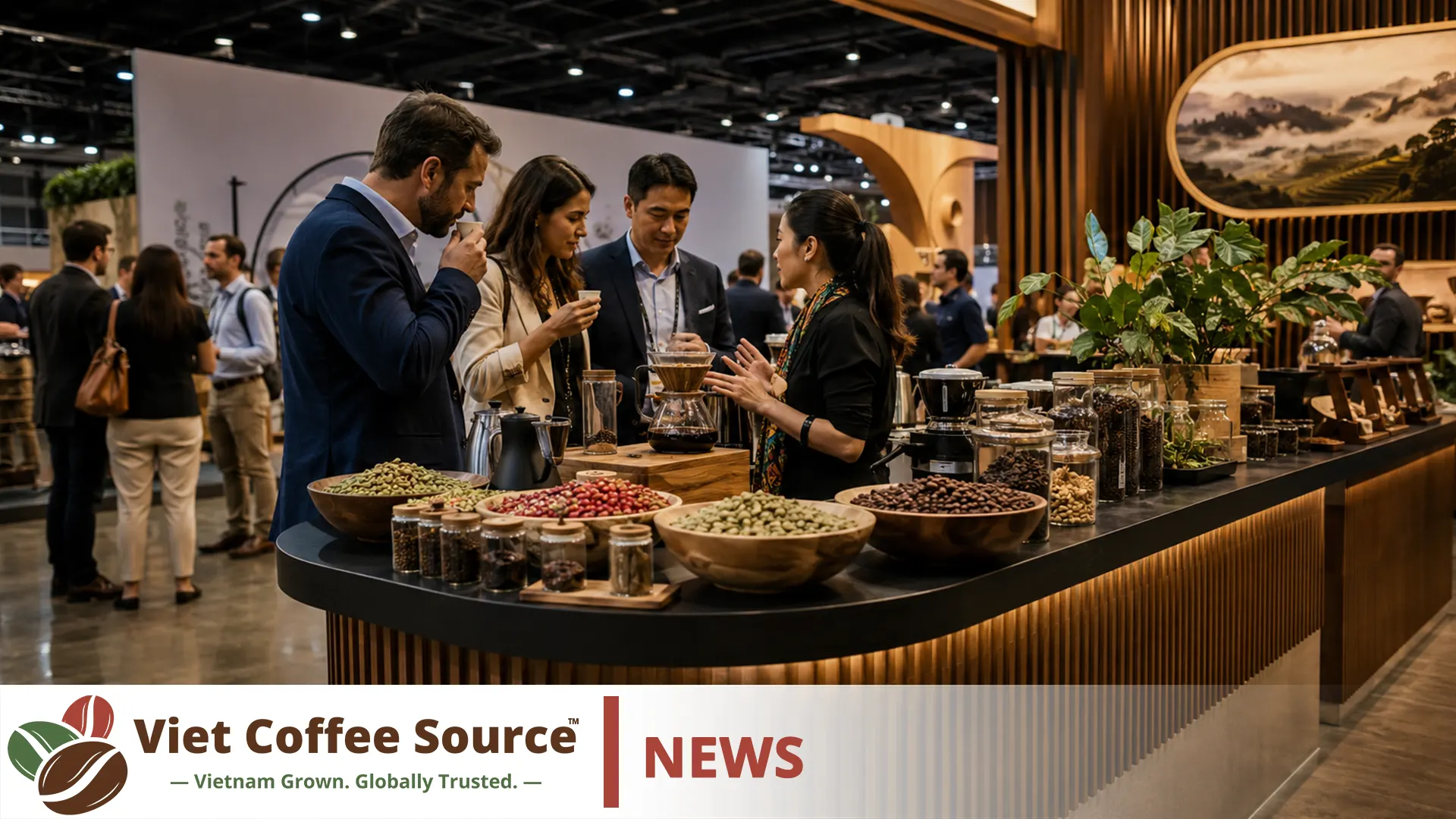
Vietnamese Coffee Showcased at Expo Café Chile 2026
Vietnamese coffee was showcased to professional buyers, industry specialists and consumers at Expo Café Chile 2026, where the Vietnam Pavilion presented a broad portfolio of products ranging from green Robusta and Arabica to roasted coffee, instant coffee, specialty lots, capsules, drip bags and traditional phin brewing equipment.
The exhibition took place from 24 to 26 July 2026 at the Espacio Riesco Exhibition Center in Santiago. The Vietnam Trade Office in Chile coordinated the country’s participation as part of a wider effort to strengthen recognition of Vietnamese coffee and create practical connections with importers, roasters, distributors, retail chains, café operators and food-and-beverage businesses in Latin America.
Expo Café Chile 2026 brought together nearly 180 exhibitors from several countries and territories and was expected to attract approximately 30,000 visitors. The event combined product displays, professional networking, tastings, technical activities and consumer experiences, creating a platform where coffee origins could build both commercial contacts and public awareness.
Vietnam’s participation in 2026 followed the country’s first National Pavilion at the exhibition in 2025. The expanded return indicated a shift from initial market introduction toward stronger brand recognition, broader business networks and more structured trade development.
The Vietnam Pavilion presented a complete coffee portfolio
The Vietnam Pavilion operated under the theme “Vietnam – El origen del café,” meaning “Vietnam – The Origin of Coffee.” The concept positioned Vietnam not only as a large coffee-producing country but also as a source of diverse products suitable for several market segments.
The pavilion displayed Robusta, Arabica, roasted and ground coffee, instant coffee, specialty coffee, coffee capsules, drip-bag products and traditional Vietnamese phin filters.
This portfolio allowed visitors to experience Vietnam through several commercial formats rather than viewing the country only as a supplier of bulk green Robusta.
For professional buyers, the diversity created opportunities to compare products for industrial roasting, specialty retail, café service, private-label programmes, e-commerce and direct consumer sales.
More than 20 Vietnamese businesses participated
More than 20 Vietnamese enterprises participated in the national display, including Simexco DakLak, Vinacafé, Trung Nguyên Legend, Shin Cà Phê, Pull’s Coffee and Matthew Coffee.
The participating companies represented different parts of the coffee value chain, including green-bean supply, processing, roasting, product development, packaging and branded consumer products.
Hundreds of coffee and agricultural products were displayed, demonstrating the breadth of Vietnam’s export capacity and the range of formats available to international buyers.
The presence of multiple companies also allowed Chilean partners to explore different supply models rather than depending on a single standard product or exporter profile.
Products represented several Vietnamese coffee regions
The products presented at Expo Café Chile were connected with recognised Vietnamese producing regions including Dak Lak, Lam Dong, Gia Lai, Kon Tum and Son La.
These origins differ in altitude, climate, coffee species, farming systems, harvest periods and processing capabilities.
Dak Lak and Gia Lai are strongly associated with Vietnam’s Robusta production, while Lam Dong and Son La can provide Arabica and differentiated specialty opportunities depending on the specific area and lot.
Buyers can review relevant Vietnamese coffee origins to understand how regional conditions may correspond with flavour, quality, processing and commercial-volume requirements.
Expo participation supports a broader image of Vietnamese coffee
Vietnam is globally recognised for its large Robusta production, but international promotion is increasingly highlighting a broader coffee identity.
This identity includes Fine Robusta, Vietnamese Arabica, controlled fermentation, specialty coffee, roasted products, instant coffee and consumer-ready formats.
Presenting this wider range at a specialised event helps challenge the perception that Vietnamese coffee is suitable only for conventional blends or soluble manufacturing.
It also allows buyers to evaluate Vietnam as a source capable of supporting multiple product levels, from high-volume green coffee to value-added branded goods.
Green Robusta remains a central export opportunity
Robusta is likely to remain one of the most relevant Vietnamese products for Chilean and regional buyers.
It can serve commercial roasters, espresso-blend manufacturers, soluble-coffee producers and businesses seeking strong body, intensity and competitive sourcing options.
Professional buyers should define the required grade, screen distribution, moisture, defect limits, processing method, crop period and cup expectations before requesting a quotation.
A broad request for Vietnamese Robusta may produce offers that differ substantially in physical preparation, sensory performance and intended use.
Fine Robusta can serve differentiated roasting programmes
Fine Robusta offers an opportunity to position Vietnamese coffee beyond conventional commodity specifications.
Carefully harvested and processed Robusta can present sweetness, cocoa, spice, fruit and a cleaner finish while retaining the body and intensity associated with the species.
This profile may be suitable for premium espresso blends, single-origin offerings, milk-based beverages and specialty concepts seeking a distinctive alternative to Arabica.
Buyers interested in Fine Robusta should evaluate individual samples because quality can vary according to variety, ripeness, fermentation, drying, storage and lot preparation.
Vietnamese Arabica can expand premium options
The pavilion also introduced Vietnamese Arabica to buyers who may associate the country primarily with Robusta.
Arabica from suitable highland regions can be used for filter coffee, espresso, lighter roast profiles, specialty retail and origin-focused café menus.
Potential buyers should review the precise production area, variety, altitude, process and sensory profile of each lot rather than assuming all Vietnamese Arabica has the same characteristics.
Smaller Arabica lots may also require earlier purchasing decisions because availability can be more limited than mainstream Robusta volumes.
Roasted and ground coffee creates direct market opportunities
Roasted and ground products allow Vietnamese businesses to export more of the processing value rather than supplying only raw material.
These products may be suitable for supermarkets, specialist retailers, Asian food stores, hospitality businesses and online channels.
However, the roast profile, grind size, packaging barrier, shelf life and brewing application must be adapted to the intended customer.
A coffee developed for traditional phin brewing may require a different grind and roast approach from one designed for espresso machines or filter brewers.
Instant coffee supports large and accessible consumer segments
Vietnam has established capabilities in instant-coffee production, including spray-dried, freeze-dried and agglomerated products.
Instant coffee can provide accessible entry points for importers because it serves household consumption, offices, hospitality, convenience retail and food-service applications.
Buyers may require pure soluble coffee, three-in-one products or customised formulas with sugar, creamer and flavour components.
Each finished product requires clear ingredient specifications, packaging information, shelf-life documentation and compliance with the import requirements of the destination market.
Capsules and drip bags reflect changing consumption formats
Coffee capsules and drip bags allow Vietnamese suppliers to participate in convenient and premium consumption segments.
Capsules require compatibility with the intended brewing system, controlled filling, oxygen protection and reliable packaging performance.
Drip bags can offer consumers an accessible way to prepare single-serve Vietnamese coffee without specialist equipment.
These formats may be especially relevant for e-commerce, corporate gifts, travel retail and consumers seeking convenient preparation with a stronger origin story.
Traditional phin brewing created a cultural connection
The Vietnam Pavilion included demonstrations of the traditional phin brewing method and coffee tasting sessions.
Phin preparation allowed visitors to experience not only the coffee product but also a distinctive part of Vietnamese coffee culture.
The slow extraction, visual preparation and serving style can support storytelling for cafés, retail promotions and cultural events.
For commercial success, however, cultural presentation should be supported by consistent product quality, clear preparation instructions and suitable packaging.
Coffee tasting helped buyers understand product differences
Tasting activities enabled visitors to compare different Vietnamese products directly instead of relying only on packaging or general origin descriptions.
Professional tasting can reveal differences in body, sweetness, acidity, bitterness, aroma, balance and aftertaste.
It can also help buyers determine whether a coffee is suitable for espresso, filter, milk beverages, soluble applications or blending.
A positive tasting response is an important starting point, but a commercial decision still requires confirmation of specifications, available volume and shipment conditions.
The pavilion attracted strong opening-day interest
The Vietnam Pavilion welcomed nearly 1,000 visitors on the opening day of Expo Café Chile 2026.
This traffic provided opportunities to introduce Vietnamese coffee to consumers while identifying professional participants with genuine purchasing, distribution or partnership potential.
High visitor numbers can increase visibility, but trade-promotion success depends on distinguishing general interest from qualified commercial inquiries.
Participating companies need organised follow-up records covering the visitor’s business type, requested product, expected quantity and agreed next step.
Business meetings included companies from Chile and Colombia
The Vietnam Pavilion held direct meetings with 21 companies from Chile and Colombia during the opening day.
The participating organisations included importers, distributors, retail chains, e-commerce companies and businesses operating in food and beverages.
This mix reflects the different routes through which Vietnamese coffee can reach Latin American markets.
Each channel requires a different commercial offer, ranging from bulk green-coffee supply to branded retail products or private-label development.
Importers focus on supply reliability and documentation
Coffee importers generally evaluate whether the supplier can provide consistent quality, realistic volume, appropriate shipment terms and complete export documentation.
They may also consider storage requirements, customs classification, payment structure and the supplier’s experience with international trade.
For green coffee, the importer will usually require technical specifications and representative samples before confirming a commercial order.
For finished products, the importer may need ingredient, label, shelf-life and manufacturing information before market approval.
Distributors evaluate market fit
Distributors assess whether a product can compete within their existing portfolio and customer network.
They may examine price position, packaging format, brand recognition, sales margin, minimum order and promotional support.
A premium Vietnamese coffee may need a different distribution strategy from an affordable instant product intended for broad retail.
Suppliers should understand the distributor’s target channels before proposing the product range.
Retail chains require dependable consumer-ready products
Retail chains generally expect products to arrive with approved packaging, barcodes, defined case quantities and reliable replenishment schedules.
They may also request promotional plans, samples, product images and information suitable for store or online listings.
A successful listing can create meaningful volume, but it may require stronger production planning and inventory commitments.
Vietnamese suppliers should confirm packaging lead times and minimum print quantities before accepting retail launch schedules.
E-commerce creates opportunities for origin-led products
Online channels can support specialised products that may initially be too narrow for large conventional retail networks.
Vietnamese coffee can be positioned through origin stories, brewing demonstrations, product comparisons and direct consumer education.
Drip bags, roasted beans, gift sets, phin kits and specialty lots may be particularly suitable for visual online marketing.
The product must still deliver consistent quality because consumer reviews can rapidly influence brand perception and repeat purchasing.
Café operators need application-specific products
Café chains and independent operators evaluate coffee according to beverage performance, operational consistency and customer appeal.
They may require espresso blends, single-origin offerings, cold-beverage components or products suitable for milk-based menus.
The buyer should test the coffee using its own equipment, water and recipes rather than relying only on exhibition tasting results.
Suppliers may need to provide brewing guidance, roast information or technical support during initial trials.
Online matchmaking extended the exhibition’s commercial reach
The Vietnam Trade Office facilitated more than 10 online business-matching sessions between Vietnamese enterprises and foreign partners during the exhibition.
Online meetings allowed companies that were not physically present at the pavilion to discuss products, technical requirements, market demand and potential cooperation.
This hybrid approach can increase participation while reducing the limitations created by travel, scheduling and exhibition space.
It also allows follow-up meetings to include technical, export or management personnel who may not have attended the event in person.
Buyer feedback highlighted quality and supply capacity
Chilean partners reportedly responded positively to the consistent quality, distinctive flavour, competitive pricing and large-scale supply capacity of Vietnamese coffee.
These attributes are commercially important because buyers need a product that can satisfy both sensory and operational requirements.
Competitive pricing alone is unlikely to create lasting business if quality varies between samples and commercial deliveries.
Likewise, an excellent small sample may not meet the needs of a buyer requiring stable volumes throughout the year.
Interest covered both conventional and value-added coffee
Potential partners expressed interest in green beans, roasted coffee, specialty coffee, instant coffee and other value-added products.
This broad interest demonstrates the need for suppliers to segment opportunities rather than sending the same presentation and price list to every buyer.
A green-coffee importer needs information that differs significantly from the requirements of a retail chain seeking packaged instant coffee.
Clear buyer qualification can reduce unnecessary samples and improve the relevance of commercial proposals.
Sustainability and traceability are becoming buyer requirements
Several partners showed interest in products that meet sustainability, traceability and environmental expectations.
For green coffee, traceability may include producer or cooperative information, production region, crop period, processing facility and lot records.
The required level of detail depends on the buyer’s market, claims and internal sourcing policies.
Suppliers should describe the evidence available for the specific lot rather than using broad sustainability language that cannot be verified.
Quality documentation must support the offered product
Buyers may request moisture, defect, screen, density, processing and sensory information for green coffee.
They may also require certificates of analysis or food-safety documentation for roasted, soluble and packaged products.
A structured quality and compliance process helps connect the sample, technical specification, production batch and final shipment.
Documents should correspond with the actual product offered rather than a general company standard that may not apply to the selected lot.
Preliminary agreements need structured follow-up
Several businesses reached preliminary understandings to exchange samples, begin commercial negotiations and explore possible imports after the exhibition.
These early agreements are valuable, but they do not yet represent completed export contracts.
The next stage may include buyer qualification, sample dispatch, technical review, quotation, packaging discussion and contract negotiation.
Participating businesses should assign clear responsibility and timelines to prevent promising contacts from becoming inactive after the event.
Sample exchanges are the bridge to commercial evaluation
A sample should represent the coffee or product that the supplier can realistically provide under the proposed commercial conditions.
Green-coffee samples should be identified by origin, crop, process, lot and specification.
Finished-product samples should correspond with the intended formula, packaging and shelf-life standard.
If the final commercial product differs from the exhibition sample, the buyer should receive updated material for approval.
Quotations must use comparable trade terms
Price discussions should identify product, specification, quantity, packaging, Incoterm, shipment period and quotation validity.
An FOB quotation should not be compared directly with a CIF or delivered offer that includes additional freight, insurance or destination services.
Green coffee, roasted coffee and finished retail products also have very different cost structures.
Clear commercial assumptions help buyers compare Vietnamese offers fairly with products from other origins.
Minimum order quantities differ by product format
Green coffee may be offered in container-scale volumes, while specialty lots can be available in smaller quantities.
Roasted and packaged products may be limited by production runs, packaging materials and private-label print requirements.
Capsules, boxes and custom bags can require minimum quantities that exceed the coffee itself.
Buyers should define their launch volume and expected repeat demand before requesting fully customised packaging.
Private-label projects require additional development
Some Chilean and regional buyers may prefer to sell Vietnamese coffee under their own brand.
A private-label programme can involve recipe selection, roast development, packaging design, label approval, barcode preparation and production testing.
The buyer and supplier should agree on brand ownership, packaging responsibilities, minimum orders and quality approval procedures.
A private-label project should not move into mass production until the final sample and packaging have been approved in writing.
Spanish-language packaging may be necessary
Consumer products intended for Chile or other Spanish-speaking markets generally require information understandable to local customers and compliant with destination requirements.
Labels may need product identity, ingredients, net quantity, preparation guidance, shelf life, production details and importer information.
The exact requirements vary by product type and market, so they should be verified before commercial packaging is printed.
A translation that is attractive for marketing must also remain technically accurate and consistent with the product documentation.
Product localisation can improve consumer acceptance
Vietnamese suppliers may need to adapt roast degree, sweetness, package size or preparation guidance for local preferences.
Localisation does not necessarily mean removing the Vietnamese identity of the product.
The strongest approach may combine authentic origin and brewing culture with formats that fit the buyer’s target consumer.
Market testing can help determine whether the original Vietnamese product or a modified version has greater commercial potential.
Phin coffee can become a differentiated café concept
Traditional phin coffee offers cafés a preparation method that is visually distinctive and closely connected with Vietnamese culture.
It can support hot coffee, iced coffee, condensed-milk beverages and modern menu variations.
The preparation may require staff training to maintain dose, grind, extraction time and presentation.
A differentiated experience can create value, but it must remain practical during busy café operations.
Vietnamese coffee can complement Latin American origins
Latin America has a strong coffee-producing identity, but Vietnamese coffee can enter the region through differentiated species, formats and applications.
Robusta may support espresso intensity and commercial blends, while Vietnamese specialty products can offer buyers new stories and sensory experiences.
Instant coffee, drip bags and traditional phin products also create categories that do not depend solely on competing with local green Arabica.
Successful positioning should focus on the specific commercial value of the product rather than presenting Vietnam simply as another origin.
Chile can support wider regional market development
Connections created in Chile may lead to discussions with buyers operating across neighbouring Latin American markets.
The participation of Colombian companies in business meetings illustrates how a national exhibition can attract broader regional interest.
However, import procedures, labels, taxes and consumer preferences vary between countries.
A product approved for Chile should not automatically be assumed to meet the requirements of every other Latin American market.
Trade-promotion events reduce the distance between origin and buyer
International buyers may know Vietnam as a major coffee producer without knowing which companies, regions or product formats are available.
A national pavilion creates a central point where buyers can compare suppliers, taste products and discuss requirements directly.
This reduces the effort required to identify potential partners and gives Vietnamese enterprises an opportunity to present their capabilities within a trusted institutional framework.
The value of the event increases when introductions are followed by organised commercial support.
The Vietnam Trade Office plays a coordination role
The Vietnam Trade Office in Chile coordinated the pavilion, business meetings, online matchmaking and cultural-promotion activities.
Such support can help Vietnamese businesses enter a distant market where language, regulations and buyer networks may otherwise create barriers.
The Trade Office can facilitate introductions and market information, but individual companies remain responsible for their product, quotation, contracts and delivery performance.
Export success ultimately depends on whether the supplier can convert institutional promotion into dependable commercial execution.
The second consecutive year signals a longer-term strategy
Vietnam’s participation in both 2025 and 2026 suggests a sustained approach to market development rather than a single promotional appearance.
The first year introduced the Vietnamese coffee industry and generated initial recognition.
The second year focused more strongly on consolidating the country’s image, expanding networks and creating tangible business opportunities.
Repeated participation can build trust because buyers are more likely to engage with suppliers that demonstrate continuing commitment to the market.
Brand recognition must be supported by consistent supply
National promotion can increase awareness of Vietnamese coffee, but the reputation created at the pavilion depends on later commercial performance.
Late samples, incomplete quotations, inconsistent quality or unreliable shipment schedules can weaken the positive impression established during the exhibition.
Participating companies should therefore treat follow-up as part of the event rather than as a separate optional activity.
Professional response times and accurate information can be as important as the original display.
Export documents depend on the selected product
Commercial shipments may require an invoice, packing list, transport document, certificate of origin, quality documents and other product-specific records.
Green coffee, roasted coffee and finished consumer products can require different documentation and controls.
Product descriptions, quantities, weights and lot codes should remain consistent across the export file.
Viet Coffee Source can help coordinate relevant supplier discussions through its export preparation support when buyers require Vietnamese coffee with defined specifications, packaging and shipment conditions.
Logistics must be evaluated after product selection
The most suitable shipping method depends on product type, volume, shelf life, packaging and delivery schedule.
Containerised sea freight may be appropriate for commercial green coffee or larger finished-product orders.
Samples and urgent trial quantities may require air or courier delivery, subject to destination procedures.
Freight costs should be confirmed close to the planned shipment because general estimates may not reflect the final route, carrier or seasonal conditions.
Packaging must protect quality during a long route
Green coffee may require suitable export bags, liners or other protective formats depending on the quality level and buyer requirements.
Roasted coffee requires strong protection against oxygen, moisture, heat and aroma loss.
Instant and other processed products also need packaging capable of maintaining stability throughout transport and storage.
Packaging selection should reflect the complete route from the Vietnamese facility to the buyer’s warehouse and final sales channel.
Payment conditions should match the commercial relationship
New buyers and suppliers need clear payment terms that balance commercial opportunity with risk control.
The appropriate structure may depend on order value, production commitment, custom packaging and previous trading history.
Private-label orders often require an advance because packaging and manufacturing are prepared specifically for the buyer.
Both parties should verify company identities, bank information and contractual responsibilities before transferring funds.
Supplier verification remains necessary after an exhibition introduction
A professional exhibition provides useful access to potential partners but does not replace commercial due diligence.
Buyers should verify the legal entity, production role, export capability, facility information, certifications and references of the proposed supplier.
Some companies may be producers, while others act as processors, exporters, brand owners or commercial representatives.
These roles should be understood before the contract determines responsibility for quality, production and shipment.
Vietnamese exporters should also qualify prospective buyers
Not every visitor or contact has the same authority, import capacity or purchasing intention.
Exporters should determine whether the prospect is an importer, distributor, retailer, café operator, e-commerce seller or intermediary.
They should also confirm the target product, estimated volume, market, decision process and purchasing timeline.
Buyer qualification allows companies to focus limited samples and follow-up resources on realistic commercial opportunities.
Trade leads should be organised by stage
Contacts can be classified according to initial interest, qualified inquiry, sample request, technical evaluation, quotation, negotiation or contract stage.
This prevents all exhibition visitors from being treated as equally advanced opportunities.
Each lead should have a responsible contact person and a defined next action.
A structured process also helps participating companies assess the actual commercial return from the exhibition.
Commercial success will be measured after the exhibition
Visitor numbers, tastings and positive feedback demonstrate visibility, but the long-term result depends on what happens after Expo Café Chile 2026.
Meaningful indicators include qualified inquiries, delivered samples, approved products, quotations, trial orders and repeat purchases.
Some opportunities may require several months of testing, registration or packaging development before the first shipment.
Consistent follow-up is therefore essential for converting exhibition interest into durable trade.
Vietnam can build a stronger position through differentiated products
Vietnam’s strongest opportunity may not depend on promoting every coffee in the same way.
Commercial Robusta, Fine Robusta, specialty Arabica, instant coffee, traditional phin products and private-label formats serve different buyers and price segments.
A clear product strategy helps the supplier communicate relevant advantages instead of relying only on the general scale of Vietnam’s coffee industry.
Differentiation can be based on origin, quality, processing, application, convenience, culture or supply capacity.
Expo Café Chile supports the shift toward value-added exports
The display of roasted coffee, soluble products, capsules, drip bags and consumer brands demonstrates Vietnam’s growing interest in exporting more than raw green beans.
Value-added products can retain a larger share of processing and branding activity within Vietnam.
They also require stronger capabilities in formulation, food safety, packaging, market compliance and international distribution.
Successful expansion therefore depends on integrating manufacturing strength with market-specific product development.
Professional preparation can convert Chilean interest into orders
Buyers interested in Vietnamese coffee should define their needs before requesting samples or final quotations.
Important information includes product type, intended application, quality, volume, preferred origin, packaging, destination, shipment period and required documents.
Suppliers can then determine whether an existing product is suitable or whether a customised sourcing, roasting or private-label programme is required.
Importers, roasters, distributors, retailers, café groups and brands seeking Vietnamese coffee can submit a wholesale inquiry describing their product, quality, volume, packaging, destination, shipment and compliance requirements.