
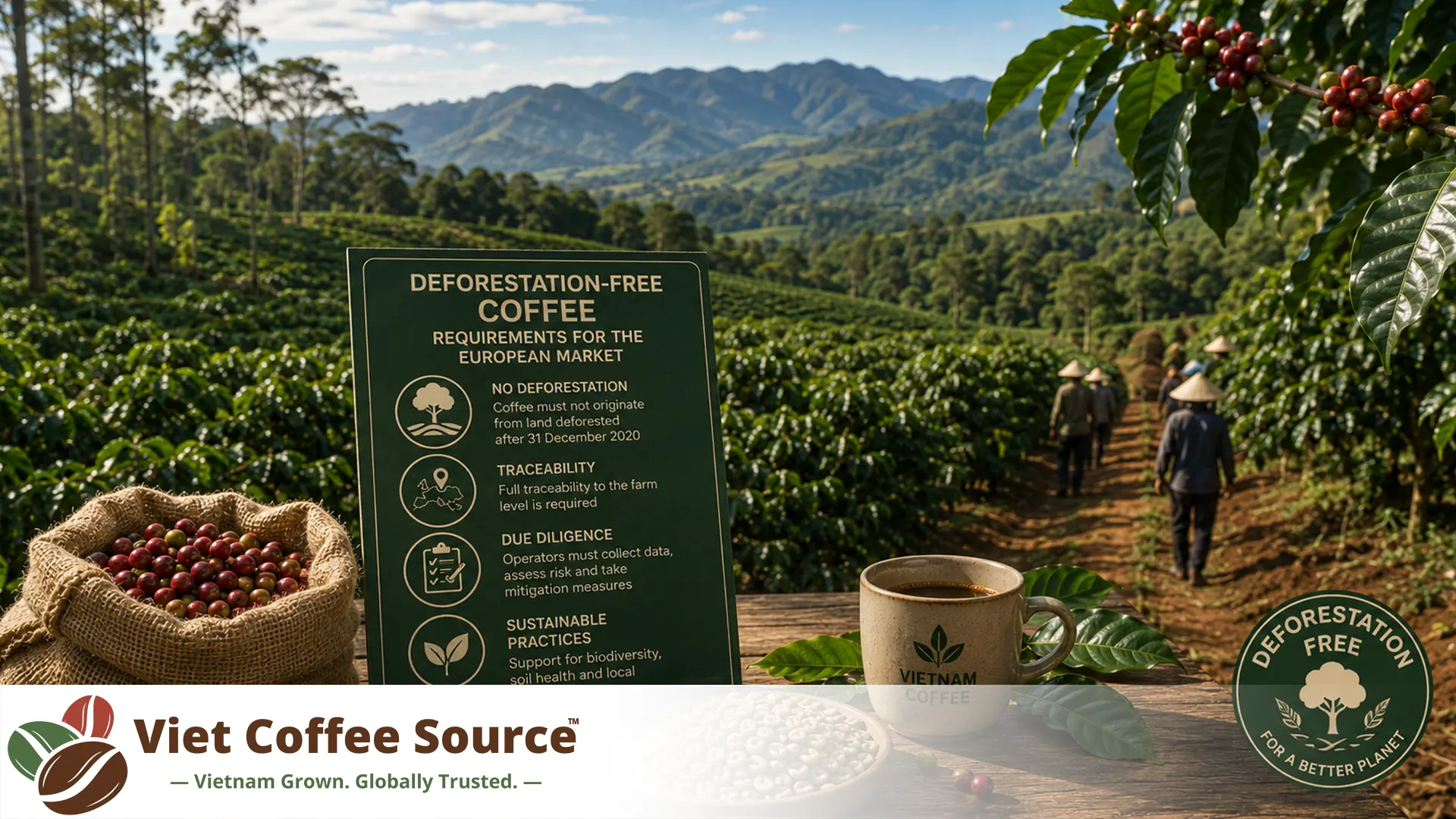
Deforestation-Free Coffee: Requirements for the European Market
Deforestation-free coffee for the European market must be linked to production plots that were not subject to deforestation after 31 December 2020, produced in accordance with the relevant laws of the country of production and covered by the required due diligence documentation before it is placed on the EU market or exported from the European Union. These requirements arise from the EU Deforestation Regulation, commonly known as the EUDR, which covers coffee together with cattle, cocoa, oil palm, rubber, soya and wood, as well as specified derived products listed by customs classification in the Regulation’s product annex.
For coffee exporters, roasters, importers and international buyers, compliance requires much more than a general sustainability declaration or a supplier certificate. Each commercial lot must remain connected to its farms or production plots, geolocation data, production period, legal-production evidence, suppliers, quantities, processing records and shipping documentation. Where the required information is missing, unreliable or inconsistent, the responsible operator cannot treat the product as compliant merely because it originates from a well-known producing region or a country classified as low risk.
What is deforestation-free coffee?
Under the EUDR, coffee is considered deforestation-free when it was produced on land that has not been converted from forest to agricultural use after the cut-off date of 31 December 2020. The relevant question is not whether the coffee was harvested after that date, but whether the production plot experienced prohibited deforestation after the cut-off.
A compliant coffee product must satisfy three main conditions:
- It must be deforestation-free.
- It must have been produced in accordance with the relevant legislation of the country of production.
- It must be covered by the required due diligence statement or simplified declaration, depending on the operator and supply-chain situation.
All three conditions matter. Geolocation alone does not prove legal production, and a land-use document alone does not prove that no prohibited forest conversion occurred.
When do the EUDR requirements apply?
Following amendments agreed in 2025, the main EUDR obligations apply from 30 December 2026 to large and medium-sized operators and to micro and small operators already covered by the former EU Timber Regulation. Most other micro and small operators have a later application date of 30 June 2027.
| Business category | Main application date | Practical implication |
|---|---|---|
| Large and medium operators | 30 December 2026 | Relevant coffee placed on the EU market or exported must satisfy the applicable EUDR obligations. |
| Micro and small operators previously covered by the EU Timber Regulation | 30 December 2026 | The later SME date does not apply to this specific group. |
| Most other micro and small operators | 30 June 2027 | A later application date applies, but supply-chain preparation is still required in advance. |
The application date should not be confused with the 31 December 2020 deforestation cut-off. The cut-off determines whether the production land is acceptable, while the application date determines when the legal obligations become enforceable for the relevant business category.
Which coffee products are covered?
The EUDR applies only to commodities and products identified in Annex I by their Combined Nomenclature or Harmonised System classification. Coffee products already within the principal scope include relevant forms of green and roasted coffee. The European Commission adopted additional product-scope measures in 2026, including changes affecting soluble coffee and other derived products, with specific application arrangements for newly added items.
Buyers should verify the precise customs code of every product rather than assume that all items containing coffee are treated identically. Particular care is required for:
- Green coffee beans
- Roasted coffee beans
- Ground roasted coffee
- Decaffeinated coffee
- Soluble and instant coffee
- Three-in-one coffee
- Coffee extracts and concentrates
- Composite beverages and food preparations containing coffee
- Samples and products intended only for testing or analysis
A product’s marketing name does not determine regulatory scope. The customs classification, composition, processing stage and current version of Annex I must be checked before shipment.
Who is responsible for compliance?
The main due diligence responsibility generally rests with the upstream operator that places the relevant coffee product on the EU market for the first time or exports it from the European Union. For imports from outside the EU, the first EU-established person that makes the product available on the market may be treated as the operator under the Regulation.
The revised EUDR framework reduces repeated submissions further down the supply chain. Downstream operators and traders may rely on reference information received from the responsible upstream operator, subject to the obligations applicable to their company size and position. The original operator nevertheless remains responsible for the accuracy and sufficiency of the due diligence supporting the product it first placed on the market.
Exporters outside the EU do not automatically become the legal EU operator merely because they produce or ship the coffee. However, they must provide the information that enables the EU importer or responsible operator to complete due diligence. In practice, an exporter unable to provide plot-level data and reliable supporting evidence may lose access to compliant European buyers.
The three stages of EUDR due diligence
Full due diligence consists of three connected stages:
- Collection of information, documents and data.
- Assessment of the risk that the coffee does not comply.
- Mitigation of any risk that is more than negligible.
The responsible operator may place the product on the market only after concluding that there is no risk or only a negligible risk of non-compliance. Due diligence is therefore not simply a file-collection exercise. Information must be checked, compared and evaluated.
Step one: information collection
The information package for a coffee shipment should identify the product, quantity, origin, production plots, production period, suppliers and customers. It must also contain sufficiently conclusive and verifiable evidence that the coffee is deforestation-free and legally produced.
Core information normally includes:
- Trade name and product description
- Relevant customs classification
- Net quantity
- Country of production
- Relevant region, province, district or other geographic subdivision
- Geolocation of every production plot
- Date or time range of production
- Supplier name, postal address and email address
- Customer or downstream recipient information where required
- Evidence of deforestation-free status
- Evidence of compliance with applicable local laws
- Lot and traceability references
If coffee from multiple plots is combined, the geolocation of every contributing plot must be included. A regional centroid, cooperative office, warehouse coordinate or processing-factory location cannot replace the production-plot data.
Geolocation requirements for coffee plots
Geolocation is the geographic location of the land on which the coffee was produced. The required format depends on the size and shape of the production plot.
For smaller plots, latitude and longitude coordinates may be used to identify the plot. For plots larger than four hectares, polygon data is generally required so that the boundaries of the production area can be evaluated accurately.
Useful geolocation records should contain:
- Farm identifier
- Plot identifier
- Farmer or legal land-user identifier
- Latitude and longitude or polygon coordinates
- Coordinate system and data format
- Plot area
- Collection date
- Person or organisation responsible for mapping
- Evidence connecting the mapped plot to the farmer
Coordinates should be checked for obvious errors. A point in the ocean, a city centre, a warehouse or another country is not acceptable merely because it appears in a spreadsheet.
Point coordinates and polygons
| Data type | Typical use | Main limitation |
|---|---|---|
| Point coordinate | Identification of eligible smaller production plots | Does not show the complete plot boundary. |
| Polygon | Boundary mapping, especially for plots larger than four hectares | Requires more detailed field data and validation. |
| Regional coordinate | General origin description | Does not meet the need to identify each production plot. |
| Factory or warehouse coordinate | Facility traceability | Cannot replace farm or plot geolocation. |
Production date or production period
The operator must know when the relevant commodity was produced. For coffee, the record may refer to the harvest period, crop year or another sufficiently precise time range that connects the coffee to the identified plots.
Production-period records should be consistent with:
- Local harvest calendars
- Farm delivery records
- Cherry or parchment purchase dates
- Processing dates
- Warehouse intake dates
- Crop-year declarations
- Export dates
Impossible timelines, such as green coffee entering a warehouse before the stated harvest period, should trigger further investigation.
The 31 December 2020 cut-off date
The EUDR cut-off means coffee cannot qualify as deforestation-free if its production plot was created through prohibited forest conversion after 31 December 2020. A farm established before the cut-off may continue producing coffee, provided that other legal requirements are met.
Evidence may include:
- Historical satellite imagery
- Official land-cover maps
- Farm registration documents
- Historical agricultural records
- Planting records
- Earlier geolocation surveys
- Time-stamped photographs
- Independent land-use assessments
No single evidence source is always sufficient. A strong assessment compares several sources and investigates contradictions.
Forest maps and satellite analysis
Satellite monitoring can help determine whether forest cover was cleared after the cut-off, but map interpretation must account for image resolution, cloud cover, plantation shade, seasonal vegetation, mixed farming systems and differences between legal definitions.
A responsible workflow may include:
- Validate the plot geometry.
- Overlay the plot against historical forest-cover data.
- Compare imagery before and after the cut-off.
- Investigate detected changes.
- Request field evidence where remote analysis is inconclusive.
- Document the conclusion and evidence source.
An automated “no alert” result should not be treated as absolute proof when the underlying data is incomplete or unsuitable for the landscape.
Legal-production requirements
Deforestation-free status is only one part of compliance. Coffee must also be produced in accordance with the relevant laws of the producing country.
Depending on the country and farm, relevant legal areas may include:
- Land-use rights
- Property and tenancy rights
- Environmental protection rules
- Forest and conservation laws
- Third-party rights
- Labour rights
- Human rights protected under applicable law
- Rights of Indigenous Peoples and local communities
- Free, prior and informed consent where relevant
- Tax, trade, customs and anti-corruption rules
The required evidence depends on local legal systems. A farm may be legally operated under a recognised use right even when it does not hold a Western-style private title. Buyers should therefore understand the legally accepted land-tenure documents in the country of production.
Examples of legal-production evidence
Possible supporting documents include:
- Land-use certificate
- Lease agreement
- Farm registration
- Cooperative membership records
- Tax registration
- Local production authorisation
- Environmental permit where required
- Documents recognising customary rights
- Employment and wage records
- Pesticide and input records
- Supplier declarations supported by independent evidence
A self-declaration without verifiable supporting data may be insufficient, particularly when the supply chain or region presents known legal or land-use risks.
Step two: risk assessment
Unless simplified due diligence applies, the operator must evaluate the collected information and determine whether the coffee presents a risk of non-compliance.
The assessment may consider:
- Country risk classification
- Presence of forests in the production area
- Prevalence of deforestation
- Presence and rights of Indigenous Peoples
- Land-tenure disputes
- Reliability of documents
- Corruption and law-enforcement concerns
- Supply-chain complexity
- Risk of mixing with coffee of unknown origin
- Supplier history
- Previous compliance failures
- Substantiated concerns raised by third parties
- Differences between declared and delivered quantities
The assessment should explain why the evidence supports a finding of no or negligible risk. A simple low, medium or high label without reasoning is not enough for a robust compliance file.
Step three: risk mitigation
Where the risk is more than negligible, the operator must take proportionate measures until the risk becomes negligible. If the risk cannot be reduced sufficiently, the product must not be placed on the EU market.
Risk-mitigation actions may include:
- Requesting additional documents
- Correcting or remapping plot boundaries
- Obtaining higher-resolution imagery
- Conducting field inspections
- Using independent audits
- Separating uncertain farms from compliant lots
- Improving supplier training
- Reconciling farm production capacity with delivered volume
- Changing the supplier or sourcing area
- Rejecting the affected lot
Mitigation must address the identified risk. A general sustainability audit may not solve a specific geolocation or land-conversion concern.
Country risk benchmarking
The European Commission classifies countries or parts of countries as low risk, standard risk or high risk. The classification affects the depth of due diligence and the frequency of competent-authority checks, but it does not change the basic requirement that coffee must be deforestation-free and legally produced.
| Risk category | Due diligence effect | What remains required |
|---|---|---|
| Low risk | Simplified due diligence may apply when all relevant commodities originate from low-risk countries and no warning information exists. | Article 9 information, plot geolocation, production information, legal-production evidence and deforestation-free evidence. |
| Standard risk | Full information collection, risk assessment and risk mitigation where needed. | Complete due diligence before market placement. |
| High risk | Full due diligence with higher expected scrutiny. | Complete evidence and risk reduction to a negligible level. |
Country classifications can be reviewed and changed. Contracts should therefore avoid assuming that a classification will remain permanent throughout a long-term supply agreement.
Vietnam’s current EUDR risk classification
Vietnam is currently classified by the European Commission as a low-risk country. This can allow simplified due diligence for qualifying supply chains, but it does not remove the need for geolocation, traceability, proof of legal production or proof that the coffee is deforestation-free.
If an operator becomes aware of relevant information suggesting non-compliance, circumvention, document falsification, unknown mixing or prohibited land conversion, the operator must move beyond the simplified approach and complete the necessary risk assessment and mitigation.
Buyers sourcing Vietnamese coffee can review the wider Vietnamese coffee origin and production structure when designing region-specific traceability systems.
Due diligence statements
Before relevant coffee is placed on the EU market or exported, the responsible operator must submit the required due diligence statement through the EUDR Information System and obtain its reference number. The statement confirms that due diligence has been completed and that no or only negligible risk was found.
The statement contains information such as:
- Operator identification
- Product information
- Customs classification
- Quantity
- Country of production
- Geolocation data
- Production period
- Declaration of completed due diligence
Submission does not transfer responsibility to the information system or to the authorities. The operator remains responsible for compliance and the accuracy of the information.
Simplified declarations for micro and small primary operators
The revised framework introduces a simplified declaration for qualifying micro or small primary operators in low-risk countries who place on the market or export products they have themselves grown or harvested on identified plots.
This arrangement is intended to reduce repeated administrative submissions. It does not authorise anonymous or untraceable production. The declaration must still identify the operator and the relevant production plots, and the declaration identifier must be communicated through the supply chain where required.
Customs declarations and reference numbers
For imports into the EU, the due diligence statement reference number or simplified declaration identifier must be available before the customs declaration is lodged. The customs declarant must include the relevant reference information in the declaration.
A reference number should be connected to:
- The correct importer or operator
- The correct product classification
- The quantity covered
- The relevant shipment or batch
- The correct production plots
- The supporting due diligence file
Using a valid reference number for unrelated coffee does not create compliance and may indicate circumvention.
Traceability from plot to export lot
A deforestation-free claim requires an unbroken connection between the production plots and the exported product. The chain may include farmers, collectors, cooperatives, wet mills, dry mills, warehouses, traders, exporters, roasters and importers.
A practical traceability chain may follow:
- Farm and plot registration
- Harvest record
- Delivery to collector or cooperative
- Cherry or parchment intake record
- Processing batch
- Dry-mill lot
- Warehouse lot
- Export lot
- Container and seal record
- Importer receipt
Each transformation, combination or split must be documented so that the quantity entering and leaving the stage can be reconciled.
Lot coding
Lot codes should remain unique, stable and understandable across records. A well-designed code may identify origin, supplier group, crop year, process, warehouse and production batch.
A code should not be reused for unrelated coffee. When one lot is divided, the child lots should retain a documented link to the parent. When lots are combined, the new lot should identify every contributing source.
Combining coffee from multiple farms
The EUDR does not prohibit aggregation. Coffee from many smallholders can be combined, provided that all contributing plots are identified and compliant.
Before aggregation, the processor should confirm:
- Every farmer is registered.
- Every plot has valid geolocation.
- The production period is recorded.
- Legal-production evidence is available.
- Deforestation screening has been completed.
- Suspended or rejected farms are blocked.
- Delivered quantities are plausible.
If one non-compliant or unknown source is mixed into an inseparable lot, the compliance status of the entire lot may be compromised.
Segregation and mass balance
Physical segregation is generally the safest approach for EUDR coffee because it prevents compliant material from being mixed with coffee of unknown or non-compliant origin. Warehouses and mills should separate lots through labelled bags, bins, silos, floor areas or processing schedules.
A purely administrative mass-balance claim cannot replace plot-level traceability where physical coffee cannot be connected to the identified compliant sources. Quantity accounting is necessary, but it must support rather than replace product identity.
Quantity reconciliation
Volume control is essential for detecting undeclared mixing. A farm, cooperative or processor should not sell more traceable coffee than it could reasonably produce or receive.
Reconciliation may compare:
- Mapped coffee area
- Expected yield
- Actual harvest
- Delivered cherry quantity
- Parchment conversion
- Green bean recovery
- Processing losses
- Warehouse inventory
- Exported quantity
Unexplained excess volume is a warning sign that coffee from unregistered plots may have entered the lot.
Processing and transformation records
Green coffee may be hulled, cleaned, polished, washed, graded, sorted, roasted, ground, decaffeinated, extracted or blended before reaching the European market. Every transformation should preserve the connection to the original compliant coffee.
Processing records may include:
- Input lot numbers
- Input quantity
- Process date
- Processing method
- Output lot numbers
- Output quantity
- Losses and by-products
- Equipment or production line
- Cleaning records between lots
Blends containing coffee from several origins must retain the geolocation and due diligence information for all contributing sources.
Green coffee requirements
For green coffee, traceability usually begins at the farm and follows the product through cherry, parchment or dried-cherry handling, milling, grading, storage and export.
A strong green-coffee file may include:
- Farm and plot register
- Geolocation files
- Harvest records
- Farmer delivery receipts
- Processing logs
- Warehouse intake and release records
- Quality certificates
- Packing list
- Commercial invoice
- Container and seal information
Roasted and ground coffee requirements
Roasting does not remove EUDR traceability obligations when the roasted product falls within scope. The roaster must know which compliant green lots entered each roast batch.
Relevant records include:
- Green coffee input lots
- Roast batch code
- Roasted output quantity
- Blend formula
- Packaging batch
- Finished-product quantity
- Customer distribution records
Private-label products should not lose their EUDR identity merely because they are sold under another company’s brand.
Instant and soluble coffee
Soluble coffee supply chains can be more complex because beans may be blended, roasted, extracted, concentrated, dried and agglomerated. Product-scope changes adopted in 2026 also require buyers to verify when the relevant soluble-coffee classification becomes subject to the updated Annex.
Manufacturers should retain:
- Green coffee sources
- Roast and extraction batches
- Extraction yield
- Concentration records
- Drying batch
- Finished soluble-coffee lot
- Quantity reconciliation
For three-in-one products, coffee traceability should remain connected to the finished formulation even though sugar, creamer and other ingredients are present.
Supplier onboarding
EUDR compliance begins before the purchasing contract is signed. Suppliers should be evaluated for their ability to map farms, maintain lot separation, provide legal documents and respond to data-quality issues.
Supplier onboarding may assess:
- Farm-registration system
- Geolocation method
- Data validation
- Land-legality evidence
- Deforestation-screening process
- Lot coding
- Warehouse segregation
- Production-capacity controls
- Internal audits
- Corrective-action procedures
A supplier that promises compliance but cannot demonstrate its system should not be treated as low risk solely on the basis of reputation.
Supplier contract clauses
Contracts for European-market coffee should address:
- Accurate plot geolocation
- Prohibition of unknown mixing
- Legal-production warranty
- Deforestation-free warranty
- Access to records
- Audit rights
- Notification of land or supplier changes
- Quantity reconciliation
- Document-retention period
- Rejection and replacement procedures
- Liability for false information
Contract wording cannot replace due diligence, but it can define responsibilities and provide remedies when the supplied information is false or incomplete.
Data validation
Data should be validated before it enters the final due diligence statement. Common validation rules include:
- Coordinates fall within the declared country and region.
- Polygon geometry is valid.
- Plot area is plausible.
- Plots do not duplicate unrelated farmers.
- Harvest dates match local seasons.
- Farmer identifiers are unique.
- Farm volume is consistent with mapped area.
- Lot quantities reconcile through processing.
- Documents refer to the same supplier and plot.
Automated checks can identify obvious errors, but manual review remains important for unusual cases.
Common geolocation errors
- Latitude and longitude reversed
- Missing negative coordinate sign
- Coordinate recorded at the farmer’s home instead of the plot
- Warehouse coordinate used for all farms
- Polygon self-intersection
- Plot mapped in another country
- Identical coordinate copied across many farms
- Area recorded in the wrong unit
- Polygon covering an entire village rather than one farm
- No link between the coordinate and the farmer record
Data confidentiality
Farm geolocation and personal supplier information can be commercially and personally sensitive. Exporters and buyers should use access controls, secure storage, defined user permissions and data-sharing agreements.
Confidentiality should not be used as a reason to withhold legally required information from the responsible operator or competent authority. A controlled data-sharing process is preferable to removing essential traceability fields.
Document retention
Operators must retain due diligence records for at least five years. The file should remain accessible even after employees, software platforms or suppliers change.
Records may include:
- Due diligence statements
- Geolocation files
- Risk assessments
- Risk-mitigation actions
- Supplier contracts
- Legal-production evidence
- Satellite assessments
- Audit reports
- Lot and quantity records
- Customer communications
Version control is important because plot boundaries, supplier status and risk conclusions may change over time.
Certification and EUDR compliance
Organic, sustainability, fair-trade or responsible-sourcing certification can support due diligence, but certification does not automatically guarantee EUDR compliance.
A certification system may help provide:
- Farm lists
- Internal-control records
- Audit reports
- Chain-of-custody information
- Farmer training records
- Environmental criteria
The operator must still confirm that the information meets EUDR requirements, especially plot geolocation, post-2020 deforestation status, legal production and product-level traceability.
Quality and EUDR traceability
EUDR compliance and coffee quality are separate but connected systems. A lot may be legally compliant but fail the buyer’s moisture, defect or sensory requirements. Another lot may taste excellent but lack adequate plot documentation.
Buyers should connect EUDR records with:
- Moisture results
- Water activity
- Screen distribution
- Defect count
- Cupping profile
- Processing method
- Crop year
- Packaging specification
These controls can be managed through documented coffee quality, traceability and compliance procedures.
Warehouse management
Warehouses should prevent compliant lots from being confused with undocumented coffee. Every movement should be recorded.
Good practice includes:
- Clearly labelled storage zones
- Unique lot tags
- Pallet or silo identification
- Controlled stock transfers
- Cleaning between lots
- Inventory reconciliation
- Restricted access to suspended coffee
- Recorded bag replacement
A digital system is useful only when the physical stock matches the records.
Container loading
Before shipment, the exporter should verify that the correct compliant lot is loaded into the correct container.
Loading controls may include:
- Final lot verification
- Bag-count confirmation
- Container inspection
- Loading photographs
- Container number
- Seal number
- Weight record
- Packing-list reconciliation
- Approval by an authorised employee
Changing the lot after the due diligence statement has been prepared may require the operator to review or replace the statement.
Preparing samples for European buyers
Samples should be identified with the same origin and lot structure intended for the commercial shipment. A compliant sample from selected farms cannot support a shipment containing additional undocumented sources.
Sample documents may state:
- Origin
- Farm group
- Crop year
- Process
- Lot code
- Traceability status
- Whether the sample represents the final lot
Internal audits and mock traceability tests
Companies should periodically test whether they can trace a finished coffee lot back to all production plots and trace each plot forward to the relevant shipments.
A mock test should verify:
- Speed of record retrieval
- Completeness of plot data
- Consistency of supplier records
- Quantity reconciliation
- Processing links
- Customer distribution records
- Ability to isolate affected stock
Failures should result in corrective actions, responsible owners and deadlines.
Competent-authority checks
EU competent authorities may inspect due diligence systems, statements, geolocation data, risk assessments, supplier records, warehouses and product samples. They may also act on substantiated concerns submitted by third parties.
Companies should be prepared to explain:
- How plots were mapped
- How deforestation was assessed
- Which local laws were evaluated
- How supplier data was verified
- How mixing was prevented
- How quantities were reconciled
- Why the final risk was considered negligible
Penalties and commercial consequences
Member States must establish effective, proportionate and dissuasive penalties. Depending on the violation, consequences may include fines, confiscation of products or revenue, temporary exclusion from public procurement and temporary prohibition from placing relevant products on the market.
Commercial consequences may arise even before formal enforcement:
- Shipment delay
- Customs blockage
- Buyer rejection
- Contract claims
- Loss of supplier approval
- Product withdrawal
- Reputational damage
- Additional audit costs
Common compliance failures
- Collecting only cooperative coordinates
- Using a regional map instead of individual plots
- Failing to verify land legality
- Combining mapped and unmapped coffee
- Accepting copied coordinates
- Ignoring quantity inconsistencies
- Relying entirely on certification
- Preparing traceability only after shipment
- Using different lot numbers across documents
- Failing to update supplier status
- Assuming low-risk classification removes all obligations
- Submitting a due diligence statement without supporting evidence
Warning signs for buyers
A buyer should investigate when:
- The supplier cannot provide plot-level geolocation.
- Every farm has exactly the same coordinates.
- Production quantities exceed plausible farm capacity.
- The exporter refuses to explain its mapping method.
- Farm names differ between files.
- The plot lies inside a protected or forested area without explanation.
- Land documents do not identify the producer.
- The lot was mixed before compliance checks.
- The supplier claims certification is sufficient by itself.
- The due diligence reference cannot be linked to the shipment.
Questions to ask a coffee exporter
- Which farms and plots produced this lot?
- Are all coordinates points or polygons in the required format?
- How were the coordinates collected and validated?
- How was post-2020 deforestation assessed?
- Which legal-production documents are available?
- Is the lot physically segregated?
- How are quantities reconciled?
- Which processing batches contributed to the shipment?
- Has any source been suspended or excluded?
- Who maintains the due diligence file?
- Can the final shipment be traced back to every plot?
- Which EUDR reference information will accompany the shipment?
Buyer checklist
- Product customs code confirmed
- Application date confirmed
- Responsible operator identified
- Country of production confirmed
- All production plots listed
- Geolocation validated
- Production period recorded
- Post-2020 deforestation assessment completed
- Legal-production evidence reviewed
- Supplier identities verified
- Risk category checked
- Risk assessment completed where required
- Mitigation completed where necessary
- Lot quantities reconciled
- Processing links documented
- Due diligence statement or declaration submitted
- Reference number connected to customs documents
- Records retained for five years
Recommended preparation workflow
- Confirm that the coffee product falls within the current EUDR scope.
- Identify the responsible EU operator.
- Register all farmers and production plots.
- Collect and validate geolocation.
- Record the production period.
- Assess land use against the 31 December 2020 cut-off.
- Collect legal-production evidence.
- Establish unique farm and lot codes.
- Prevent mixing with unknown coffee.
- Reconcile quantities through collection and processing.
- Complete risk assessment where required.
- Mitigate every non-negligible risk.
- Prepare the due diligence file.
- Submit the required statement or declaration.
- Connect the reference number to customs and shipment records.
- Retain the full evidence package.
Export opportunities for prepared suppliers
EUDR preparation can create a commercial advantage for exporters that offer reliable plot data, stable lot separation and rapid document delivery. European importers may prefer suppliers capable of reducing compliance uncertainty even when their coffee is not the lowest-priced option.
Export-ready programmes may include:
- Traceable commercial Robusta
- Farm-level Arabica
- Fine Robusta micro-lots
- Certified coffee with EUDR data
- Segregated regional lots
- Private-label roasted coffee
- EUDR-ready espresso blends
- Documented soluble-coffee supply chains
Exporters can review structured coffee export, traceability and documentation services when preparing products for European customers.
Final assessment
Deforestation-free coffee for the European market requires verifiable evidence connecting each relevant product to legally operated production plots that were not deforested after 31 December 2020. Compliance depends on accurate geolocation, production dates, supplier records, land-legality evidence, deforestation assessment, lot segregation, quantity reconciliation and the required submission through the EUDR Information System.
A low-risk country classification can simplify part of the process, but it does not eliminate plot mapping, traceability or legal-production requirements. Certification, satellite monitoring and supplier declarations can support the file, but none of them automatically replaces the operator’s responsibility.
Companies planning to supply European buyers should build the system before contracting and shipping, not after customs documents are prepared. Businesses seeking Vietnamese green, roasted or processed coffee with defined traceability requirements can submit a customised wholesale coffee inquiry stating the product, quantity, destination, origin, processing method, packaging and required EUDR data.