
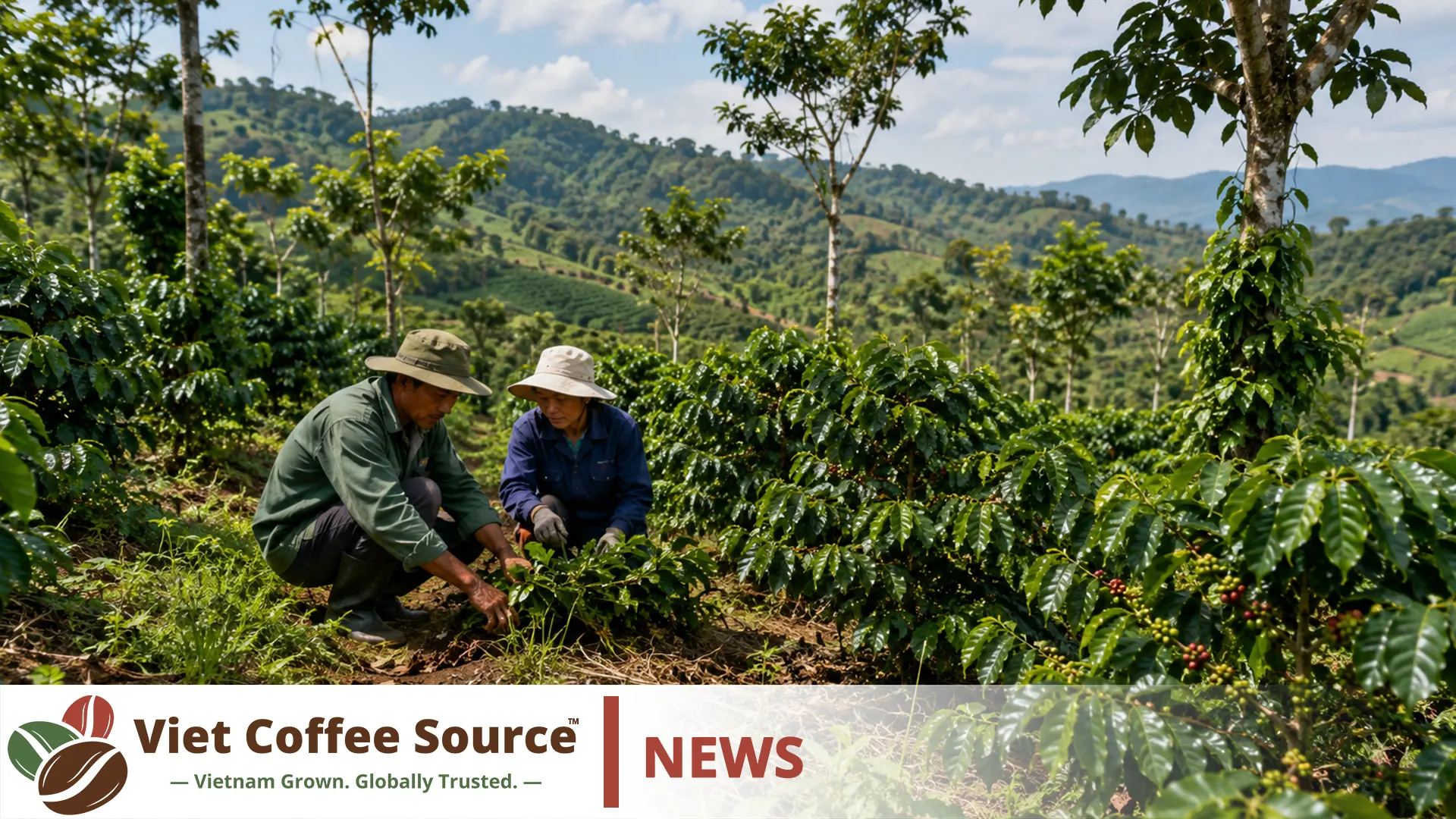
Regenerative Agriculture Gains Momentum Across Vietnam’s Coffee Sector
Regenerative agriculture is gaining momentum across Vietnam’s coffee sector as farmers, government agencies, exporters and international companies seek more resilient production methods. The transition is being driven by increasingly unpredictable weather, declining soil health, pressure on water resources and stronger buyer expectations regarding emissions, deforestation and traceability.
Rather than focusing only on short-term yield, regenerative coffee farming aims to restore soil functions, use agricultural inputs more efficiently, protect water and increase biodiversity. Common practices include mulching, composting, agroforestry, intercropping, balanced fertilisation, integrated pest management and the renovation of ageing coffee trees.
Central Highlands Farmers Adopt New Production Methods
Vietnam’s Central Highlands, the country’s main coffee-producing region, has become the centre of this transition. Farmers in Đắk Lắk, Lâm Đồng, Gia Lai and surrounding areas are testing production systems that combine coffee with shade trees, fruit crops, pepper or macadamia.
These systems can provide additional income while reducing dependence on coffee as a single crop. Tree cover can also help protect soil from direct sunlight, reduce moisture loss and create a more stable environment around coffee plants during periods of extreme heat.
A climate-resilience programme implemented between 2024 and 2026 trained 5,575 smallholder farmers through 225 Farmer Field Schools. The initiative also delivered thousands of farm coaching visits, trained local instructors and established 15 demonstration farms where producers could observe new practices under local conditions.
Soil and Water Management Receive Greater Attention
Soil degradation has become a significant concern in coffee areas where intensive production has depended heavily on mineral fertilisers, herbicides and repeated irrigation. Regenerative programmes are encouraging farmers to analyse soil conditions before deciding how much fertiliser to apply.
Vietnam’s climate-smart coffee farming programme has developed demonstration models involving pure coffee cultivation and intercropping with crops such as durian and pepper. During the 2024–2025 season, more than 200 soil samples were examined through approximately 2,300 agricultural indicators, while nearly 500 farming households were surveyed.
The programme promotes balanced fertilisation, organic and microbial inputs, scientific irrigation, integrated pest management and the renewal of ageing plantations. Early field observations indicate that farmers can reduce unnecessary fertiliser and water use when decisions are based on soil analysis and actual crop requirements.
Agroforestry Connects Coffee Production with Forest Protection
Agroforestry is becoming especially important because Vietnam must increase coffee resilience without encouraging agricultural expansion into natural forests. A USD 102 million initiative launched in 2026 is supporting climate-smart agroforestry, rural livelihoods and forest protection in major Central Highlands provinces.
The programme connects sustainable agricultural production with the development of deforestation-free supply chains. This approach is increasingly relevant to European buyers that need evidence showing that imported coffee is not linked to forest conversion.
For exporters, farm boundaries and production records must remain connected to individual coffee lots. Regenerative practices cannot replace traceability, but they can strengthen a broader sourcing system that combines responsible land use, farm data and verifiable supply-chain controls.
Low-Emission Farming Becomes a National Priority
Vietnam’s wider agricultural policy is also moving toward lower-emission production. The national low-emission crop programme for 2025–2035 targets a reduction of at least 15% in greenhouse gas emissions from crop production compared with the 2020 baseline.
The programme calls for technical packages covering major crops, demonstration projects in producing provinces and systems for measurement, reporting and verification. Although implementation will differ by crop and region, coffee is expected to benefit from greater attention to organic inputs, efficient fertilisation, digital soil monitoring and value-chain cooperation.
This policy direction may make environmental performance more measurable. Exporters and cooperatives could increasingly be asked to demonstrate not only where coffee was produced, but also how water, fertiliser, soil and emissions were managed at farm level.
International Coffee Programmes Increase Their Support
Large coffee companies are also expanding regenerative agriculture programmes in Vietnam and other producing countries. Nescafé reported that 53% of its global green coffee supply in 2025 came from farmers adopting regenerative practices, compared with 32% in the previous year.
Vietnam is one of the company’s principal sourcing origins and has participated in farmer training, digital knowledge-sharing and the distribution of improved coffee plants. International programmes generally focus on practices such as optimised fertilisation, mulching, agroforestry, intercropping and the replacement of old trees with more productive and climate-resilient varieties.
The growing involvement of private buyers is important because farmers often need technical guidance and reliable market access during the transition. Changing an established production system involves cost and risk, and benefits may not appear during the first season.
Regenerative Agriculture Is Not an Automatic Solution
The expansion of regenerative agriculture does not guarantee immediate improvements on every farm. The correct combination of shade, intercrops, fertilisation and water management depends on altitude, soil, rainfall, coffee variety and the farmer’s commercial objectives.
Poorly designed intercropping can create competition for water or nutrients, while excessive shade may affect coffee productivity. Farmers therefore need location-specific advice rather than a single standard model applied across every production area.
Measurement also remains a challenge. Claims involving carbon reduction, biodiversity or soil restoration require credible baseline data and consistent monitoring. Buyers should distinguish between farms that have begun adopting individual practices and supply chains that can document measurable environmental outcomes.
Export Buyers Look Beyond Certification
Regenerative practices are becoming part of a wider commercial assessment that includes product quality, traceability, legality and shipment reliability. European and international buyers increasingly want farm information to remain connected with processing records and export lots.
Suppliers should therefore integrate farm-level data with structured quality and compliance procedures. Information about moisture, defects, processing, origin and production practices should remain consistent from the farm or cooperative to the final export documentation.
The transition also creates an opportunity for Vietnam’s individual coffee-producing origins to develop clearer environmental and production profiles. Buyers may increasingly compare regions not only by flavour and coffee type, but also by water efficiency, agroforestry adoption and supply-chain transparency.
Regenerative agriculture is unlikely to replace conventional production across Vietnam immediately. However, its expansion shows that the sector is moving from isolated sustainability projects toward broader farm, landscape and commercial programmes. Exporters that connect improved farming practices with reliable traceability and structured export procedures will be better positioned to meet changing market requirements.
International buyers seeking Vietnamese coffee with defined specifications, origin information and traceability support can submit a wholesale inquiry based on their product, volume, destination and compliance requirements.