
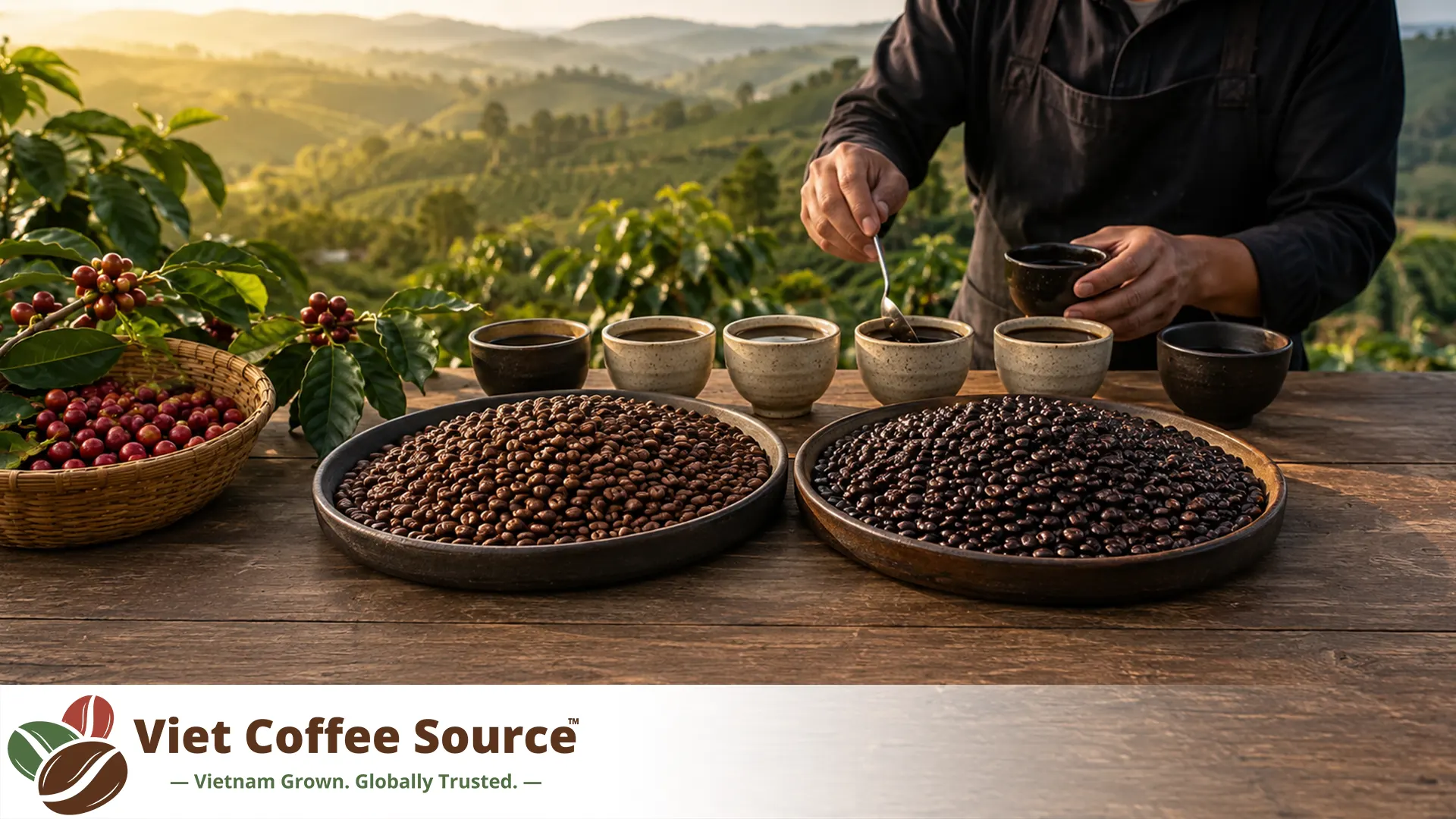
Vietnamese Specialty Coffee: The Rise of Fine Robusta and Arabica
Vietnamese Specialty Coffee: The Rise of Fine Robusta and Arabica examines how Vietnam’s coffee sector is expanding beyond high-volume commercial supply and developing a stronger position in the global specialty market. The country remains closely associated with Robusta, but improvements in farming, harvesting, processing, drying, storage, roasting and traceability are creating new opportunities for Fine Robusta and high-quality Vietnamese Arabica.
This transition does not mean replacing Vietnam’s commercial coffee industry. Instead, specialty development adds higher-value segments alongside traditional production. Farmers, cooperatives, processors, exporters, roasters and brands are separating carefully managed lots, building origin identities and developing coffees with cleaner cups, greater sweetness and more distinctive flavour profiles.
Fine Robusta is particularly important because it gives Vietnam an opportunity to compete through a coffee species that already matches the country’s agricultural strengths. Vietnamese Arabica, especially from suitable highland areas, adds another specialty direction through acidity, fragrance, fruit, caramel and floral complexity.
For international buyers, Vietnamese specialty coffee can support single-origin programmes, premium espresso blends, filter coffee, phin products, cold beverages, private-label ranges and differentiated retail offerings. Successful sourcing depends on evaluating the actual lot, production system and quality controls rather than relying only on broad terms such as specialty, premium or highland coffee.
What is Vietnamese specialty coffee?
Vietnamese specialty coffee refers to coffee produced with greater attention to quality, traceability and sensory value than standard commodity supply. It may include Arabica evaluated under established specialty practices, Fine Robusta assessed for cleanliness and flavour, experimental processing lots, estate coffee, cooperative microlots and carefully prepared commercial-premium grades.
Specialty positioning normally depends on several connected factors:
- Suitable variety and growing conditions
- Selective harvesting of ripe cherries
- Controlled processing
- Careful drying
- Protected storage
- Physical grading
- Traceable lot separation
- Professional sensory evaluation
- Consistent roasting performance
A coffee does not become specialty simply because it comes from a highland region or uses attractive packaging. The quality must be visible in the physical preparation, cup profile, consistency and supporting information.
Why Vietnamese specialty coffee is gaining attention
Global buyers increasingly seek coffees that combine distinct origin, reliable supply and commercial flexibility. Vietnam can offer all three when quality-focused producers separate specialty lots from ordinary bulk production.
Interest is rising because Vietnam can provide:
- Fine Robusta with a clear regional identity
- Arabica from elevated growing areas
- Natural, washed and honey processing
- Experimental fermentation
- Strong espresso performance
- High body for milk-based beverages
- Distinctive coffee for phin brewing
- Competitive alternatives to established specialty origins
- Scalable supply for growing brands
Buyers can compare Vietnamese coffee origins, elevations and regional flavour directions when evaluating where Fine Robusta and Arabica programmes may fit within their portfolios.
The role of Robusta in Vietnam’s coffee identity
Robusta has shaped Vietnam’s international coffee position for decades. It is well suited to many of the country’s growing regions and provides strong yields, heavy body, high caffeine and reliable performance in espresso, soluble coffee and dark-roast applications.
Traditional commercial Robusta is often associated with:
- Strong bitterness
- Heavy body
- Dark chocolate
- Cocoa
- Roasted nuts
- Low perceived acidity
- High caffeine
These characteristics are valuable, but inconsistent harvesting, uncontrolled drying, poor storage and high defect levels can create harsh, woody, rubbery, fermented or smoky flavours. Fine Robusta production aims to preserve the species’ strength while reducing defects and increasing sweetness, clarity and complexity.
What is Fine Robusta?
Fine Robusta is high-quality Robusta produced and evaluated with greater attention to physical preparation and cup quality. It should present a clean and intentional profile rather than simply being a lower-defect commercial coffee.
A well-produced Fine Robusta may show:
- Cocoa sweetness
- Dark chocolate
- Brown sugar
- Caramel
- Roasted almonds
- Hazelnut
- Dried fruit
- Spice
- Molasses
- Smooth heavy body
- A clean and persistent finish
Some lots can also produce brighter fruit, floral impressions or fermentation-driven complexity, depending on variety, altitude and processing.
Fine Robusta compared with commercial Robusta
| Area | Fine Robusta | Standard commercial Robusta |
|---|---|---|
| Harvesting | Greater selection of ripe cherries | May contain mixed ripeness |
| Processing | Controlled and documented | Focused mainly on volume and efficiency |
| Drying | Monitored to reduce defects | May vary by producer and season |
| Physical preparation | Lower defects and more consistent grading | Defined mainly by commercial grade |
| Cup profile | Cleaner, sweeter and more complex | Strong, functional and often more bitter |
| Traceability | Farm, group, region or lot may be identified | Often blended across larger supply pools |
| Market use | Specialty espresso, premium blends and single-origin products | Commodity blends, soluble coffee and mass-market roasting |
Why Fine Robusta matters to specialty coffee
Fine Robusta broadens the meaning of specialty coffee. It demonstrates that quality is not limited to Arabica and that species should be judged according to their own strengths and carefully managed production.
Fine Robusta can offer specialty buyers:
- Heavy body without excessive defects
- High caffeine with a cleaner finish
- Strong performance in milk drinks
- Natural compatibility with espresso
- Distinctive cocoa and nut profiles
- Higher resistance to dilution in iced beverages
- A differentiated origin story
- Potentially scalable supply
For brands, it can create a premium product that is recognisably Vietnamese rather than imitating the sensory style of a conventional washed Arabica.
Vietnamese Arabica
Vietnamese Arabica is grown in cooler highland environments where altitude and local climate support slower cherry development and greater aromatic potential. Production volume is smaller than Robusta, but Arabica plays an important role in Vietnam’s specialty growth.
Depending on origin, variety and processing, Vietnamese Arabica may offer:
- Caramel
- Milk chocolate
- Citrus
- Red fruit
- Stone fruit
- Floral notes
- Tea-like character
- Herbal complexity
- Moderate to bright acidity
- A clean sweet finish
Arabica can be marketed as a single-origin coffee, used in balanced espresso blends or combined with Fine Robusta to create products with both aromatic complexity and substantial body.
Common Arabica varieties in Vietnam
Vietnamese Arabica production may include Catimor and other varieties selected for local adaptation, disease resistance and cup quality. Variety names alone do not guarantee specialty performance, because farming, harvesting and processing have an equally important influence.
| Factor | Influence on cup quality |
|---|---|
| Variety | Affects disease resistance, yield and flavour potential |
| Elevation | Can support slower maturation and greater complexity |
| Shade | Influences temperature and cherry development |
| Soil | Supports plant nutrition and growth |
| Harvest selection | Determines ripeness consistency |
| Processing | Shapes acidity, sweetness, fruit and body |
| Drying | Influences cleanliness and stability |
Fine Robusta and Arabica compared
| Characteristic | Fine Robusta | Vietnamese Arabica |
|---|---|---|
| Body | Heavy and dense | Light to medium, sometimes syrupy |
| Bitterness | More pronounced | Usually softer |
| Acidity | Generally lower | More noticeable |
| Caffeine | Higher | Lower |
| Typical flavours | Cocoa, chocolate, nuts, spice and dried fruit | Caramel, citrus, red fruit, flowers and tea |
| Espresso use | Body, crema and intensity | Aroma, sweetness and acidity |
| Filter use | Distinctive, full-bodied and low-acid cup | Cleaner and more aromatic cup |
| Blend role | Structure and strength | Fragrance and complexity |
Growing conditions and specialty potential
Specialty quality begins with the interaction between plant material and environment. Elevation, temperature, rainfall, soil, shade and farm management influence cherry development and flavour potential.
Robusta typically performs well in warmer conditions and at lower to moderate elevations. Arabica generally benefits from cooler environments and higher elevations. However, regional suitability should be evaluated lot by lot rather than through simple assumptions.
Important agricultural practices include:
- Balanced fertilisation
- Soil protection
- Water management
- Shade management
- Pest and disease control
- Pruning
- Cherry ripeness monitoring
- Selective harvesting
Selective harvesting
Selective harvesting is one of the most important differences between ordinary volume production and specialty-focused coffee. Ripe cherries normally provide better sweetness and more balanced flavour than green, underripe or overripe fruit.
Mixed ripeness can create:
- Astringency
- Green or peanut-like flavours
- Excess fermentation
- Uneven sweetness
- Inconsistent drying
- Reduced cup clarity
Producers may improve ripeness through repeated picking, flotation, hand sorting or mechanical separation before processing.
Natural processing
In natural processing, coffee cherries are dried with the fruit surrounding the seed. The method can create heavy body, fruit sweetness and fermentation complexity when managed carefully.
Natural Fine Robusta may show:
- Chocolate
- Dried fruit
- Molasses
- Berry-like notes
- Spice
- Heavy body
Natural Arabica may develop red fruit, tropical fruit, wine-like sweetness and a fuller mouthfeel. The main risks are uneven drying, mould, overfermentation and excessive fruit defects.
Washed processing
Washed processing removes most of the fruit before drying. Fermentation and washing are used to clean the coffee before the parchment or bean is dried.
Washed coffees often provide:
- Cleaner acidity
- Greater flavour clarity
- Lighter body
- More transparent origin character
- Reduced heavy fermentation notes
Washed Vietnamese Arabica can work particularly well for filter and lighter espresso applications. Washed Fine Robusta can create a cleaner, more structured and less fruit-heavy profile.
Honey processing
Honey processing removes the skin but leaves part of the mucilage on the seed during drying. It can create a balance between the clarity of washed coffee and the sweetness of natural processing.
Potential cup characteristics include:
- Caramel
- Brown sugar
- Stone fruit
- Moderate acidity
- Syrupy body
- Balanced sweetness
The amount of mucilage, drying speed and turning frequency must be controlled carefully to avoid unwanted fermentation.
Experimental fermentation
Some Vietnamese specialty producers use controlled fermentation to develop differentiated flavours. Methods may include sealed tanks, anaerobic fermentation, selected cultures or extended fermentation periods.
These techniques can produce:
- Tropical fruit
- Spice
- Wine-like notes
- Floral aromas
- Enhanced sweetness
- Unusual acidity
Experimental processing should not be viewed as a substitute for good raw material. Unripe cherries, poor sanitation and uncontrolled temperatures can produce unpleasant sourness, phenolic notes or instability.
Drying and moisture management
Drying is critical because it affects flavour, shelf stability and physical quality. Coffee that dries too quickly may develop uneven moisture, while coffee that dries too slowly can ferment excessively or become mouldy.
Specialty-focused drying may use:
- Raised beds
- Clean patios
- Mechanical dryers
- Covered drying houses
- Thin and controlled layers
- Frequent turning
- Moisture monitoring
- Resting before dry milling
Final moisture should be stable and appropriate for storage. Water activity may also be monitored by professional suppliers when greater control is required.
Storage and preservation
Even excellent coffee can lose quality through poor storage. Green coffee should be protected from moisture, heat, sunlight, oxygen, pests and external odours.
Storage practices may include:
- Clean and dry warehouses
- Products stored away from walls and floors
- Food-grade liners
- Hermetic inner packaging
- Lot identification
- Controlled stock rotation
- Periodic moisture checks
- Protection from chemicals and strong-smelling goods
Long storage can reduce aroma and make coffee taste faded or woody, even when the physical grade remains acceptable.
Physical grading of specialty coffee
Physical preparation supports sensory quality and roasting consistency. Buyers should examine more than screen size because beans of the same size can still differ in density, moisture and defect level.
Physical specifications may include:
- Screen size distribution
- Defect count
- Moisture
- Bean density
- Foreign-material limits
- Colour consistency
- Uniformity
- Insect damage
- Broken or black beans
Specialty lots should have specifications that match the intended roasting and market position.
Sensory evaluation and cupping
Cupping is used to evaluate aroma, flavour, acidity, sweetness, body, balance, aftertaste, cleanliness and defects. Fine Robusta and Arabica should be assessed using methods suitable for their species and intended application.
Evaluation should consider:
- Dry fragrance
- Wet aroma
- Flavour clarity
- Sweetness
- Bitterness
- Acidity
- Body
- Aftertaste
- Uniformity
- Defects
A coffee with heavy body is not automatically high quality if it contains rubber, smoke, mould or phenolic defects. Likewise, high acidity does not guarantee quality if the cup is sour, thin or unbalanced.
Quality-control requirements
Professional buyers should define clear quality requirements before commercial approval. Specifications should connect physical condition, sensory profile and traceability.
Important controls may include:
- Pre-shipment sample approval
- Reference sample retention
- Moisture limits
- Defect limits
- Screen distribution
- Cup profile
- Lot traceability
- Packaging integrity
- Contaminant testing when required
- Shipment inspection
Businesses can review Vietnamese coffee quality-control, traceability and compliance practices when building sourcing standards for Fine Robusta and Arabica.
Roasting Fine Robusta
Fine Robusta should not automatically be roasted extremely dark. The roast should support the coffee’s body, chocolate and sweetness while avoiding burnt, smoky or carbonised flavours.
Possible roasting directions include:
| Roast direction | Potential result |
|---|---|
| Medium | More origin character, cocoa sweetness and cleaner finish |
| Medium-dark | Strong body, chocolate, caramel and espresso performance |
| Dark | Traditional intensity but greater risk of burnt flavours |
Fine Robusta can perform well as a single-origin espresso, in phin brewing or as the structural component of a premium blend.
Roasting Vietnamese Arabica
Vietnamese Arabica may be roasted for filter, espresso or omni-roast applications. A lighter development can preserve fruit, flowers and acidity, while a more developed roast can emphasise caramel, chocolate and body.
Roast development should consider:
- Bean density
- Moisture
- Variety
- Processing method
- Target brew method
- Desired acidity
- Solubility
- Batch consistency
Fine Robusta in espresso
Fine Robusta can improve espresso body, crema, intensity and performance in milk. It may be used alone or blended with Arabica.
In espresso, it can contribute:
- Dense mouthfeel
- Long crema
- Dark chocolate
- Cocoa
- Nutty sweetness
- Strong finish
- High caffeine
Excessive Robusta or poor roasting can create harsh bitterness. The blend ratio should reflect the desired consumer experience.
Vietnamese Arabica in espresso
Arabica can add sweetness, aroma and acidity to espresso. Vietnamese Arabica with chocolate, caramel and fruit notes can create balanced shots that remain approachable in milk beverages.
It may be used for:
- Single-origin espresso
- Robusta-Arabica blends
- Flat white and cappuccino programmes
- Cold espresso beverages
- Retail whole-bean coffee
Specialty coffee for phin brewing
Phin brewing gives Vietnamese specialty coffee a culturally relevant preparation method. Fine Robusta produces a strong and full-bodied cup, while Arabica can create a more aromatic and delicate interpretation.
Products developed for phin should consider:
- Medium or medium-fine grind
- Controlled roast development
- Strong but clean extraction
- Performance with condensed milk
- Performance over ice
- Consumer brewing instructions
Specialty filter coffee
Vietnamese Arabica and selected Fine Robusta can be prepared with pour-over, batch brew, AeroPress and French press. Filter preparation allows buyers and consumers to evaluate origin character more transparently than heavily sweetened applications.
Fine Robusta filter coffee may appeal to consumers seeking:
- Low acidity
- Heavy body
- Cocoa and nut flavours
- High caffeine
- A distinctive alternative to Arabica
Cold brew and iced applications
Fine Robusta performs well in cold beverages because its body and bitterness remain noticeable after dilution. Arabica can add fruit and aroma to cold brew or iced coffee blends.
Potential applications include:
- Cold brew concentrate
- Nitro coffee
- Vietnamese iced coffee
- Ready-to-drink coffee
- Milk-based cold beverages
- Coffee cocktails and café specials
Single-origin positioning
Single-origin Vietnamese specialty coffee allows brands to communicate region, farm, cooperative, elevation, variety, processing method and flavour profile.
A strong single-origin presentation should include:
- Clear origin information
- Traceable producer or group
- Harvest period
- Processing method
- Variety or species
- Expected flavour profile
- Recommended brewing method
Claims should be supported by real lot information rather than generic marketing language.
Specialty blends
Blending Fine Robusta and Arabica can create a product with a recognisably Vietnamese identity and broad commercial appeal.
| Blend objective | Suggested direction |
|---|---|
| Traditional strong espresso | Fine Robusta-dominant blend |
| Balanced modern espresso | Robusta and Arabica in a moderate ratio |
| Milk beverage performance | Fine Robusta for body with sweet Arabica |
| Filter-oriented blend | Arabica-dominant with selected Fine Robusta |
| High-caffeine specialty coffee | Fine Robusta with aromatic Arabica support |
Private-label opportunities
Vietnamese specialty coffee can be developed for private-label retail and foodservice programmes.
Possible products include:
- Single-origin Fine Robusta
- Vietnamese highland Arabica
- Robusta-Arabica espresso blend
- Ground coffee for phin
- Whole-bean specialty coffee
- Drip bags
- Cold-brew coffee
- Gift sets
- Limited-harvest microlots
- Custom café blends
Private-label development should define product identity, roast, grind, sensory target, packaging, minimum order quantity and market labelling before production begins.
Wholesale supply formats
Specialty coffee may be supplied as green coffee, roasted whole beans, ground coffee or finished retail products.
| Supply format | Typical buyer | Main consideration |
|---|---|---|
| Green coffee | Roasters and importers | Lot quality, storage and roasting potential |
| Roasted whole bean | Cafés, distributors and retailers | Freshness and roast consistency |
| Ground coffee | Retail and foodservice | Grind accuracy and oxygen protection |
| Private-label retail pack | Brands and chains | Packaging, artwork and minimum quantity |
| Foodservice pack | Hotels, restaurants and cafés | Operational consistency and portion cost |
How to evaluate a specialty coffee supplier
A reliable supplier should be able to explain how the coffee was produced and provide evidence that the approved quality can be repeated.
Evaluation areas include:
- Origin and producer information
- Harvesting method
- Processing control
- Drying system
- Storage conditions
- Physical specifications
- Cupping results
- Lot separation
- Sampling procedures
- Export experience
Sample approval
Samples should represent the actual commercial lot whenever possible. A general showroom sample may not match the coffee available for shipment.
A structured approval process may include:
- Define the intended application.
- Request green and roasted samples when relevant.
- Review physical specifications.
- Cup the coffee.
- Test the intended roast profile.
- Evaluate espresso, filter, phin or cold applications.
- Approve a reference sample.
- Compare pre-shipment material with the reference.
Consistency and seasonality
Specialty coffee is an agricultural product, so flavour can change by harvest and lot. Buyers should decide whether they want exact consistency or controlled seasonal variation.
Consistency can be improved through:
- Blending compatible lots
- Maintaining producer relationships
- Defining wider but acceptable sensory ranges
- Using reference samples
- Planning purchases by harvest
- Separating limited lots from core products
Pricing factors
Specialty coffee pricing reflects more than the commodity market. Selective harvesting, small-lot processing, careful drying, traceability, sorting, testing and lower production yields can all increase cost.
Price may be influenced by:
- Species and variety
- Origin and elevation
- Processing method
- Lot size
- Physical quality
- Cup score or sensory value
- Certification requirements
- Packaging
- Freight and logistics
Buyers should compare price with verified quality, repeatability and final product value rather than selecting solely by the lowest offer.
Export planning
International supply requires coordination of samples, contracts, production, packaging, documentation and transport. Specialty coffee may need additional protection because buyers expect greater aroma and freshness.
Export planning should consider:
- Bag type
- Inner liner
- Vacuum or hermetic systems
- Container cleanliness
- Moisture protection
- Lot identification
- Shipment timing
- Required documents
Buyers can review Vietnamese coffee export, packaging, documentation and shipping solutions when planning international orders for green or roasted specialty coffee.
Questions professional buyers should ask
- Is the coffee Fine Robusta, Arabica or a blend?
- Which region, producer or cooperative supplied it?
- What is the elevation?
- Which variety or species is used?
- How were the cherries harvested?
- Which processing method was applied?
- How was the coffee dried?
- What are the moisture and defect specifications?
- Is the lot fully traceable?
- Does the sample represent the available lot?
- Which flavour profile should be expected?
- How consistent is supply across the season?
- Which packaging formats are available?
- Can the coffee be roasted or packed under private label?
- Which export documents can be supplied?
Wholesale selection guide
| Business requirement | Suggested coffee direction |
|---|---|
| Heavy-bodied specialty espresso | Fine Robusta |
| Balanced espresso blend | Fine Robusta with Vietnamese Arabica |
| Aromatic filter coffee | Washed or honey-process Arabica |
| Distinctive low-acid filter coffee | Selected Fine Robusta |
| Traditional premium phin coffee | Natural or honey Fine Robusta |
| Single-origin retail product | Traceable Arabica or Fine Robusta lot |
| Milk beverage programme | Chocolate-forward Robusta-Arabica blend |
| Cold brew or iced coffee | Fine Robusta or a Robusta-dominant blend |
The future of Vietnamese specialty coffee
The future of Vietnamese specialty coffee depends on building consistent quality systems rather than relying only on novelty. Fine Robusta can become one of the country’s strongest differentiated products because it connects specialty expectations with Vietnam’s established production base.
Arabica will continue to support diversity through highland origin, aromatic profiles and specialty processing. Blends of Fine Robusta and Arabica can also create commercially practical products that preserve a clear Vietnamese identity.
Long-term growth will require:
- Farmer training
- Selective harvesting
- Improved processing infrastructure
- Better drying and storage
- Transparent traceability
- Professional sensory evaluation
- Stable buyer relationships
- Market education about Fine Robusta
Final assessment
Vietnamese specialty coffee is developing through the rise of Fine Robusta, high-quality Arabica and carefully managed blends that combine regional identity with stronger physical and sensory standards. Fine Robusta offers body, chocolate, caffeine and espresso performance, while Vietnamese Arabica contributes aroma, sweetness, acidity and flavour complexity.
The quality of either species depends on selective harvesting, controlled processing, careful drying, protected storage, physical grading and professional evaluation. A specialty claim should be supported by a real lot, a clear profile and repeatable quality.
For roasters and brands, Vietnamese specialty coffee can support single-origin products, espresso blends, phin coffee, filter ranges, cold beverages and private-label programmes. Fine Robusta provides a particularly distinctive opportunity because it offers a premium product directly connected to Vietnam’s strongest coffee species.
Importers, roasters, cafés, distributors and private-label brands seeking Vietnamese Fine Robusta, Arabica, microlots or custom specialty blends can submit a wholesale coffee inquiry with the required origin, species, processing method, cup profile, quantity, packaging, destination and preferred shipment period.