
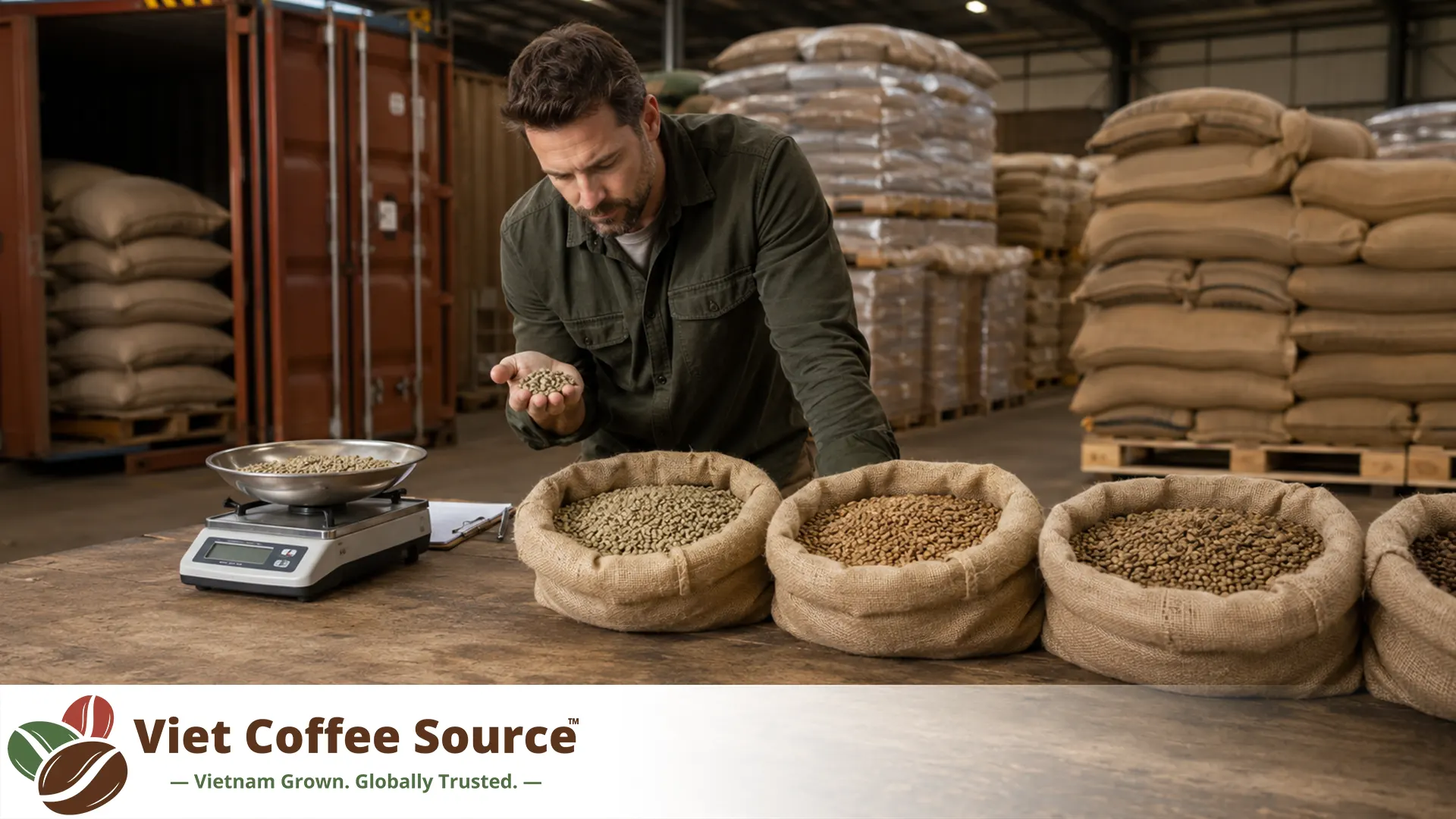
Wholesale Coffee Prices: What Determines the Cost of Coffee Beans?
Wholesale Coffee Prices: What Determines the Cost of Coffee Beans? explains the agricultural, quality, processing, commercial and logistical factors that shape the price paid by importers, roasters, distributors, manufacturers and private-label brands. Wholesale coffee prices cannot be evaluated accurately through a single price per kilogram because two coffees with the same species or country of origin may differ substantially in grade, screen size, defect level, crop period, processing method, cup profile, traceability, packaging and delivery terms.
A supplier’s quotation may refer to green coffee at origin, coffee delivered to a port, roasted beans packed for retail or a complete private-label product. Each format includes different costs and responsibilities. A quotation that appears inexpensive may exclude inland transport, export documents, liners, inspections, ocean freight or destination charges that are included in another offer.
Professional buyers should therefore compare complete specifications and landed-cost structures rather than only headline prices. The most commercially suitable coffee is not necessarily the cheapest product. It is the coffee that delivers the required quality, consistency, availability and operational performance at an acceptable total cost.
Understanding the components behind wholesale pricing also improves negotiations. When the buyer clearly defines species, origin, grade, volume, packaging, destination and shipment period, the supplier can prepare a more accurate and transparent proposal.
What does a wholesale coffee price include?
A wholesale coffee price may include only the coffee itself or a combination of production, preparation, packaging, documentation and transport services. The exact scope depends on the product format and delivery term.
The quotation may include:
- Farm-level coffee production
- Cherry purchasing or raw-material collection
- Processing and drying
- Dry milling and hulling
- Screening and grading
- Defect removal
- Quality control and cupping
- Warehouse storage
- Export packaging
- Inland transportation
- Documentation and customs preparation
- Container loading
- Ocean freight or other transport
- Roasting, grinding and retail packaging
Buyers should request a written breakdown of what is included and excluded before comparing quotations.
The difference between coffee price and landed cost
The quoted coffee price is only one part of the total amount paid to move the product into the buyer’s warehouse. Landed cost includes all expenses required to purchase, transport, clear and receive the coffee.
| Cost area | Possible components | Buyer consideration |
|---|---|---|
| Product cost | Coffee, processing, grading and supplier margin | Confirm the exact specification |
| Packaging | Jute bags, liners, hermetic materials, retail pouches and cartons | Compare material and net weight |
| Origin logistics | Warehouse handling, trucking, port movement and loading | Check whether included in the Incoterm |
| Documents | Certificates, inspection, fumigation and legalisation | Confirm destination requirements |
| International transport | Ocean, air, rail or road freight | Review validity and surcharges |
| Destination costs | Customs, duties, taxes, terminal charges and delivery | Estimate before ordering |
| Finance and risk | Bank charges, insurance, currency exposure and credit cost | Include in commercial comparison |
Coffee species strongly influences price
Robusta and Arabica have different cultivation requirements, supply structures, cup profiles and commercial applications. These differences influence wholesale pricing.
Robusta is widely used for:
- Commercial blends
- Espresso formulations
- Instant coffee
- Vietnamese phin coffee
- High-caffeine products
- Foodservice applications
Arabica is commonly used for:
- Specialty coffee
- Single-origin products
- Filter brewing
- Premium espresso
- Aromatic retail blends
Fine Robusta can command a higher price than standard commercial Robusta because it requires more selective harvesting, processing control, sorting, traceability and sensory quality. Similarly, commercial Arabica and specialty Arabica belong to very different price categories.
Origin and production region affect cost
The producing country and region influence labour, land, yield, infrastructure, processing capacity, climate risk and transportation cost. Even within one country, coffee from different provinces or elevations may carry different prices.
Regional price differences may result from:
- Farm elevation
- Climate and rainfall
- Yield per hectare
- Variety or cultivar
- Distance from mills and ports
- Availability of processing facilities
- Regional reputation
- Traceability level
- Local demand from exporters and roasters
Buyers sourcing from Vietnam can compare Vietnamese coffee regions and their production characteristics when selecting Robusta, Fine Robusta or Arabica supply.
Farm productivity and production cost
The farm’s production cost contributes to the base price of coffee. Labour, fertiliser, irrigation, equipment, land management and harvesting all affect the amount needed to produce one kilogram of exportable coffee.
Important production expenses include:
- Seedlings and replanting
- Fertiliser and soil management
- Irrigation
- Pruning
- Pest and disease control
- Harvest labour
- Farm equipment
- Cherry transport
- Environmental and social compliance
When yields decline because of weather, ageing trees, disease or reduced inputs, the production cost per kilogram can rise even if the farm’s total expenditure remains similar.
Harvesting method changes the price
Selective hand-picking generally costs more than strip harvesting or highly mechanised collection because workers must return to the same trees and choose ripe cherries. However, selective harvesting can improve sweetness, consistency and defect control.
| Harvest approach | Potential cost effect | Quality implication |
|---|---|---|
| Selective picking | Higher labour cost | Greater ripeness consistency |
| Strip picking | Lower collection cost | More mixed maturity levels |
| Mechanical harvesting | Equipment investment but lower labour dependence | Requires effective post-harvest sorting |
| Multiple harvest rounds | Higher operational cost | Improved cherry selection |
Processing method affects wholesale value
The processing method changes flavour, labour requirements, water use, drying time, risk and infrastructure needs. Washed, natural and honey coffees therefore may have different production costs even when they originate from the same region.
| Processing method | Main cost drivers | Potential cup direction |
|---|---|---|
| Washed | Water, pulping, fermentation control and wastewater management | Cleaner structure and clearer acidity |
| Natural | Drying space, turning labour, long drying period and defect control | Heavy body, fruit and sweetness |
| Honey | Careful pulping, mucilage control and managed drying | Caramel sweetness and rounded body |
| Controlled fermentation | Equipment, monitoring, lot separation and higher processing risk | Distinctive or intensified flavours |
A specialised process does not automatically guarantee a higher-quality cup. Buyers should evaluate whether the additional processing cost creates value for their target product.
Drying quality and moisture management
Proper drying protects coffee against mould, fermentation defects and instability during storage. Slow, controlled drying may require raised beds, patios, mechanical dryers, labour and additional warehouse time.
Drying costs can increase when:
- Rainfall interrupts sun drying
- Mechanical drying is required
- Lots are separated into small batches
- Coffee must be turned frequently
- Moisture is reduced gradually
- Quality staff monitor the drying curve
Coffee dried unevenly or stored at unsuitable moisture may be cheaper initially but can create quality losses, claims and roasting problems later.
Grade and defect level
Higher grades generally require more cleaning and sorting. The supplier may remove black, sour, broken, insect-damaged or immature beans through mechanical and manual processes.
The price can rise because of:
- Lower maximum defect count
- Reduced black-bean tolerance
- Lower broken-bean percentage
- Strict foreign-matter limits
- Improved colour sorting
- Additional hand selection
- Higher yield loss during preparation
When defective beans are removed, the supplier loses saleable weight. The remaining higher-quality coffee therefore carries more of the total production and preparation cost.
Screen size and bean uniformity
Screen size describes the physical dimensions of green coffee beans. Larger or more uniform beans may receive a premium because they require additional separation and may support more predictable roasting.
| Screen factor | Possible price effect | Reason |
|---|---|---|
| Larger screen | Potential premium | Lower percentage of the original lot may qualify |
| Narrow screen range | Higher preparation cost | More precise separation is required |
| Mixed screen | Potentially lower price | Less grading and broader commercial use |
| Guaranteed screen tolerance | Additional quality-control cost | Testing and documentation are required |
Screen size alone does not prove cup quality. It should be evaluated together with defects, density, moisture, origin and sensory performance.
Bean density and elevation
Coffee grown at higher elevations often develops more slowly and may become denser. Dense beans can tolerate different roasting approaches and may be associated with more complex flavour, especially in Arabica.
However, elevation is only one factor. Variety, climate, shade, nutrition, ripeness and processing also influence density and quality. Buyers should avoid paying a premium based on elevation claims without supporting specifications and samples.
Crop period and freshness
The harvest period affects availability, storage duration and sensory condition. Current-crop coffee may carry a premium when buyers value freshness and greater replacement potential.
Older crop coffee may be discounted when:
- Aroma has declined
- Colour has faded
- Moisture has changed
- The cup shows woody or baggy notes
- The supplier needs to release warehouse space
Older coffee is not automatically unusable. Correct storage and stable moisture can preserve commercial quality, but buyers should receive accurate crop information.
Seasonality and supply availability
Coffee availability changes throughout the crop cycle. Prices may differ before harvest, during peak supply and later in the season when preferred lots become limited.
Seasonal factors include:
- Harvest timing
- Export demand
- Warehouse stock
- Processing capacity
- Port congestion
- Availability of specific grades
- Competition between buyers
A buyer requiring a large volume outside the main supply period may face higher prices or greater variation between lots.
Weather and agricultural risk
Weather can affect production volume, bean development, harvesting and drying. Drought, excessive rainfall, storms, unusual temperatures and flowering disruption may reduce supply or lower quality.
Weather-related costs can appear through:
- Reduced farm yields
- Higher irrigation requirements
- Greater disease pressure
- Delayed harvesting
- Longer drying times
- More defects
- Lower availability of premium grades
Wholesale prices may therefore move before the full crop impact becomes visible because suppliers and buyers adjust their expectations.
Global market benchmarks and differentials
Many commercial coffee transactions are influenced by international benchmark markets. However, the final physical coffee price is not identical to the benchmark value.
A physical quotation may include:
- A benchmark component
- An origin differential
- A quality premium or discount
- Processing and preparation costs
- Packaging
- Financing
- Logistics
- Supplier margin
The differential reflects the relationship between the specific physical coffee and the broader market. It can change according to origin availability, grade, demand, shipment period and quality.
Currency movements
Coffee may be produced, processed, financed and sold using different currencies. Exchange-rate movements can therefore affect quotations even when the physical supply situation has not changed.
Currency exposure may influence:
- Farm-gate purchasing
- Export pricing
- Packaging materials
- Freight charges
- Banking expenses
- Supplier margins
Buyers should confirm the quotation currency, validity period and whether the supplier may revise the price before contract confirmation.
Financing and inventory cost
Coffee may remain in storage for months before shipment. During this period, the supplier finances the product, warehouse, insurance and quality protection.
Inventory cost may include:
- Capital tied up in stock
- Warehouse rent
- Insurance
- Handling
- Periodic quality checks
- Moisture and pest control
- Risk of market-price changes
- Risk of quality deterioration
Long reservation periods or delayed shipment may therefore increase the price or require a deposit.
Storage conditions and warehouse quality
Professional storage protects coffee from moisture, heat, pests, contamination and strong odours. Better warehouse management creates cost but reduces commercial risk.
Warehouse-related price factors include:
- Pallet use
- Ventilation
- Humidity monitoring
- Lot separation
- Pest management
- Security
- Stock rotation
- Traceability records
Premium and specialty lots may require more controlled storage and protective inner liners.
Cup quality and sensory score
Two coffees with similar physical specifications may have different prices because of their sensory performance. Cleanliness, sweetness, balance, body, acidity, aroma and aftertaste influence commercial value.
Premiums may be paid for:
- Clean cup quality
- Distinctive flavour notes
- High sweetness
- Balanced acidity
- Strong but refined body
- Long clean aftertaste
- Absence of phenolic, mouldy or fermented defects
- Consistency across samples
A sensory description should be connected to a representative sample and evaluation protocol rather than used only as marketing language.
Commercial Robusta and Fine Robusta
Commercial Robusta is generally priced around measurable physical requirements and broad cup suitability. Fine Robusta requires more control throughout harvesting, processing, drying, sorting and evaluation.
| Area | Commercial Robusta | Fine Robusta |
|---|---|---|
| Harvesting | Broader ripeness range may be accepted | Greater emphasis on ripe-cherry selection |
| Processing | Volume and efficiency focused | More controlled and lot-specific |
| Defects | Commercial tolerance | Lower tolerance and additional sorting |
| Traceability | May be regional or warehouse based | Usually more detailed |
| Cup profile | Strong body and commercial consistency | Cleaner sweetness and greater complexity |
| Price | Generally more accessible | Higher due to selection and quality control |
Commercial Arabica and specialty Arabica
Arabica pricing also covers a broad range. Commercial Arabica may be purchased for blends and large-scale retail products, while specialty Arabica may be priced according to traceability, sensory quality, producer identity and limited availability.
Specialty premiums can reflect:
- Farm or producer separation
- Specific variety
- High elevation
- Selective harvesting
- Small-lot processing
- Distinctive cup quality
- Independent evaluation
- Limited volume
Traceability level
Traceability has a cost because lots must be separated, coded, recorded and connected to origin and processing information. A broadly blended regional lot may cost less than a farm-specific product with detailed records.
Traceability may be provided at:
- Country level
- Region level
- District level
- Cooperative level
- Mill level
- Farm level
- Plot or producer level
The buyer should request only the level needed for the product, destination and marketing claim because deeper traceability requires additional administration and supply-chain control.
Certification and verified programmes
Certified coffee may carry additional cost because farms, processors, warehouses and exporters must meet programme requirements, maintain records and complete audits.
Certification-related costs may include:
- Audit fees
- Internal inspections
- Training
- Record keeping
- Lot segregation
- Chain-of-custody management
- Certificate administration
- Lower available volume
A certificate should be checked for validity, scope and applicability to the offered lot. Buyers can review coffee quality, traceability and compliance considerations when defining documentation requirements.
Sustainability and due-diligence requirements
Some buyers require farm data, environmental records, social information, geolocation or deforestation-risk documentation. Collecting, verifying and managing this information creates additional supply-chain costs.
The price impact depends on:
- Number of farms in the supply base
- Depth of data required
- Verification method
- Need for mapping or field visits
- Frequency of updates
- Lot-segregation requirements
Buyers should communicate these requirements before requesting a final quotation.
Order volume and economies of scale
Large orders can reduce the cost per kilogram because fixed expenses are distributed over more coffee. However, a very large order may also require the supplier to combine several lots or purchase additional stock.
| Order size | Potential advantage | Possible limitation |
|---|---|---|
| Small trial order | Lower commitment and easier evaluation | Higher unit cost |
| Partial-container order | Moderate flexibility | Shared-container and handling costs |
| Full-container order | Better logistics efficiency | Higher inventory commitment |
| Multi-container programme | Potential volume pricing and planning | Requires forecasting and consistency control |
Volume discounts should not be evaluated without confirming whether the quality specification remains identical at the higher quantity.
Minimum order quantity
The minimum order quantity reflects production efficiency, lot size, packaging setup and administrative cost. It may differ for green coffee, roasted beans, ground coffee and private-label products.
MOQ can be affected by:
- Available lot size
- Minimum milling run
- Minimum roasting batch
- Printed packaging quantity
- Number of product variants
- Number of language versions
- Container-loading efficiency
Trial orders and small-volume premiums
Small orders often carry a higher unit price because the supplier must complete sampling, preparation, paperwork and handling for less total volume.
A trial-order premium may cover:
- Separate lot preparation
- Small-batch roasting
- Manual packing
- Partial pallet handling
- Less efficient freight
- Additional administrative work
The buyer should determine whether a higher first-order price is acceptable in exchange for reduced purchasing risk.
Packaging material
Packaging can make a significant difference to wholesale cost. Standard jute sacks, lined bags, hermetic liners, vacuum packs and retail pouches provide different levels of protection and branding.
| Packaging format | Relative cost direction | Main value |
|---|---|---|
| Standard jute bag | Lower | Basic export handling |
| Jute bag with liner | Moderate | Improved moisture and odour protection |
| Hermetic liner | Higher | Greater quality protection |
| Vacuum packaging | Higher | Reduced oxygen exposure |
| Printed retail pouch | Significantly higher | Consumer-ready presentation |
Bag weight and packing configuration
The same coffee can produce different unit costs when packed in different bag sizes. Smaller bags require more packaging material, closures, labels and handling per tonne.
Cost considerations include:
- Net weight per bag
- Bag material
- Inner liner
- Printing
- Lot marking
- Palletisation
- Number of bags per container
- Manual handling requirements
Custom and private-label packaging
Custom packaging introduces design, printing, setup and inventory costs. Private-label buyers should separate coffee cost from packaging-development cost.
Customisation may require:
- Artwork preparation
- Printing plates or setup
- Minimum packaging quantities
- Colour matching
- Mock-ups and proofs
- Labels in multiple languages
- Custom cartons
- Storage of unused packaging
Low-volume private-label orders often have a much higher packaging cost per unit than large programmes.
Roasting cost
When the supplier provides roasted coffee, the quotation must include roasting loss, energy, labour, quality control and equipment use. Green coffee loses weight during roasting, so one kilogram of green coffee does not produce one kilogram of roasted coffee.
Roasting cost is influenced by:
- Batch size
- Roast level
- Energy consumption
- Production efficiency
- Blend complexity
- Quality-control frequency
- Required roast consistency
- Cooling and degassing time
Darker roasting may create greater weight loss, while small custom batches may be less efficient than standard production runs.
Grinding cost
Ground coffee requires additional equipment, labour and quality control. It also needs stronger packaging protection because aroma declines more quickly after grinding.
The cost depends on:
- Target grind size
- Particle-distribution tolerance
- Production volume
- Cleaning between products
- Risk of cross-contamination
- Packaging speed
- Required oxygen control
Instant coffee production
Instant coffee pricing reflects more than the green-coffee input. Extraction, concentration, drying, agglomeration, aroma recovery and packaging all contribute to the finished cost.
Important price factors include:
- Robusta and Arabica composition
- Extraction yield
- Spray-dried or freeze-dried technology
- Particle size
- Bulk density
- Aroma addition
- Agglomeration
- Packaging format
Freeze-dried coffee usually requires a more complex production process than spray-dried coffee, while three-in-one products also include creamer, sugar and blending costs.
Quality-control and laboratory costs
Professional suppliers test physical and sensory quality before shipment. More detailed testing and third-party verification can increase the quotation.
Quality-control costs may cover:
- Sampling
- Moisture testing
- Screen analysis
- Defect counting
- Sample roasting
- Cupping
- Water-activity testing
- Microbiological analysis
- Residue or contaminant testing
- Independent inspection
Testing should be appropriate to the product and destination rather than added without a clear commercial need.
Pre-shipment sample approval
A pre-shipment sample provides additional protection but creates sampling, courier and scheduling costs. Delayed approvals can also increase storage and container-booking expenses.
The buyer should define:
- Who draws the sample
- How much is sent
- Who pays courier charges
- How quickly approval must be given
- What happens after rejection
- Whether reprocessing is possible
Export documentation
Document costs depend on the product, origin, destination and contractual requirements. Standard documents may be included, while special certifications or legalisation may be charged separately.
Possible documents include:
- Commercial invoice
- Packing list
- Certificate of origin
- Phytosanitary certificate
- Fumigation certificate
- Quality certificate
- Weight certificate
- Inspection certificate
- Bill of lading
- Health or analysis certificates
Incoterm and delivery responsibility
The same coffee can have very different quoted prices depending on the Incoterm. Buyers should never compare offers with different delivery responsibilities without adjustment.
| Pricing area | Possible seller responsibility | Buyer action |
|---|---|---|
| Ex-warehouse or origin | Product prepared at the seller’s location | Add transport and export expenses |
| Port-delivered arrangement | Origin transport and export handling may be included | Confirm exact delivery point |
| Freight-included arrangement | International freight may be included | Check destination exclusions |
| Insurance-included arrangement | Cargo insurance may be included | Review coverage and claim terms |
| Delivered arrangement | More transport stages may be included | Confirm customs, duties and unloading |
Inland transportation
Coffee may travel from farms to collection centres, mills, warehouses and ports. The cost depends on distance, road conditions, fuel, truck availability and shipment size.
Inland logistics can be higher when:
- The origin is remote
- Road access is difficult
- Lots are transported separately
- Truck capacity is underutilised
- Multiple warehouses are involved
- Special handling is required
Ocean freight and transport conditions
International freight can represent a significant portion of landed cost. Rates vary by route, container availability, season, fuel, port congestion and carrier conditions.
Freight quotations should clarify:
- Port of loading
- Port of destination
- Container size
- Full or shared container
- Transshipment
- Rate validity
- Surcharges
- Free-time conditions
- Estimated transit time
Buyers can review coffee packaging, export-documentation and shipping solutions when calculating the complete supply cost.
Full-container and less-than-container shipments
A full-container shipment usually offers better cost efficiency per kilogram because the buyer uses the entire container. Smaller shared shipments can reduce inventory commitment but increase handling and freight cost per unit.
| Shipment type | Advantage | Cost consideration |
|---|---|---|
| Full container | Efficient loading and lower unit freight | Requires larger purchase volume |
| Shared container | Lower inventory commitment | Additional handling and consolidation |
| Air freight | Fast delivery for samples or urgent goods | Very high unit transport cost |
| Road or rail | Useful for regional trade | Depends on route and border procedures |
Container protection and loading materials
Moisture absorbers, container liners, pallets and protective materials add cost but reduce the risk of condensation, contamination and damaged packaging.
Protection may include:
- Container inspection
- Drying and cleaning
- Moisture absorbers
- Floor protection
- Wall liners
- Pallets
- Load securing
- Loading supervision
Insurance
Cargo insurance protects against specified transit risks. Its cost depends on shipment value, route, product, coverage and claims history.
The buyer should confirm:
- Who arranges insurance
- What risks are covered
- Where coverage begins and ends
- How claims are submitted
- Which documents are required
- Whether quality deterioration is covered
Payment terms and credit cost
Payment structure can affect price. A supplier receiving full payment before production carries less financial risk than one offering extended credit after shipment.
Price differences may reflect:
- Advance-payment percentage
- Time until balance payment
- Letter-of-credit expenses
- Bank charges
- Credit insurance
- Buyer risk
- Financing duration
Longer payment terms may increase the price because the supplier must finance coffee, production and logistics for a longer period.
Quotation validity
Coffee, freight and currency conditions can change. Suppliers therefore normally limit how long a quotation remains valid.
The buyer should confirm:
- Quotation expiry date
- Required order-confirmation date
- Deposit deadline
- Whether freight is fixed or estimated
- Whether currency changes can alter the price
- Whether the lot remains reserved
Supplier margin and service level
The supplier’s margin supports sourcing, staff, quality control, communication, risk management and operational service. The lowest margin does not always create the best purchasing result.
A higher-priced supplier may provide:
- More reliable specifications
- Faster communication
- Better lot traceability
- Stronger quality control
- More accurate documents
- Better claims handling
- Greater consistency across shipments
- Private-label development support
The buyer should determine whether the service difference creates measurable operational value.
Spot purchases and supply programmes
A spot purchase covers a specific available lot, while a supply programme may include repeated deliveries over several months. These approaches involve different price and risk structures.
| Purchase model | Potential advantage | Potential risk |
|---|---|---|
| Spot purchase | Access to currently available coffee | Limited repeatability |
| Fixed-volume programme | Improved supply planning | Inventory or commitment risk |
| Periodic call-off programme | Flexible shipment scheduling | Storage and financing cost |
| Long-term partnership | Product consistency and development support | Requires forecasting and contract management |
Fixed and variable pricing
A contract may fix the total price immediately or use a structure in which part of the price is determined later. Each approach creates different market exposure.
The contract should explain:
- Which component is fixed
- Which component may change
- When the price becomes final
- Which benchmark or formula is used
- Who chooses the fixing date
- How currency and freight changes are handled
Custom blends and formulation work
A custom blend may cost more than a standard product because the supplier must source components, conduct trials, roast samples and manage additional stock.
Blend-development cost can include:
- Sample selection
- Formulation trials
- Roast testing
- Cupping
- Application testing
- Reference-sample preparation
- Separate inventory
- Change-control records
Product consistency and replacement planning
Maintaining the same flavour across changing crops may require blending, stricter purchasing or holding additional stock. This consistency has commercial value and cost.
A supplier may need to:
- Reserve larger volumes
- Blend several lots
- Maintain reference samples
- Conduct repeated cupping
- Adjust roast profiles
- Seek replacement lots with similar characteristics
Quality claims and risk allowance
The contract’s inspection and claims terms can influence price. A supplier accepting strict tolerances, independent inspection and replacement obligations carries more risk.
Risk-related price factors include:
- Narrow specification tolerances
- Destination inspection
- Replacement commitments
- Long claims periods
- Sensory guarantees
- Penalties for delay
- Return or discount obligations
How to compare two wholesale coffee quotations
Quotations should be normalised before a decision is made. The buyer should create a comparison based on the same quantity, specification, packaging, Incoterm and destination.
| Comparison category | Quotation A | Quotation B |
|---|---|---|
| Species and origin | Confirm exact product | Confirm exact product |
| Grade and defects | Record guaranteed limits | Record guaranteed limits |
| Screen and moisture | Compare tolerance | Compare tolerance |
| Cup profile | Evaluate representative sample | Evaluate representative sample |
| Crop and availability | Confirm quantity | Confirm quantity |
| Packaging | List bag and liner | List bag and liner |
| Delivery term | Identify included logistics | Identify included logistics |
| Payment | Calculate finance impact | Calculate finance impact |
| Total landed cost | Add excluded expenses | Add excluded expenses |
Questions to ask about a wholesale coffee price
- Which exact species and origin does the price cover?
- Which crop period is included?
- What processing method was used?
- Which grade and defect limits are guaranteed?
- What screen size and moisture range apply?
- Is the cup profile guaranteed or descriptive?
- Is the sample drawn from the exact commercial lot?
- How much of the lot is available?
- What quantity is assumed in the quotation?
- Which packaging and liner are included?
- Which documents are included?
- Which Incoterm applies?
- Which port or delivery point is used?
- Is freight fixed or estimated?
- How long is the quotation valid?
- What payment terms apply?
- Are inspection costs included?
- What happens if the shipment fails specification?
Common reasons one quotation is cheaper
A lower price may result from legitimate efficiency or from a lower specification. Buyers should identify the reason before choosing.
- Broader defect tolerance
- Mixed screen sizes
- Older crop
- Lower traceability
- Standard packaging without liner
- Larger order volume
- Shorter storage period
- Fewer included documents
- Different Incoterm
- Freight excluded
- Higher advance payment
- Less quality-control work
- Greater lot availability
When paying more can reduce total cost
A higher product price may reduce total commercial cost if the coffee creates better roasting yield, fewer defects, lower complaint rates and greater consistency.
Potential savings may come from:
- More uniform roasting
- Lower sorting loss
- Fewer rejected batches
- Stronger consumer acceptance
- Reduced blend adjustment
- Lower quality-control workload
- Fewer claims
- Better repeat-order consistency
Warning signs in unusually low quotations
An unusually low price should be investigated carefully. It does not automatically indicate a problem, but the buyer should verify whether important costs or quality requirements have been omitted.
- The offered grade is not clearly defined
- The sample is not connected to an available lot
- The crop period is missing
- Moisture and defects are not guaranteed
- Packaging is described only as export standard
- The Incoterm is unclear
- Freight and destination costs are excluded without explanation
- The quotation has no validity period
- Independent inspection is refused
- The supplier cannot provide draft documents
- Payment is requested before basic verification
How to reduce wholesale coffee cost without reducing quality
Buyers can improve cost efficiency by adjusting commercial and operational requirements rather than lowering the core quality specification.
Possible strategies include:
- Order full-container quantities
- Use standard bag sizes
- Limit unnecessary packaging customisation
- Plan purchases earlier
- Combine forecasted shipments
- Define realistic screen tolerances
- Use a consistent annual specification
- Approve equivalent replacement lots
- Reduce urgent air shipments
- Standardise documents and labels
- Negotiate a supply programme
How to prepare a useful request for quotation
A detailed request for quotation allows suppliers to price the same requirement and reduces revisions.
The request should include:
- Species
- Preferred origin
- Processing method
- Grade
- Screen size
- Maximum defects
- Moisture range
- Cup expectations
- Crop preference
- Order quantity
- Packaging
- Destination
- Preferred Incoterm
- Shipment period
- Required documents
- Payment preference
Wholesale coffee cost checklist
| Category | Information to confirm |
|---|---|
| Product | Species, origin, variety, crop and processing |
| Physical specification | Grade, defects, screen, moisture and foreign matter |
| Sensory specification | Cup profile, evaluation method and approved sample |
| Volume | MOQ, lot availability and repeat supply |
| Packaging | Bag type, liner, net weight, printing and pallets |
| Compliance | Traceability, certificates and destination requirements |
| Commercial terms | Price basis, validity, currency and payment |
| Logistics | Incoterm, port, freight, container and transit |
| Quality protection | Samples, inspections, tolerances and claims |
| Landed cost | All origin, freight, customs and delivery expenses |
Final assessment
Wholesale coffee prices are determined by the complete combination of species, origin, harvest, processing, grade, defects, screen size, moisture, cup quality, traceability, certification, order volume, packaging, payment terms and logistics. A price per kilogram cannot be evaluated correctly without knowing which product and services it includes.
Buyers should separate the coffee’s base value from preparation, packaging, documents, freight and destination costs. They should also distinguish between a cheaper specification and genuine supplier efficiency.
The best purchasing decision is based on total commercial performance rather than the lowest headline price. A coffee that costs more but roasts consistently, produces fewer defects, matches the approved sample and arrives with accurate documents may offer a lower overall business cost.
Importers, roasters, distributors, manufacturers and private-label brands seeking Vietnamese Robusta, Fine Robusta, Arabica or custom coffee products can submit a wholesale coffee inquiry with the required species, origin, grade, processing method, quality specifications, packaging, quantity, destination and preferred shipment period.