
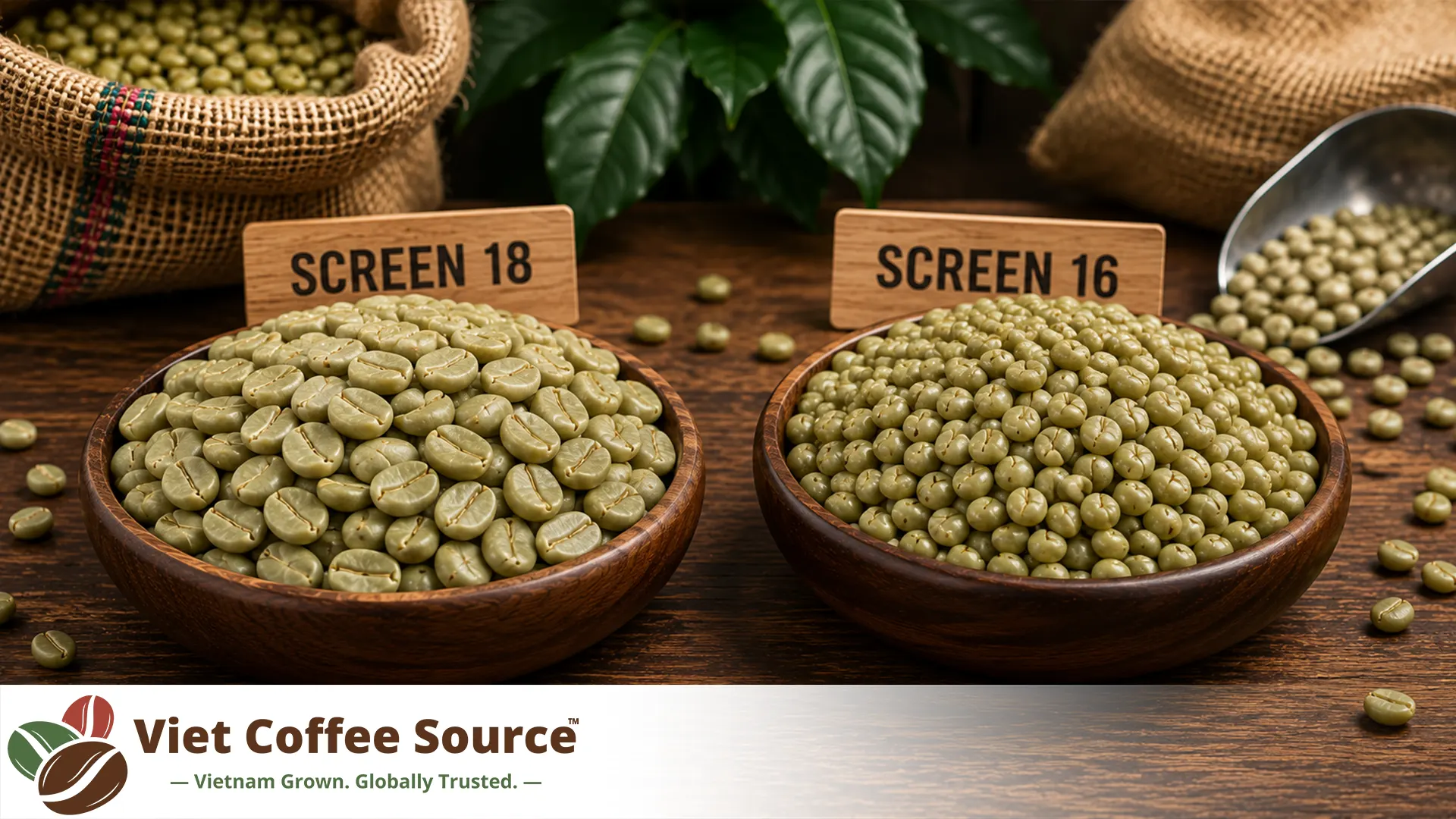
Screen 18 vs Screen 16 Coffee Beans: What Is the Difference?
Screen 18 vs Screen 16 Coffee Beans: What Is the Difference? explains how green coffee beans are classified by physical size and why the distinction matters to importers, roasters, wholesalers, private-label brands and industrial buyers. Screen size does not directly measure flavour or overall quality, but it affects purchasing specifications, sorting accuracy, roast consistency, visual appearance, density distribution, yield expectations and the final commercial value of a lot.
Screen 18 coffee consists mainly of larger beans retained above a screen with holes measuring approximately 18/64 of an inch, while Screen 16 coffee is generally retained above holes measuring approximately 16/64 of an inch. In metric terms, Screen 18 corresponds to roughly 7.14 millimetres and Screen 16 to roughly 6.35 millimetres. The exact percentage retained on each screen, the permitted undersize tolerance and the terminology used in contracts may differ between origins and suppliers.
For a buyer, the practical question is not simply whether Screen 18 is better than Screen 16. The correct choice depends on the intended product, roast system, target market, quality positioning, price level and required uniformity. A well-prepared Screen 16 lot can outperform a poorly sorted Screen 18 lot, while a consistent Screen 18 specification may justify a premium for premium retail, export programmes or customers who value large and visually uniform beans.
What does coffee screen size mean?
Coffee screen size is a physical grading method used to separate green coffee beans according to width. The beans pass over or through metal screens containing round holes of standardised dimensions. Each screen number represents the hole diameter in sixty-fourths of an inch.
| Screen number | Hole diameter in inches | Approximate diameter in millimetres |
|---|---|---|
| Screen 18 | 18/64 inch | 7.14 mm |
| Screen 17 | 17/64 inch | 6.75 mm |
| Screen 16 | 16/64 inch | 6.35 mm |
| Screen 15 | 15/64 inch | 5.95 mm |
| Screen 14 | 14/64 inch | 5.56 mm |
When a supplier describes coffee as Screen 18, the specification normally means that most beans are retained on an 18 screen or fall within an agreed large-bean range. A Screen 16 specification normally refers to beans retained on a 16 screen, sometimes with a defined proportion of Screen 17 or Screen 18 beans included.
How screen grading is performed
Green coffee is placed into a mechanical or laboratory screen grader. The machine separates beans using screens arranged from larger holes to smaller holes. Larger beans remain on the upper screens, while smaller beans fall through to lower levels.
A typical grading process may include:
- A representative sample is taken from the lot.
- The sample is weighed before screening.
- The beans are placed into a screen set.
- The screens are shaken for a controlled period.
- The coffee retained on each screen is collected.
- Each fraction is weighed separately.
- The percentage distribution is calculated.
- The result is compared with the contractual specification.
Reliable testing requires representative sampling. A result based on coffee taken from only one bag or one part of a container may not accurately describe the complete shipment.
The main difference between Screen 18 and Screen 16
The primary difference is bean width. Screen 18 beans are physically larger than Screen 16 beans. This difference can affect appearance, sorting cost, roasting behaviour and price, but it does not automatically determine cup quality.
| Factor | Screen 18 | Screen 16 |
|---|---|---|
| Bean size | Larger | Medium to large |
| Typical visual positioning | Premium and highly uniform | Commercial or premium depending on preparation |
| Sorting requirement | More selective | Less restrictive |
| Availability | Generally lower | Generally higher |
| Price tendency | Often carries a premium | Usually more cost-efficient |
| Roasting flexibility | Suitable for larger-bean programmes | Suitable for broad commercial use |
| Common buyer focus | Appearance, consistency and premium positioning | Value, availability and reliable performance |
Is Screen 18 always higher quality?
No. Screen size is only one physical characteristic. A large bean can still contain defects, excessive moisture, insect damage, poor processing, off-odours or undesirable cup characteristics. A smaller bean can be clean, dense, well processed and excellent in the cup.
Overall green-coffee quality should also consider:
- Origin
- Variety
- Processing method
- Defect count
- Moisture
- Water activity
- Density
- Colour
- Foreign matter
- Crop year
- Storage condition
- Cup profile
- Traceability
Screen 18 may represent a higher physical grade when the lot is carefully sorted, but it should never replace sensory evaluation and a complete quality specification.
Why larger beans often cost more
Larger beans are usually less abundant within a crop. Producing a Screen 18 lot requires the exporter to remove smaller beans and create a more selective fraction. This reduces the available yield from the original unsorted coffee and increases preparation costs.
The Screen 18 premium may reflect:
- Lower percentage of large beans in the crop
- Additional mechanical sorting
- More colour sorting
- Higher rejection volume
- Greater visual uniformity
- Specific buyer demand
- Premium retail positioning
- More restrictive contract tolerances
The price difference is therefore partly a result of preparation economics rather than a guarantee of better flavour.
Does bean size affect flavour?
Bean size can be associated with variety, altitude, growing conditions and cherry development, but it does not independently define flavour. Two coffees with the same screen size can taste very different because of origin, processing, storage and roasting.
Screen size can influence flavour indirectly by affecting roast uniformity. When a lot contains beans with widely different sizes, smaller beans may roast faster while larger beans require more energy. This can produce uneven development, scorched small beans or underdeveloped large beans if the roast profile is not adjusted correctly.
A narrow size distribution helps a roaster apply energy more consistently across the batch. This may improve repeatability, but the sensory result still depends on the quality of the raw material and the roast design.
Screen size and bean density
Size and density are different measurements. A large bean is not necessarily denser than a smaller bean. Density reflects internal structure and is influenced by variety, altitude, maturation, moisture and processing.
A buyer may encounter:
- Large but relatively soft beans
- Small but dense beans
- Large and dense high-quality beans
- Mixed-density lots within the same screen range
Roast development is affected by both dimensions. Screen size helps describe external dimensions, while density provides information about how the bean may absorb and transfer heat.
Screen size and roasting consistency
Uniform screen size can simplify roast control because beans of similar dimensions tend to respond to heat more consistently. A broad mixture of Screen 18, Screen 16 and smaller beans may require more careful profile management.
Potential advantages of a narrow screen range include:
- More even heat penetration
- More consistent colour development
- Lower risk of small beans scorching
- Lower risk of large beans remaining underdeveloped
- More repeatable production batches
- Improved visual uniformity after roasting
However, roasters can successfully process mixed screen distributions when they understand the coffee and design the roast accordingly.
How Screen 18 behaves during roasting
Screen 18 beans may require slightly different energy management because of their larger physical dimensions. Heat must reach the centre of the bean without overdeveloping the exterior.
Depending on density and moisture, a roaster may consider:
- Charge temperature
- Initial energy application
- Rate of rise
- Airflow
- Time to first crack
- Development time
- Final colour target
Large beans should not automatically be roasted longer. The correct profile depends on the full physical and chemical condition of the coffee.
How Screen 16 behaves during roasting
Screen 16 coffee is widely used by commercial and specialty roasters. Its medium-to-large size can provide reliable roast performance and broad flexibility across espresso, filter and blended products.
When the lot is well prepared, Screen 16 can offer:
- Good batch consistency
- Efficient heat transfer
- Competitive raw-material cost
- Strong availability
- Flexibility for blending
- Suitable appearance for many retail products
A roaster should still examine the complete screen distribution because a Screen 16 contract may allow smaller beans within a specified tolerance.
Screen distribution matters more than the headline grade
A label such as Screen 18 or Screen 16 does not always describe every bean in the bag. Commercial contracts usually permit a defined percentage of beans above or below the principal screen.
For example, two suppliers may both offer Screen 18 coffee, but one lot may contain a very high proportion retained on Screen 18 while another may contain more Screen 17 beans within tolerance. Both may technically meet their respective contracts, but their visual uniformity and roast behaviour can differ.
Buyers should request a complete screen analysis showing:
- Percentage above Screen 18
- Percentage retained on Screen 18
- Percentage retained on Screen 17
- Percentage retained on Screen 16
- Percentage below the minimum screen
Typical commercial specification language
A clear contract should describe the exact retention requirement rather than using only a general product name.
Examples of useful specification language include:
- Minimum percentage retained on Screen 18
- Maximum percentage below Screen 18
- Minimum percentage retained on Screen 16
- Maximum undersize tolerance
- Permitted screen range
- Testing method
- Sample size
- Inspection location
The buyer and seller should also agree whether the screen result is calculated by weight and which recognised testing method will be used.
Screen 18 in Vietnamese Robusta trade
Vietnamese Screen 18 Robusta is commonly purchased by buyers seeking large beans, strong physical uniformity and premium presentation. It may be supplied as standard commercial Robusta, polished coffee, wet-polished coffee, washed Robusta or part of a customised preparation.
Screen 18 Vietnamese Robusta can be suitable for:
- Premium commercial espresso blends
- Large-bean retail products
- Private-label whole-bean coffee
- Customers with strict visual requirements
- Roasters requiring a narrow size range
- Markets where bean appearance influences purchasing
Buyers can review Vietnamese coffee origins and regional sourcing options before selecting a grade.
Screen 16 in Vietnamese Robusta trade
Vietnamese Screen 16 Robusta is a widely traded commercial grade offering a balance between bean size, availability and price. It can support high-volume roasting, espresso blends, filter products, private-label programmes and industrial processing.
Screen 16 may be suitable for:
- Commercial espresso blends
- Foodservice coffee
- Mainstream retail products
- Large-volume roasting
- Cost-controlled private-label programmes
- Soluble-coffee production when other parameters are suitable
Its broader availability can make Screen 16 easier to source consistently across repeated shipments.
Visual differences after roasting
After roasting, Screen 18 beans generally create a larger and more visually impressive appearance. This may matter when the product is sold as whole bean in transparent or partially visible packaging.
Screen 16 beans are slightly smaller but can still present a uniform and attractive product when properly sorted. For ground coffee, instant coffee or opaque packaging, the visual difference may have limited value to the final customer.
Businesses should therefore avoid paying for an appearance premium that their customer will never see unless the larger size also supports production or quality requirements.
Which size is better for espresso?
Both Screen 18 and Screen 16 can perform well in espresso. The result depends more on density, roast profile, blend composition, grind control and extraction than on size alone.
Screen 18 may be selected when the roaster wants:
- Large and uniform beans
- Premium whole-bean presentation
- Controlled roast consistency
- A differentiated product specification
Screen 16 may be selected when the roaster wants:
- Reliable commercial performance
- Better cost control
- Greater supply availability
- Flexibility in high-volume blends
Which size is better for filter coffee?
Screen size alone does not determine suitability for filter brewing. Clean cup quality, sweetness, aroma, acidity, processing and roast development are more important.
A high-quality Screen 16 lot can produce a better filter cup than an ordinary Screen 18 lot. Buyers should evaluate representative samples using the intended brewing method rather than relying on physical grade alone.
Which size is better for Vietnamese phin coffee?
Both grades can be used for Vietnamese phin coffee. Robusta intended for phin is often selected for body, intensity, bitterness and compatibility with condensed milk or sugar.
Screen 16 can provide strong commercial value and consistent availability. Screen 18 may support premium positioning, especially when the coffee is sold as whole bean or marketed around large selected beans.
Which size is better for soluble coffee?
For soluble-coffee manufacturing, screen size is usually less important than extraction yield, moisture, defect level, flavour intensity, soluble solids, density and process consistency.
A manufacturer may prefer Screen 16 or a broader commercial grade if it delivers the required industrial performance at a lower cost. Purchasing Screen 18 for a process that destroys the visible form of the bean may not provide sufficient economic value unless the larger size is associated with another required quality characteristic.
Which size is better for private-label coffee?
The choice depends on the private-label positioning. Screen 18 can support a premium whole-bean product with strong visual appeal. Screen 16 may be more appropriate for mainstream retail, foodservice or price-sensitive programmes.
| Private-label objective | Potentially suitable grade | Reason |
|---|---|---|
| Premium whole-bean line | Screen 18 | Larger and more uniform presentation |
| Mainstream retail coffee | Screen 16 | Balanced appearance, supply and cost |
| Ground coffee | Screen 16 or approved mixed range | Bean appearance disappears after grinding |
| Foodservice blend | Screen 16 | Good availability and commercial efficiency |
| Premium origin-focused product | Screen 18 or selected Screen 16 | Final choice should follow cup and quality approval |
Companies can examine wholesale, OEM, private-label and packaging solutions when planning the final product.
Does Screen 18 produce more coffee after roasting?
Screen size does not automatically determine roasting yield. Weight loss during roasting depends mainly on moisture, roast degree, density and the roast profile.
Two lots with different screen sizes may produce similar or different yields depending on:
- Initial moisture
- Target roast colour
- Development time
- Bean density
- Defect removal
- Production losses
Buyers should calculate actual roasted yield through production trials rather than assume larger beans create more finished coffee.
How screen size affects bulk density
Larger beans can occupy container or packaging volume differently from smaller beans. However, bulk density is influenced by bean shape, internal density, moisture and how efficiently the beans settle.
This can affect:
- Bag filling
- Warehouse volume
- Roaster batch loading
- Packaging fill level
- Volumetric dosing
- Container planning
Industrial buyers should verify both net weight and volumetric behaviour when changing specifications.
Price comparison
Screen 18 usually trades at a premium over Screen 16 when origin, processing, defect count and other conditions are equivalent. The exact difference changes according to crop availability, buyer demand, export competition and sorting costs.
The premium may widen when:
- Large beans are scarce
- Premium retail demand is strong
- Sorting yields are low
- Buyers request strict undersize tolerances
- High-quality Screen 18 inventory is limited
The premium may narrow when the crop contains a larger proportion of big beans or when buyers prioritise cost over visual grade.
Should a buyer always pay the Screen 18 premium?
No. The premium should be justified by a measurable commercial benefit.
Screen 18 may justify the additional cost when:
- The product is sold as visible whole bean
- Customers require large beans
- The brand uses size as part of its premium positioning
- The roaster needs a narrow and uniform size range
- A contractual customer specification requires Screen 18
Screen 16 may be more commercially efficient when:
- The coffee will be ground
- The product is used in a blend
- The customer prioritises cup performance over appearance
- Large recurring volumes are required
- Price competitiveness is important
Defect count remains essential
A large-bean lot with a high defect count can perform worse than a smaller-bean lot prepared to a cleaner standard. Screen grading does not remove every defect because some defective beans may still be physically large.
Buyers should separately specify limits for:
- Black beans
- Sour beans
- Broken beans
- Insect-damaged beans
- Shells
- Foreign matter
- Sticks and stones
- Mould-related defects
Defect analysis and screen analysis should be treated as separate quality-control activities.
Moisture and water activity
Moisture influences storage stability, roasting performance and weight. Screen 18 and Screen 16 coffees should both comply with an agreed moisture range.
Excessive moisture can increase:
- Mould risk
- Weight-related disputes
- Uneven roasting
- Storage instability
- Container condensation risk
Very low moisture can indicate ageing or excessive drying and may affect roast behaviour. Water activity can provide additional information about microbial stability and moisture availability.
Colour sorting and visual preparation
Mechanical screen grading separates by size but not by colour. Premium preparation may also require optical colour sorting to remove discoloured, black, pale, insect-damaged or otherwise abnormal beans.
A high-quality Screen 18 programme may therefore include:
- Size grading
- Density separation
- Destoning
- Colour sorting
- Manual inspection
- Final metal detection
The same preparation processes can also be applied to Screen 16 when the buyer requires a cleaner commercial or premium grade.
Polished and wet-polished coffee
Polishing removes part of the silver skin from the surface of green beans and creates a cleaner, smoother appearance. Wet polishing involves moisture and mechanical friction and is used in some commercial markets.
Screen size and polishing are separate characteristics. A product may be:
- Screen 18 unpolished
- Screen 18 polished
- Screen 18 wet-polished
- Screen 16 unpolished
- Screen 16 polished
- Screen 16 wet-polished
The buyer should specify both size and surface preparation when requesting a quotation.
Washed, natural and honey processing
Processing method influences flavour, colour, cleanliness and physical appearance. Screen size does not indicate whether coffee is natural, washed or honey processed.
A complete specification should therefore state:
- Processing method
- Screen requirement
- Defect tolerance
- Moisture range
- Cup expectation
- Packaging
- Crop year
Comparing Screen 18 natural Robusta with Screen 16 washed Robusta based only on size would ignore major processing differences.
Sampling before purchase
Buyers should request a representative sample before approving either grade. The sample should match the lot that will be shipped rather than serve only as a general type sample.
The approval process may include:
- Confirm the sample code and lot reference.
- Measure screen distribution.
- Check moisture and water activity.
- Conduct defect analysis.
- Assess odour and appearance.
- Roast a representative batch.
- Cup or brew the coffee.
- Compare it with the approved specification.
- Retain a sealed reference sample.
Pre-shipment inspection
A pre-shipment inspection can confirm that the prepared lot matches the approved contract before loading.
The inspection may verify:
- Screen distribution
- Defect count
- Moisture
- Foreign matter
- Bag condition
- Markings
- Net weight
- Container cleanliness
- Odour
- Representative cup quality
These controls should be part of a documented quality, compliance and traceability programme.
How to write the purchase specification
A professional purchase specification should avoid vague descriptions such as large beans or export quality.
It should include:
- Product name
- Origin
- Crop year
- Screen retention percentage
- Maximum undersize percentage
- Defect limits
- Moisture range
- Foreign-matter limit
- Processing method
- Polishing status
- Packaging type
- Net weight
- Required certificates
- Sampling method
- Claim procedure
A complete specification protects both buyer and seller by reducing differences in interpretation.
Common mistakes when buying by screen size
- Assuming larger beans always taste better
- Ignoring the complete screen distribution
- Not defining the permitted undersize percentage
- Comparing offers with different defect tolerances
- Ignoring processing method
- Approving a type sample instead of a shipment sample
- Failing to check moisture
- Paying a premium for appearance that the final customer will not see
- Changing grades without production roast testing
- Using screen size as the only quality standard
Questions buyers should ask suppliers
- What percentage is retained on the stated screen?
- What percentage below the minimum screen is allowed?
- Which testing method is used?
- Is the sample representative of the shipment lot?
- What is the defect tolerance?
- What moisture range applies?
- Is the coffee polished or wet-polished?
- What processing method was used?
- What is the crop year?
- Is cup approval included?
- What packaging is offered?
- Can the supplier maintain the same grade for repeat shipments?
- How are quality claims handled?
Decision guide for importers
| Business requirement | More suitable option | Reason |
|---|---|---|
| Premium whole-bean appearance | Screen 18 | Larger and more visually uniform beans |
| High-volume commercial roasting | Screen 16 | Better availability and cost efficiency |
| Ground coffee | Screen 16 or approved range | Visual size becomes less relevant after grinding |
| Strict customer specification | Specified screen grade | Contract requirement determines the choice |
| Premium private-label product | Screen 18 or selected Screen 16 | Choice should follow brand and cup objectives |
| Soluble-coffee production | Screen 16 or industrial grade | Extraction performance matters more than appearance |
| Flexible commercial blend | Screen 16 | Strong balance of performance, supply and price |
Final comparison
Screen 18 coffee beans are larger and usually more selectively prepared, making them attractive for premium whole-bean presentation, visually demanding customers and programmes requiring a narrow size distribution. They often carry a higher price because fewer beans meet the size requirement and additional sorting reduces production yield.
Screen 16 coffee beans are slightly smaller but widely available, commercially efficient and suitable for a broad range of espresso, filter, foodservice, private-label and industrial applications. A clean and consistent Screen 16 lot can provide excellent roasting and cup performance without the additional premium associated with larger beans.
The correct decision should not be based on screen size alone. Buyers should compare screen distribution, defect count, moisture, density, processing method, crop year, cup quality, traceability, price and intended use. Screen 18 is not automatically superior, and Screen 16 is not automatically lower quality. The best grade is the one that meets the required product performance and commercial objective at a sustainable landed cost.
Businesses seeking Vietnamese Screen 18 Robusta, Screen 16 Robusta, polished coffee, washed Robusta, Fine Robusta or customised export specifications can submit a wholesale coffee inquiry with their required screen retention, defect tolerance, moisture range, quantity, destination and shipment schedule.