
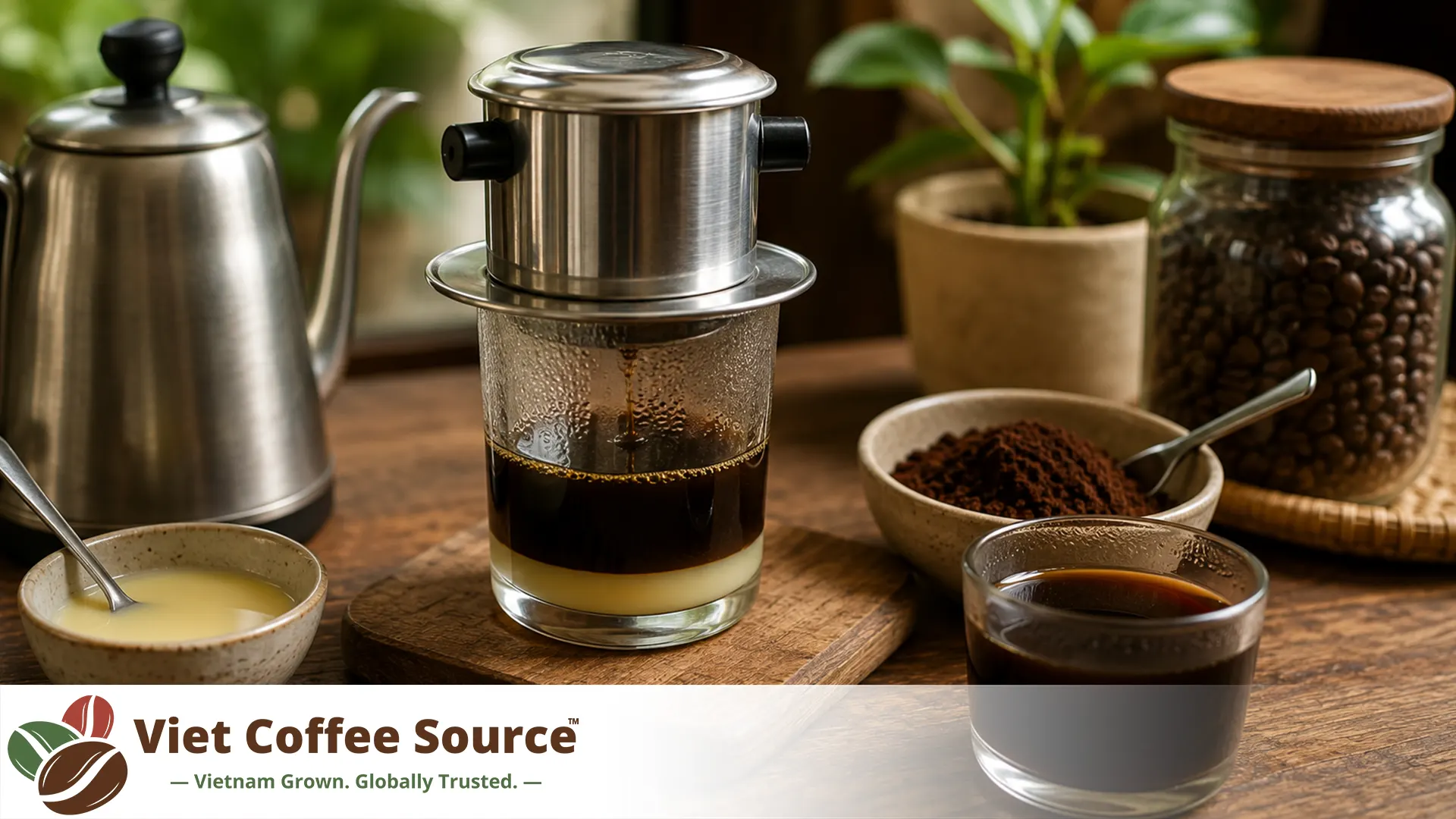
How to Make Vietnamese Coffee with a Phin Filter
Vietnamese coffee made with a phin filter is known for its slow extraction, concentrated body and distinctive balance of bitterness, sweetness and aroma. The phin is a compact metal brewer placed directly over a cup or glass. Instead of forcing water through coffee under pressure, it allows hot water to pass gradually through a compressed coffee bed. The result is a strong, full-bodied drink that can be served black, combined with sweetened condensed milk or poured over ice.
Although the phin looks simple, brewing consistently requires control over coffee grind, dose, water temperature, compression, bloom time and total drip speed. If the coffee is too coarse, the water may pass too quickly and create a weak cup. If the grind is too fine or the coffee is compressed too heavily, the filter may stall and produce excessive bitterness. This guide explains how to make Vietnamese coffee with a phin filter step by step and how to adjust the method for different beans, cup sizes and serving styles.
What is a Vietnamese phin filter?
A phin is a small gravity-based coffee brewer traditionally made from stainless steel or aluminium. It usually consists of four parts:
- A perforated base plate that rests on the cup
- A cylindrical brewing chamber that holds the ground coffee
- A perforated press or gravity insert placed over the coffee
- A lid that helps retain heat and can serve as a drip tray after brewing
Some phin filters have a screw-down press, while others use a simple gravity press. Both can produce excellent coffee, but they require slightly different handling. A screw press allows more direct control over compression, while a gravity insert is easier to use and reduces the risk of overtightening.
Why phin coffee tastes different
The phin produces a concentrated beverage because it normally uses a relatively high coffee-to-water ratio and a slow extraction. The metal filter allows more oils and fine particles to enter the cup than a paper filter, creating a heavier body and more intense mouthfeel.
The final flavour is influenced by:
- Coffee species and blend
- Roast level
- Grind size
- Coffee dose
- Water volume
- Water temperature
- Pressure applied by the insert
- Total brewing time
- Whether condensed milk or ice is added
Traditional Vietnamese-style blends often contain Robusta or a combination of Robusta and Arabica. Robusta contributes intensity, body, bitterness and a strong roasted character, while Arabica may add sweetness, acidity and aromatic complexity.
Equipment needed
You do not need an espresso machine or specialised electric brewer. A basic phin setup includes:
- A Vietnamese phin filter
- Freshly roasted coffee
- A coffee grinder
- A digital scale if available
- A kettle
- A cup or heat-resistant glass
- A timer
- Sweetened condensed milk for traditional milk coffee
- Ice for an iced version
A scale and timer are not essential, but they make the process easier to repeat. Once a reliable recipe is established, the same measurements can be used for consistent daily brewing.
Choosing the right phin size
Phin filters are available in several sizes. The correct size depends on the volume and strength required.
| Phin size | Typical coffee dose | Typical water amount | Best use |
|---|---|---|---|
| Small single cup | 12 to 16 grams | 60 to 90 millilitres | Short and concentrated coffee |
| Standard single cup | 16 to 22 grams | 90 to 130 millilitres | Traditional daily phin coffee |
| Large individual phin | 22 to 30 grams | 130 to 180 millilitres | Larger serving or iced coffee |
| Multi-cup phin | Depends on capacity | Depends on capacity | Several servings or foodservice use |
The chamber should not be overfilled. Coffee expands during blooming, so enough space must remain for the press and hot water.
Choosing coffee for a phin filter
The phin can brew many types of coffee, but full-bodied medium-dark and dark roasts are especially common. Vietnamese Robusta is a natural choice for an intense traditional profile, while Arabica or Arabica-Robusta blends can produce a smoother and more aromatic cup.
Possible choices include:
- Dark-roasted Robusta for maximum body and bitterness
- Medium-dark Robusta for strength with more origin character
- Arabica-Robusta blend for balance
- Medium-roasted Arabica for a lighter and more aromatic version
- Fine Robusta for a cleaner and more refined strong cup
- Natural-process coffee for fruitier and sweeter notes
- Washed coffee for a cleaner and more structured profile
Buyers interested in the regional differences behind Vietnamese beans can explore Vietnam’s coffee origins and growing regions.
The correct grind size
Grind size is one of the most important variables. A phin normally requires a grind finer than typical filter coffee but coarser than espresso. The coffee should resemble fine sand rather than powder.
| Grind condition | What happens | Adjustment |
|---|---|---|
| Too coarse | Water passes too quickly and the cup tastes weak or sour | Grind finer |
| Too fine | The filter stalls or drips extremely slowly | Grind coarser |
| Uneven grind | Extraction becomes inconsistent | Use a burr grinder if possible |
| Correct grind | Steady dripping with a concentrated and balanced cup | Keep the same grinder setting |
Pre-ground Vietnamese coffee can work well when it is prepared specifically for phin brewing, but freshly grinding whole beans generally provides stronger aroma and better control.
Recommended starting recipe
A practical starting recipe for one standard serving is:
- 18 to 20 grams of coffee
- 100 to 120 millilitres of hot water
- Water temperature between approximately 92 and 96 degrees Celsius
- 20 to 30 millilitres of sweetened condensed milk for a milk version
- Total brewing time of approximately four to six minutes
This recipe can be adjusted according to the phin size, coffee roast and desired strength. Darker coffee may taste better with slightly cooler water, while lighter roasts may benefit from hotter water and a little more extraction time.
Step 1: Heat the water
Bring fresh water to a boil, then allow it to rest briefly before brewing. Water that is far below the recommended range may underextract the coffee, while continuously boiling water can increase harshness, especially with very dark roasts.
Water quality also matters. Strong chlorine, excessive hardness or unusual mineral content can reduce clarity and alter flavour. Clean drinking water with moderate mineral content usually produces the best result.
Step 2: Preheat the phin and cup
Place the phin over the cup and pour a small amount of hot water through the empty brewer. This warms the metal and the serving vessel.
Preheating helps because:
- The brewing temperature remains more stable
- The first water does not lose excessive heat
- Condensed milk blends more easily
- The final coffee remains hot for longer
Discard the preheating water before adding coffee.
Step 3: Add condensed milk when making traditional milk coffee
For cà phê sữa nóng or cà phê sữa đá, add sweetened condensed milk to the cup before placing the phin on top. A common starting amount is 20 to 30 millilitres, but the quantity can be increased or reduced according to sweetness preference.
Adding the milk first allows the coffee to drip directly over it. The two layers can then be stirred together after brewing. For black coffee, simply use an empty cup.
Step 4: Weigh and add the coffee
Add the ground coffee to the chamber. For a standard phin, begin with approximately 18 to 20 grams.
Gently shake or tap the chamber to level the coffee bed. Do not pack the grounds with a spoon or tamper. The objective is an even surface, not espresso-style compression.
Step 5: Position the press
Place the perforated insert on top of the coffee. With a gravity press, allow it to rest naturally. With a screw-down model, tighten it only until gentle resistance is felt.
Excessive pressure can:
- Compress the coffee too strongly
- Prevent water from passing evenly
- Create an extremely long brew time
- Increase bitter and burnt flavours
- Cause water to escape around the edges
If the filter repeatedly stalls, reduce the pressure or use a slightly coarser grind.
Step 6: Bloom the coffee
Pour a small amount of hot water over the coffee, generally around 20 to 30 millilitres. Use enough water to wet the entire coffee bed without filling the chamber.
Wait approximately 30 to 45 seconds. During this bloom phase, trapped gases escape and the grounds become evenly saturated. Freshly roasted coffee may expand visibly.
An effective bloom helps reduce channeling and prepares the coffee for a more even main extraction.
Step 7: Add the remaining water
After blooming, slowly pour the rest of the hot water into the chamber. Avoid pouring aggressively in one spot. A controlled circular pour helps wet the surface evenly.
Fill only to the intended recipe volume. Place the lid on top to retain heat.
Step 8: Observe the drip rate
The coffee should begin dripping after a short delay. A good starting target is a slow and steady drip rather than a continuous stream.
The first drops may appear after approximately 30 to 60 seconds, depending on grind size, pressure and coffee freshness. The total brew commonly takes around four to six minutes.
| Brewing behaviour | Likely cause | Recommended correction |
|---|---|---|
| Water runs through immediately | Grind too coarse or insufficient coffee | Grind finer or increase the dose |
| No coffee drips | Grind too fine or press too tight | Loosen the press or grind coarser |
| Dripping starts but stops | Coffee bed is compacted or fines block the filter | Reduce pressure and improve grind consistency |
| Very uneven flow | Coffee bed is not level | Level the grounds before placing the insert |
| Brew finishes in the target range | Balanced grind, dose and pressure | Record the settings for future use |
Step 9: Remove the phin
When dripping has nearly stopped, remove the phin and place it on the inverted lid. This keeps residual coffee away from the table and allows the filter to cool safely.
Do not leave the brewer over the cup for an unnecessarily long period. The last drops can be more bitter and may not improve the final drink.
Step 10: Stir and serve
For hot black coffee, stir briefly and drink as it is. For hot coffee with condensed milk, stir until the milk is completely dissolved.
For iced Vietnamese coffee:
- Brew the coffee over condensed milk.
- Stir until evenly combined.
- Fill a separate glass with ice.
- Pour the coffee mixture over the ice.
- Stir again and serve immediately.
Using plenty of ice helps cool the concentrated coffee quickly while maintaining a balanced final strength.
Classic Vietnamese phin recipes
| Drink | Coffee | Water | Additional ingredients |
|---|---|---|---|
| Hot black phin coffee | 18 to 20 grams | 100 to 120 millilitres | None |
| Hot coffee with condensed milk | 18 to 20 grams | 100 to 120 millilitres | 20 to 30 millilitres condensed milk |
| Iced coffee with condensed milk | 20 to 25 grams | 90 to 110 millilitres | Condensed milk and a full glass of ice |
| Lighter Arabica phin | 16 to 18 grams | 120 to 140 millilitres | Optional sugar or milk |
| Strong Robusta phin | 20 to 22 grams | 90 to 110 millilitres | Optional condensed milk |
These are starting points rather than fixed rules. Coffee age, roast level, grinder calibration and phin design can require adjustments.
How to make cà phê sữa đá
Cà phê sữa đá is one of the best-known Vietnamese coffee drinks. It combines concentrated phin coffee, sweetened condensed milk and ice.
- Add approximately 25 millilitres of condensed milk to a heat-resistant glass.
- Place the phin over the glass.
- Add approximately 20 grams of medium-fine coffee.
- Level the grounds and position the press gently.
- Bloom with approximately 25 millilitres of hot water.
- Wait 30 to 45 seconds.
- Add approximately 80 to 90 millilitres of additional hot water.
- Allow the coffee to drip for around four to six minutes.
- Remove the phin and stir the coffee with the condensed milk.
- Pour the mixture over a full glass of ice.
The result should be strong enough to remain flavourful after dilution from the melting ice.
How to make black Vietnamese iced coffee
Black iced phin coffee is suitable for drinkers who prefer a less sweet beverage.
- Use approximately 20 to 22 grams of coffee.
- Brew with approximately 100 millilitres of water.
- Allow a slow four-to-six-minute extraction.
- Stir the finished coffee.
- Pour it over a glass filled with ice.
- Add a small amount of sugar only if desired.
A medium-dark Arabica-Robusta blend can work especially well because it retains body while providing more aroma than a very dark pure Robusta roast.
How to make a less bitter phin coffee
If the coffee tastes excessively bitter, adjust one variable at a time.
- Use a slightly coarser grind
- Reduce the coffee dose slightly
- Use water at a slightly lower temperature
- Reduce pressure from the insert
- Shorten the total brewing time
- Choose a medium-dark rather than very dark roast
- Try a blend containing more Arabica
- Clean the phin thoroughly to remove old oils
Bitterness is not always a defect in Vietnamese coffee. Traditional recipes are designed to produce an intense base that is balanced by condensed milk and ice. The objective is controlled bitterness rather than harshness or burnt flavour.
How to make stronger phin coffee
To increase strength without creating excessive bitterness:
- Increase the coffee dose while keeping the same water volume
- Use a blend with more Robusta
- Use a slightly finer grind
- Reduce the water volume
- Choose a darker roast
- Use a larger phin with a deeper coffee bed
Changing several variables at once makes it difficult to identify what improved or damaged the result. Adjust one factor, record the outcome and repeat.
How to make a lighter and more aromatic cup
A lighter phin coffee can be made by using medium-roasted Arabica, reducing the dose and increasing the water volume slightly.
A useful starting point is:
- 16 to 18 grams of Arabica
- 120 to 140 millilitres of water
- Medium-fine grind
- Gentle pressure
- Four-to-five-minute brew time
This style may produce more fruit, floral or caramel notes while retaining the characteristic body of the metal filter.
Common phin brewing mistakes
- Using coffee ground as finely as espresso
- Using a grind intended for French press
- Tightening the press excessively
- Skipping the bloom
- Pouring the water too aggressively
- Using too little coffee for the phin size
- Overfilling the brewing chamber
- Using stale pre-ground coffee
- Brewing with poor-quality water
- Failing to preheat the phin
- Not measuring the coffee and water
- Leaving old coffee oils on the filter
Troubleshooting weak coffee
If the cup tastes weak, watery or hollow, the coffee may be underextracted or overly diluted.
Possible solutions include:
- Use a finer grind
- Increase the coffee dose
- Use less water
- Increase the water temperature slightly
- Apply slightly more pressure with the insert
- Use fresher coffee
- Choose a darker roast or higher-Robusta blend
If the brew finishes in less than approximately three minutes, the grind is often too coarse or the coffee bed lacks resistance.
Troubleshooting a stalled phin
If no coffee drips or the extraction takes an extremely long time:
- Loosen the screw press
- Use a coarser grind
- Reduce the coffee dose
- Level the grounds without tamping
- Clean blocked perforations
- Check whether very fine particles are clogging the filter
Do not repeatedly lift and push the insert during brewing because this can disturb the bed and create uneven extraction.
Cleaning and maintaining a phin filter
A phin should be cleaned after every use. Coffee oils can become stale and create rancid or burnt flavours.
- Allow the brewer to cool.
- Remove the press and discard the grounds.
- Rinse every component with warm water.
- Use a soft brush to clean blocked holes.
- Wash with a mild unscented detergent when necessary.
- Rinse thoroughly.
- Dry all parts completely before storage.
Avoid strongly scented detergents and abrasive materials that may damage the metal surface or leave unwanted aromas.
How fresh should the coffee be?
Coffee should ideally be used after it has rested sufficiently following roasting but before its aroma has faded. The exact period depends on roast level, packaging and storage.
For better results:
- Buy coffee in quantities that can be consumed reasonably quickly
- Keep beans in an airtight container
- Store away from heat, moisture and direct sunlight
- Grind immediately before brewing when possible
- Avoid keeping the coffee beside spices or strong-smelling foods
Vacuum-sealed or valve-equipped packaging helps protect roasted coffee during transport and storage.
Can specialty coffee be brewed with a phin?
Yes. A phin is not limited to dark commercial blends. Specialty Arabica, Fine Robusta and single-origin coffees can also be brewed successfully.
For specialty coffee:
- Use a clean and consistent grinder
- Start with a medium-fine grind
- Apply minimal pressure
- Use accurately measured water
- Adjust temperature according to roast level
- Taste the coffee black before adding milk
The metal filter emphasises body and oils, so the same coffee may taste fuller and less delicate than when brewed through paper.
Phin coffee compared with other brewing methods
| Method | Body | Typical strength | Main characteristic |
|---|---|---|---|
| Phin filter | Full | Strong | Slow gravity extraction with metal filtration |
| Paper pour-over | Light to medium | Moderate | Clean and aromatic cup |
| French press | Full | Moderate | Immersion brewing with visible oils |
| Espresso | Very full | Highly concentrated | Pressure-based rapid extraction |
| Moka pot | Full | Strong | Stovetop pressure and concentrated character |
The phin occupies a distinctive position between filter coffee and concentrated pressure brewing. It produces more intensity than a typical pour-over but requires no machine.
Choosing coffee for home, café or wholesale use
Home users can experiment with small bags and different roast profiles. Cafés and distributors require greater consistency across batches, packaging and supply schedules.
Commercial buyers should define:
- Preferred species and blend ratio
- Roast level
- Grind size for phin preparation
- Target flavour profile
- Retail or foodservice packaging
- Monthly consumption
- Required shelf life
- Private-label requirements
- Destination-market labelling rules
Businesses evaluating Vietnamese roasted coffee, green coffee, OEM products or private-label formats can review available coffee export and supply solutions.
Simple phin brewing checklist
- Select a phin that matches the serving size.
- Use fresh coffee with a medium-fine grind.
- Heat clean water.
- Preheat the phin and cup.
- Add condensed milk if required.
- Measure the coffee dose.
- Level the grounds.
- Place the insert gently.
- Bloom the coffee for 30 to 45 seconds.
- Add the remaining water slowly.
- Cover the phin.
- Observe the drip speed.
- Target a total brew time of approximately four to six minutes.
- Remove the brewer when dripping is complete.
- Stir and serve hot or over ice.
Final assessment
Making Vietnamese coffee with a phin filter is simple, but excellent results depend on controlling the details. The most important factors are coffee freshness, medium-fine grind size, correct dose, stable water temperature, gentle compression, proper blooming and a slow, consistent drip.
A useful starting recipe is 18 to 20 grams of coffee with 100 to 120 millilitres of hot water and a total brewing time of approximately four to six minutes. From this baseline, the drink can be adjusted to become stronger, lighter, sweeter or more aromatic.
Traditional Vietnamese condensed-milk coffee benefits from a strong Robusta or Arabica-Robusta base, while black and specialty versions may perform better with medium roasts and gentler extraction. Keeping notes on dose, grind, temperature and brew time is the fastest way to develop a repeatable personal recipe.
Businesses seeking Vietnamese coffee for phin brewing, café service, retail distribution, OEM production or private-label programmes can submit a customised wholesale coffee inquiry with the preferred coffee type, roast, grind, packaging, quantity and destination market.