
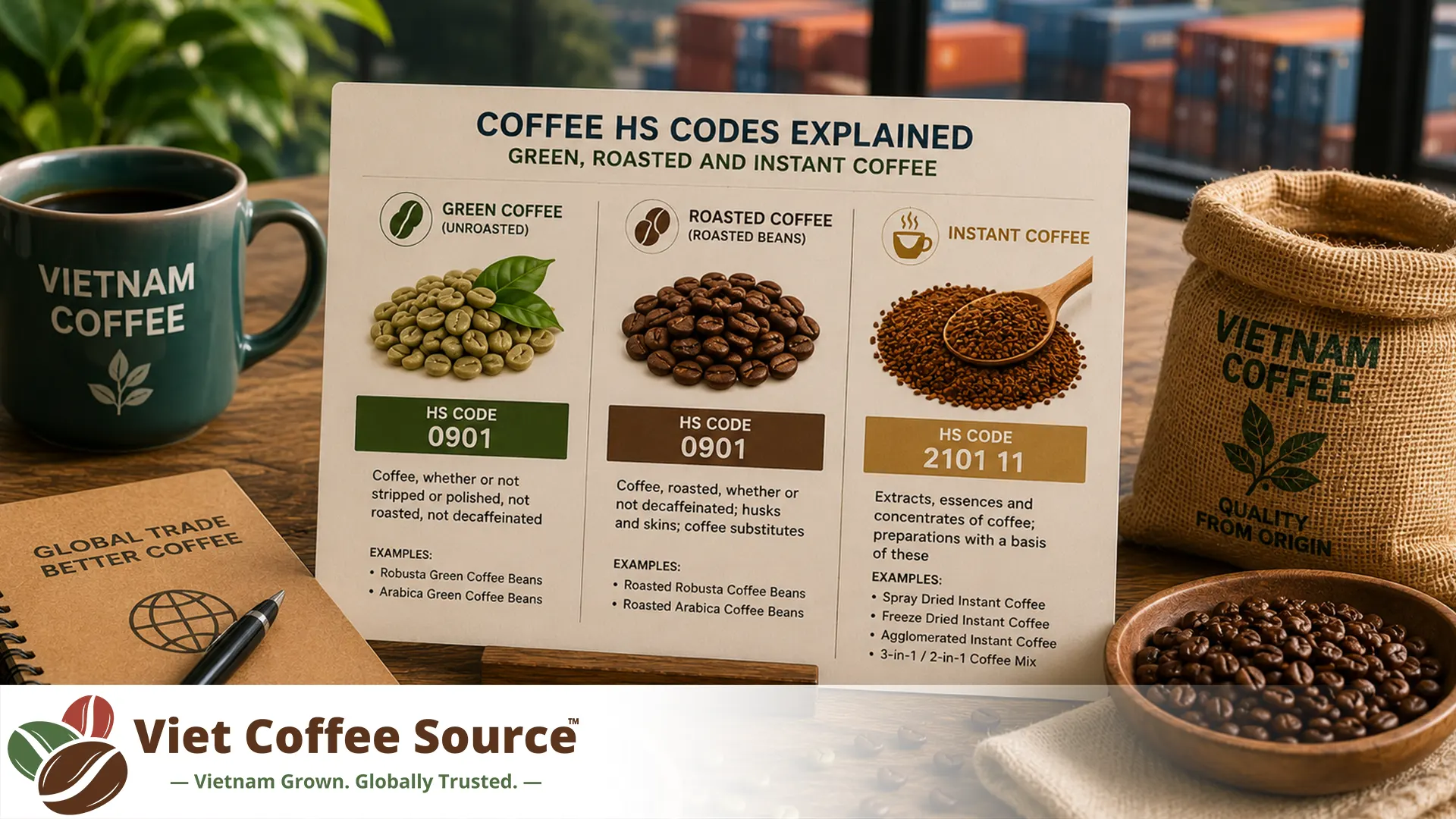
Coffee HS Codes Explained: Green, Roasted and Instant Coffee
Coffee HS codes identify the customs classification of green, roasted, decaffeinated, soluble and prepared coffee products in international trade. The correct code affects customs declarations, import duties, taxes, trade statistics, rules of origin, licensing requirements, food controls and eligibility for preferential tariff treatment. Using a code that appears commercially convenient but does not accurately describe the product can lead to customs delays, reassessment of duty, penalties, document amendments or rejection of a preferential-origin claim.
The Harmonized System is an international product-classification structure administered by the World Customs Organization. The internationally harmonized portion normally consists of six digits. Individual customs territories can extend those six digits into eight-digit, ten-digit or longer national tariff codes. This means the same coffee may share a common six-digit HS subheading internationally while requiring a more detailed code for entry into the European Union, United States, United Kingdom or another destination market.
Main HS codes for coffee
| HS code | General product description | Typical coffee product |
|---|---|---|
| 0901.11 | Coffee, not roasted and not decaffeinated | Standard green Arabica or Robusta coffee beans |
| 0901.12 | Coffee, not roasted and decaffeinated | Decaffeinated green coffee beans |
| 0901.21 | Coffee, roasted and not decaffeinated | Regular roasted whole-bean or ground coffee |
| 0901.22 | Coffee, roasted and decaffeinated | Decaffeinated roasted whole-bean or ground coffee |
| 0901.90 | Coffee husks and skins; coffee substitutes containing coffee | Coffee husks, skins or qualifying substitutes containing coffee |
| 2101.11 | Extracts, essences and concentrates of coffee | Pure instant coffee, soluble coffee extract or coffee concentrate |
| 2101.12 | Preparations based on coffee extracts, concentrates or coffee | Certain coffee preparations and formulated soluble products |
| 2101.30 | Roasted chicory and other roasted coffee substitutes and their extracts | Roasted coffee substitutes that do not fall under ordinary coffee classifications |
How the HS code structure works
An HS code is hierarchical. The first two digits identify the chapter, the first four identify the heading and the first six identify the international subheading.
| Code level | Example | Meaning |
|---|---|---|
| Chapter | 09 | Coffee, tea, maté and spices |
| Heading | 0901 | Coffee, whether or not roasted or decaffeinated, together with specified related products |
| HS subheading | 0901.11 | Coffee that is not roasted and not decaffeinated |
| National extension | Eight or ten digits | Additional classification created by the importing or exporting customs territory |
The first six digits are the international foundation, but importers must normally declare the complete commodity code required by the destination country. An exporter should therefore avoid assuming that the six-digit number alone is sufficient for customs entry.
HS code 0901.11 for green coffee
HS 0901.11 generally covers coffee that has not been roasted and has not been decaffeinated. This is the principal six-digit code for commercially traded green coffee beans.
Products commonly classified under 0901.11 include:
- Green Robusta coffee beans
- Green Arabica coffee beans
- Washed green coffee
- Natural-process green coffee
- Honey-process green coffee
- Specialty green coffee
- Commercial-grade green coffee
- Screen-sorted green coffee
- Polished green coffee beans
- Green coffee packed in jute bags, GrainPro liners or bulk bags
At the international six-digit level, 0901.11 does not normally distinguish Arabica from Robusta, washed from natural, specialty from commercial grade or Screen 18 from Screen 16. Those characteristics remain essential for the sales contract, invoice, packing list, quality specification and inspection records, but they do not create separate six-digit HS classifications.
Does processing change the green coffee HS code?
Common post-harvest processes such as washing, natural drying, honey processing, hulling, grading, polishing and screen sorting generally do not turn green coffee into roasted or instant coffee. Properly processed but unroasted coffee beans will therefore commonly remain under heading 0901 and, when not decaffeinated, under 0901.11.
Classification should nevertheless be reviewed when the product has undergone an unusual transformation, has been converted into an extract, is mixed with other ingredients or is no longer commercially identifiable as ordinary green coffee.
HS code 0901.12 for decaffeinated green coffee
HS 0901.12 generally covers coffee that is not roasted but has been decaffeinated. The key difference between 0901.11 and 0901.12 is therefore the decaffeination status rather than the species, origin or grade.
A shipment should not be declared under the standard non-decaffeinated green coffee code merely because the beans still look like ordinary green coffee. The commercial invoice and specification should clearly identify the product as decaffeinated, and supporting records may need to state the decaffeination process and residual caffeine specification.
HS code 0901.21 for roasted coffee
HS 0901.21 generally covers roasted coffee that has not been decaffeinated. It normally includes both whole roasted beans and ground roasted coffee.
Products commonly falling under this subheading include:
- Roasted whole-bean Robusta
- Roasted whole-bean Arabica
- Roasted espresso blends
- Ground filter coffee
- Vietnamese ground coffee
- Dark-roast coffee
- Medium-roast coffee
- Light-roast coffee
- Retail roasted coffee bags
- Bulk roasted coffee for food-service or industrial use
The roast profile, grind size, retail packaging, valve type and brand do not usually change the international six-digit subheading when the product remains ordinary roasted, non-decaffeinated coffee. However, national tariff schedules may create additional subdivisions based on packaging, product form or other characteristics.
HS code 0901.22 for decaffeinated roasted coffee
HS 0901.22 generally covers roasted coffee that has also been decaffeinated. This may include decaffeinated roasted beans and decaffeinated ground coffee.
The exporter should clearly separate decaffeinated and non-decaffeinated products in commercial and customs records. A mixed shipment may contain different product lines requiring separate invoice items and separate HS codes even if all products travel in the same container.
Whole-bean and ground roasted coffee
At the six-digit HS level, ordinary whole-bean and ground roasted coffee are commonly classified according to roasting and decaffeination status rather than grind size. Therefore:
- Non-decaffeinated whole roasted beans generally fall under 0901.21.
- Non-decaffeinated ground roasted coffee generally falls under 0901.21.
- Decaffeinated whole roasted beans generally fall under 0901.22.
- Decaffeinated ground roasted coffee generally falls under 0901.22.
This does not mean that whole-bean and ground coffee should be described identically. The product description should still state whether the goods are whole bean or ground, together with roast level, net weight, packaging and intended use.
HS code 0901.90 for coffee husks, skins and substitutes containing coffee
HS 0901.90 covers specific residual or substitute products associated with coffee, including coffee husks and skins and coffee substitutes containing coffee in any proportion.
This classification may be relevant to:
- Coffee husks
- Coffee skins
- Some cascara-type materials, subject to exact product condition and destination rules
- Substitute mixtures that still contain coffee
Coffee husks and skins should not automatically be declared as green coffee beans. Their composition, processing, food status and intended use should be reviewed carefully, especially when the product is marketed as a beverage ingredient.
HS code 2101.11 for instant coffee
HS 2101.11 covers extracts, essences and concentrates of coffee. Pure instant coffee is commonly classified within this subheading because soluble coffee is produced from a coffee extract rather than shipped as roasted beans.
Products that may fall under 2101.11 include:
- Spray-dried instant coffee
- Freeze-dried instant coffee
- Agglomerated instant coffee
- Bulk soluble coffee powder
- Pure instant coffee granules
- Coffee extract
- Liquid coffee concentrate
- Industrial coffee concentrate used in food or beverage manufacturing
The precise national code can depend on whether the product is flavored, decaffeinated, packaged for retail sale or supplied in bulk. For example, one country may create separate national tariff lines for retail instant coffee, bulk instant coffee, flavored products or decaffeinated soluble coffee even though they share the same international six-digit foundation.
Spray-dried, freeze-dried and agglomerated instant coffee
The drying or agglomeration method generally does not create a separate international six-digit HS code when the final product remains a pure coffee extract or concentrate. Spray-dried, freeze-dried and agglomerated soluble coffee will therefore often share HS 2101.11.
These production characteristics should still appear in the commercial description because they affect quality, pricing, solubility, density, appearance and buyer specifications. A useful invoice description may state “freeze-dried instant coffee, non-flavored, bulk packed” rather than only “coffee powder.”
HS code 2101.12 for coffee preparations
HS 2101.12 generally covers preparations based on coffee extracts, essences or concentrates, or preparations with a basis of coffee. It becomes relevant when the product is not simply pure soluble coffee but a formulated coffee preparation.
Potential examples can include:
- Certain instant coffee preparations containing additional ingredients
- Coffee premixes based primarily on coffee extract
- Formulated soluble coffee products
- Preparations containing coffee extract and sweetening or flavoring components
- Some private-label coffee mixes
The presence of sugar, creamer, milk powder, flavoring, cocoa or other ingredients can affect classification. The correct code depends on the complete formulation, ingredient percentages, product presentation and applicable classification rules.
Three-in-one coffee is not automatically 2101.11
Three-in-one instant coffee usually contains soluble coffee, sugar and creamer. Because it is a preparation rather than pure instant coffee, it should not automatically be assigned the same code as unblended soluble coffee.
Depending on its composition and the destination tariff, a three-in-one product may be considered under 2101.12 or another national classification for food preparations. Customs authorities may examine:
- Percentage of soluble coffee
- Percentage of sugar
- Type and percentage of creamer
- Presence of milk ingredients
- Presence of cocoa or flavorings
- Retail presentation
- Essential character of the mixture
- Relevant chapter and explanatory notes
A supplier should provide the complete formula and ingredient declaration to the importer or customs specialist before a code is selected.
Flavored coffee classification
Flavored roasted coffee may remain within heading 0901 in some circumstances, while certain formulated products can fall under heading 2101 or another heading depending on their composition and legal interpretation. The classification should not be determined from the marketing name alone.
Important questions include:
- Is the product still fundamentally roasted coffee?
- Was only a flavor applied, or were substantial additional ingredients mixed into the product?
- Is it a soluble extract, roasted coffee or a beverage preparation?
- Does the destination tariff contain a specific national subdivision for flavored coffee?
Ready-to-drink coffee beverages
A bottled or canned ready-to-drink coffee beverage is not normally classified as ordinary roasted coffee or pure instant coffee merely because coffee is one of its ingredients. Finished non-alcoholic beverages can fall under Chapter 22 or another applicable heading depending on composition.
Ready-to-drink products should be reviewed using:
- Water content
- Milk content
- Sugar content
- Coffee extract content
- Packaging
- Whether the product is ready for direct consumption
- Applicable beverage and dairy-product notes
Roasted chicory and coffee substitutes
Roasted chicory and other roasted coffee substitutes, together with their extracts, essences and concentrates, may fall under HS 2101.30. A coffee substitute that contains actual coffee may instead be considered under 0901.90.
The distinction depends on whether the product contains coffee and on the form of the substitute. The word “coffee” in a brand name does not prove that the product contains coffee beans or coffee extract.
Arabica and Robusta HS codes
Arabica and Robusta generally share the same six-digit HS code when they have the same roasting and decaffeination status.
| Product | Typical six-digit HS code |
|---|---|
| Green Robusta, not decaffeinated | 0901.11 |
| Green Arabica, not decaffeinated | 0901.11 |
| Decaffeinated green Arabica or Robusta | 0901.12 |
| Roasted Robusta, not decaffeinated | 0901.21 |
| Roasted Arabica, not decaffeinated | 0901.21 |
| Decaffeinated roasted Arabica or Robusta | 0901.22 |
Origin, species, grade and quality must nevertheless be described accurately on sales and quality documents. Buyers can review the principal Vietnamese coffee origins and producing regions when defining product descriptions for Robusta and Arabica shipments.
Does packaging change the HS code?
Packaging does not usually change the international six-digit classification of ordinary green or roasted coffee. A one-kilogram retail bag and a twenty-kilogram bulk carton may share the same six-digit code when the coffee itself is equivalent.
However, packaging can affect:
- National tariff subdivisions
- Statistical suffixes
- Labeling requirements
- Food registration
- Unit-of-measure declarations
- Retail-product controls
- Environmental packaging obligations
Instant coffee tariffs in some countries distinguish products packaged for retail sale from other products. Importers must therefore check the full destination code rather than relying only on the international six digits.
HS code, HTS code, CN code and TARIC code
| Term | Meaning | Typical length |
|---|---|---|
| HS code | International Harmonized System subheading | Six digits |
| CN code | European Union Combined Nomenclature classification | Eight digits |
| TARIC code | EU integrated tariff code used with additional tariff measures | Commonly ten digits |
| HTS code | National import tariff classification, especially the United States HTSUS | Often ten digits |
| Schedule B code | United States export statistical classification | Ten digits |
| Commodity code | General term for a customs classification code | Varies by country |
These terms are related but not interchangeable. A six-digit HS code can be correct at the international level but incomplete for a national customs declaration.
Why the importing country’s code matters
The importer normally declares the product according to the tariff schedule of the destination customs territory. National extensions can determine:
- Customs duty rate
- Preferential duty rate
- Import VAT or other taxes
- Quota eligibility
- Anti-dumping or safeguard measures
- Import-license requirements
- Food or agricultural controls
- Required certificates
- Trade-statistics reporting
The exporting country may also require its own complete statistical code on the export declaration. Export and import codes often share the same first six digits but can differ afterward.
HS codes and customs duty rates
An HS code does not by itself provide a universal duty rate. The final duty depends on:
- Destination country
- Complete national tariff code
- Country of origin
- Applicable trade agreement
- Preferential-origin qualification
- Import date
- Quota status
- Temporary tariff measures
- Customs value
Two shipments with the same six-digit HS code can therefore face different duty rates because they enter different countries or have different origin status.
HS codes and preferential origin
The HS classification is used when applying rules of origin under free trade agreements. A rule may require a tariff-heading change, subheading change, regional-value calculation or specific manufacturing process.
Correct classification is essential because an origin rule tied to heading 0901 may differ from a rule applying to heading 2101. Transforming imported green coffee into roasted coffee can involve a different origin analysis from transforming imported coffee extract into a sweetened instant mix.
HS codes and EUDR product scope
For shipments to the European Union, customs classification can also affect whether a coffee product falls within the product scope of the EU Deforestation Regulation. Businesses should compare the complete product and code with the current regulatory annex rather than assume that every beverage containing coffee is treated identically.
Classification and EUDR compliance are separate tasks. A correct code does not replace geolocation, deforestation-free evidence, legality checks, traceability or due diligence when those obligations apply.
HS code on the commercial invoice
A commercial invoice should contain an accurate and commercially meaningful product description. When an HS code is included, the description and code must be consistent.
Examples of useful invoice descriptions include:
- Vietnam Robusta green coffee beans, not roasted, not decaffeinated, HS 0901.11
- Vietnam Arabica green coffee beans, washed, not roasted, not decaffeinated, HS 0901.11
- Roasted whole-bean coffee, not decaffeinated, HS 0901.21
- Ground roasted coffee, decaffeinated, HS 0901.22
- Freeze-dried instant coffee, pure and non-flavored, HS 2101.11
The final national code should be confirmed by the importer. The exporter should avoid presenting an unverified country-specific code as universally applicable.
Consistency across export documents
The HS code should be reviewed against:
- Commercial invoice
- Packing list
- Sales contract
- Certificate of Origin
- Customs declaration
- Bill of Lading description
- Product specification
- Certificate of Analysis
- Ingredient declaration
- Label artwork
If the invoice states pure instant coffee but the ingredient specification shows sugar and creamer, customs may question whether 2101.11 is correct.
Common coffee classification mistakes
- Using 0901.11 for roasted coffee: Green and roasted coffee belong to different subheadings.
- Ignoring decaffeination: Decaffeinated coffee has separate six-digit classifications.
- Using 2101.11 for every instant mix: Pure soluble coffee and formulated coffee preparations may not share the same code.
- Classifying three-in-one coffee from its product name: Ingredient composition must be reviewed.
- Using only a six-digit code on a national declaration: The importing country may require eight or ten digits.
- Copying a competitor’s code: Products with similar marketing names can have different formulations.
- Using the export-country extension for import clearance: National digits can differ after the first six.
- Assuming packaging never matters: Some national schedules distinguish retail and bulk products.
- Using the code for the main ingredient only: Mixtures and preparations must be classified as complete products.
- Failing to update the code: National tariff schedules and measures can change.
How to classify a coffee product step by step
- Identify the physical product being shipped.
- Determine whether it is green, roasted, extracted, soluble, prepared or ready to drink.
- Determine whether it is decaffeinated.
- Review every ingredient and its percentage.
- Determine whether the product is whole bean, ground, powder, granule, liquid or beverage.
- Review the HS heading and subheading descriptions.
- Apply the General Rules for Interpretation and relevant legal notes.
- Check the destination country’s full tariff schedule.
- Review national subdivisions and import measures.
- Confirm the proposed code with the importer or customs broker.
- Request a binding classification decision when material uncertainty remains.
- Use the approved code consistently across all shipment documents.
Information needed to classify instant coffee preparations
For a coffee premix, customs specialists may need:
- Complete ingredient list
- Percentage by weight of soluble coffee
- Percentage of sugar
- Percentage and type of creamer
- Milk-fat and milk-protein content
- Cocoa content
- Flavoring content
- Preparation instructions
- Retail or industrial presentation
- Sample label and packaging
- Technical manufacturing process
Without these details, selecting between 2101.11, 2101.12 or another possible heading may be unreliable.
Binding tariff information and classification rulings
When classification has significant financial or compliance consequences, the importer may request a binding tariff decision from the relevant customs authority. Depending on the jurisdiction, this may be called Binding Tariff Information, an advance ruling or a customs classification ruling.
A ruling application commonly requires:
- Detailed product description
- Ingredient percentages
- Manufacturing process
- Photographs or samples
- Packaging and label
- Technical specification
- Suggested classification and reasoning
A binding decision can provide greater certainty, but it normally applies only under the conditions, product details and jurisdiction covered by the ruling.
Classification checklist for green coffee
- Confirm that the beans are not roasted.
- Confirm whether the beans are decaffeinated.
- State Arabica or Robusta in the commercial description.
- State process, grade, screen and crop information separately.
- Confirm the six-digit HS subheading.
- Confirm the complete national commodity code.
- Check origin and preferential-duty requirements.
- Use the same classification across export documents.
Classification checklist for roasted coffee
- Confirm that the product is roasted coffee.
- Confirm whether it is decaffeinated.
- State whether it is whole bean or ground.
- Review whether added ingredients affect classification.
- Confirm retail or bulk national subdivisions.
- Check destination labeling and food requirements.
- Confirm the complete import code before dispatch.
Classification checklist for instant coffee
- Determine whether the product is pure coffee extract.
- Identify spray-dried, freeze-dried or agglomerated form.
- Confirm whether it is flavored or decaffeinated.
- Review whether it is packaged for retail sale.
- Check whether sugar, creamer or other ingredients are present.
- Separate pure instant coffee from formulated preparations.
- Review country-specific tariff subdivisions.
- Obtain a ruling for complex formulations when necessary.
Working with the buyer and customs broker
The supplier understands the product, while the importer and customs broker understand the destination tariff and entry procedure. Effective classification therefore requires cooperation.
The exporter should provide:
- Product specification
- Ingredient list
- Processing method
- Decaffeination status
- Packaging details
- Intended use
- Product photographs
- Previous rulings or classifications when relevant
The buyer should confirm the complete import code, duty treatment and required documents before the goods are shipped. Importers can review broader coffee export, logistics and documentation solutions when establishing their customs process.
Final HS code reference table
| Coffee category | Typical HS code | Important condition |
|---|---|---|
| Green coffee | 0901.11 | Not roasted and not decaffeinated |
| Decaffeinated green coffee | 0901.12 | Not roasted but decaffeinated |
| Roasted coffee | 0901.21 | Roasted and not decaffeinated |
| Decaffeinated roasted coffee | 0901.22 | Roasted and decaffeinated |
| Coffee husks and skins | 0901.90 | Not ordinary green coffee beans |
| Pure instant coffee or coffee extract | 2101.11 | Extract, essence or concentrate of coffee |
| Coffee preparation | 2101.12 | Prepared product based on coffee or coffee extract |
| Roasted chicory or other roasted substitute | 2101.30 | Classification depends on whether actual coffee is present |
Final assessment
The principal international coffee HS classifications are 0901.11 for non-decaffeinated green coffee, 0901.12 for decaffeinated green coffee, 0901.21 for non-decaffeinated roasted coffee, 0901.22 for decaffeinated roasted coffee and 2101.11 for coffee extracts and pure instant coffee. Coffee preparations containing sugar, creamer, flavors or other ingredients require a more detailed review and may fall under 2101.12 or another destination-specific classification.
The six-digit HS code is only the international starting point. Importers must identify the complete national commodity code, applicable duty, origin rule, tax treatment and regulatory measures in the destination market. Product composition, processing, decaffeination status and presentation should always be checked before the code is used.
Correct classification begins with an accurate technical description and ends with consistent customs and commercial documents. Buyers seeking Vietnamese green, roasted or instant coffee with structured specifications and export documentation can submit a customized wholesale coffee inquiry stating the product, formulation, quantity, packaging and destination market.