
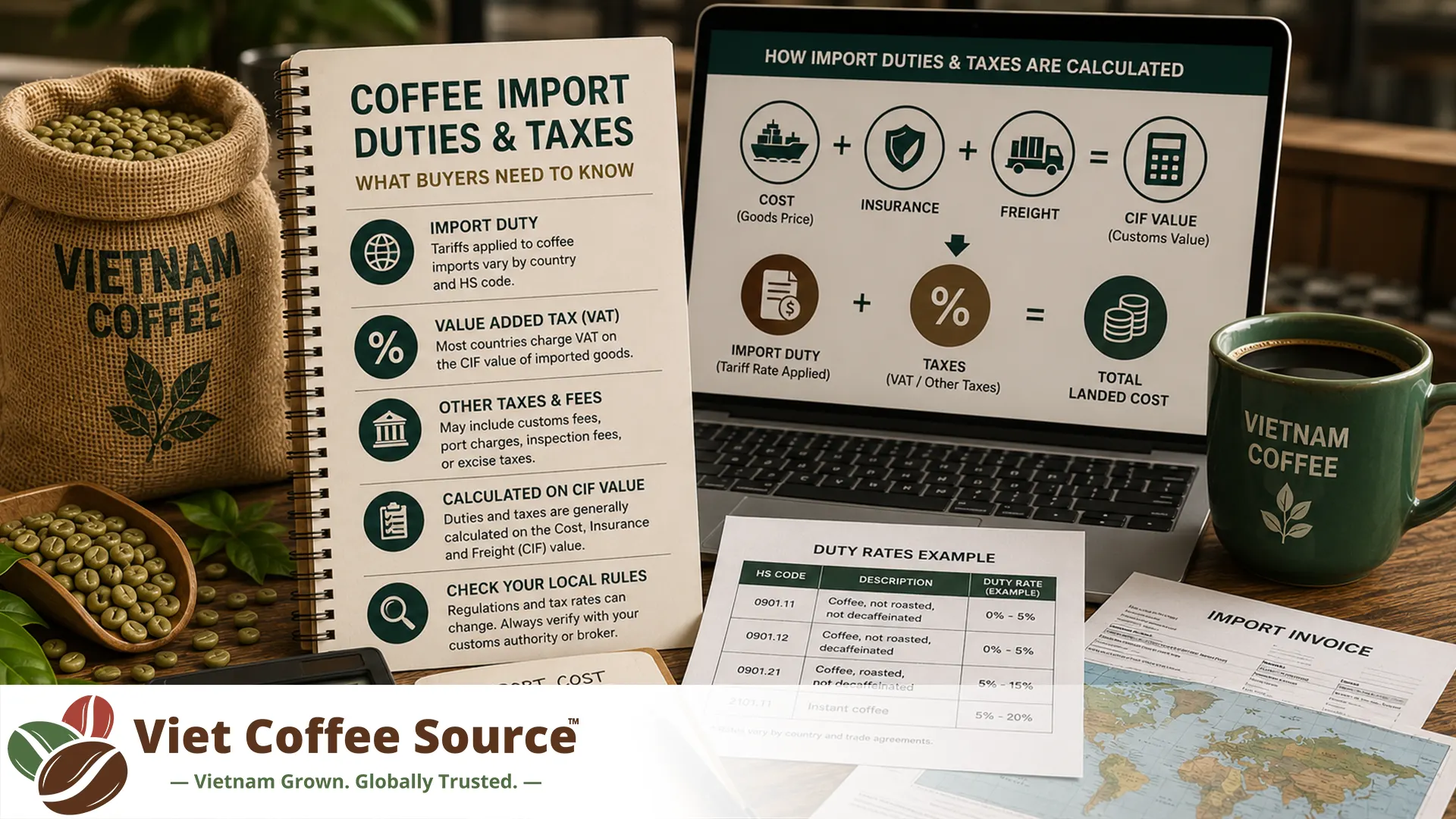
Coffee Import Duties and Taxes: What Buyers Need to Know
Coffee import duties and taxes determine how much a buyer must pay when green, roasted, soluble or prepared coffee enters a destination market. The final amount depends on the product’s customs classification, country of origin, customs value, trade agreement, import date and local tax rules. Buyers who calculate only the supplier’s price and international freight can underestimate the true landed cost, especially when roasted coffee, instant coffee, retail packs or formulated coffee preparations are involved.
Green coffee may enter some markets at a low or zero customs-duty rate, while roasted coffee, soluble coffee and three-in-one preparations can face different tariffs. Import VAT, GST, sales tax, excise duties, customs-processing fees and regulatory charges may also apply even when the basic customs duty is zero.
What are coffee import duties?
Import duty is a customs charge applied when coffee enters a country or customs territory. It is commonly calculated as a percentage of the customs value, although some tariff systems may also use specific rates based on weight, quantity or another unit.
The duty payable can depend on:
- Complete HS or national commodity code
- Green, roasted, decaffeinated, soluble or prepared form
- Country of origin
- Country of export
- Destination market
- Preferential trade agreement
- Customs value
- Tariff quota
- Temporary suspension or safeguard measure
- Import date
A coffee shipment should not be assumed to have the same tariff in every country. The same product can enter one market duty-free and face a positive tariff in another.
What taxes can apply to imported coffee?
Customs duty is only one part of the government charges payable at import. Depending on the destination, buyers may also encounter:
- Import VAT
- Goods and Services Tax
- Sales tax
- Excise duty
- Customs-processing fees
- Statistical taxes
- Port or infrastructure levies
- Agricultural or food-control charges
- Environmental packaging fees
- Advance tax or withholding mechanisms
Some taxes may be recoverable by registered businesses, while others become a permanent cost. Import VAT can still create a substantial cash-flow requirement even when it is later reclaimed.
Main coffee customs classifications
| Product category | Typical international HS code | General description |
|---|---|---|
| Green coffee, not decaffeinated | 0901.11 | Coffee that is not roasted and not decaffeinated |
| Green coffee, decaffeinated | 0901.12 | Coffee that is not roasted but has been decaffeinated |
| Roasted coffee, not decaffeinated | 0901.21 | Roasted whole-bean or ground coffee |
| Roasted coffee, decaffeinated | 0901.22 | Roasted and decaffeinated whole-bean or ground coffee |
| Coffee husks, skins and certain substitutes | 0901.90 | Specified coffee residues and substitutes containing coffee |
| Coffee extracts and pure instant coffee | 2101.11 | Extracts, essences and concentrates of coffee |
| Coffee preparations | 2101.12 | Preparations based on coffee or coffee extracts |
The six-digit HS code is the international foundation. Import declarations usually require a longer national code of eight, ten or more digits. The importer must confirm the complete code used by the destination customs authority.
Why tariff classification matters
The classification determines more than the customs-duty rate. It can also affect:
- Import VAT treatment
- Eligibility for preferential tariffs
- Food-control procedures
- Import-license requirements
- Quota access
- Statistical reporting
- Rules of origin
- Required certificates
- Product scope under other regulations
Pure instant coffee and a three-in-one preparation may look similar to a buyer but can belong to different tariff classifications because the second product contains sugar, creamer or other ingredients.
Import duties on green coffee
Green coffee is often treated more favorably than processed coffee because it is an agricultural raw material used by domestic roasters. However, tariff treatment varies by market and must be verified before purchase.
The duty calculation for green coffee can be affected by:
- Whether the beans are decaffeinated
- Country of origin
- Preferential trade arrangement
- Tariff quota
- Temporary agricultural measures
- Complete national tariff code
Arabica and Robusta usually share the same six-digit HS code when they have the same roasting and decaffeination status. Species, grade, screen and processing method remain important commercial specifications but generally do not create separate international six-digit classifications.
Buyers evaluating Vietnamese green coffee can review the main coffee origins and production regions of Vietnam while preparing sourcing and origin documentation.
Import duties on roasted coffee
Roasted coffee can face different tariffs from green coffee because it has undergone further manufacturing. Whole-bean and ground roasted coffee generally share the same international subheading when their decaffeination status is identical, but national tariff schedules may create additional subdivisions.
Buyers should confirm whether national codes distinguish:
- Whole-bean and ground coffee
- Retail and bulk packaging
- Flavored and non-flavored products
- Decaffeinated and regular coffee
- Specific package sizes
A country may encourage local roasting by applying a lower tariff to green coffee and a higher tariff to imported roasted products. This can materially affect whether a buyer should import green beans for domestic roasting or purchase finished retail coffee.
Import duties on instant coffee
Pure instant coffee is commonly classified under HS 2101.11, but the complete national tariff code can depend on product form, packaging, flavoring and decaffeination status.
Products commonly reviewed under this category include:
- Spray-dried instant coffee
- Freeze-dried instant coffee
- Agglomerated instant coffee
- Bulk soluble coffee
- Retail instant coffee
- Liquid coffee extract
- Coffee concentrate
Instant coffee may be subject to a higher duty than green coffee because it is a processed product. Retail packaging can also create additional national subdivisions or regulatory costs.
Three-in-one coffee and prepared products
Three-in-one coffee typically contains soluble coffee, sugar and creamer. It should not automatically be classified as pure instant coffee. Depending on the formulation and destination tariff, it may fall under HS 2101.12 or another national heading for food preparations.
Customs authorities may examine:
- Percentage of soluble coffee
- Percentage of sugar
- Type and percentage of creamer
- Milk-fat and milk-protein content
- Cocoa content
- Flavoring
- Retail presentation
- Essential character of the mixture
A complete ingredient formula should be provided to the importer or customs broker before the code and duty rate are confirmed.
Customs value of imported coffee
Customs duty is usually calculated from the customs value rather than only from the amount shown as the coffee price. The transaction value is commonly the starting point, adjusted according to the destination’s valuation rules.
The customs value may include:
- Price paid or payable
- Freight to the import border
- Cargo insurance
- Packing costs
- Assists supplied by the buyer
- Specified royalties or license fees
- Selling commissions where applicable
Domestic transport after import may sometimes be excluded when separately stated and permitted by local rules.
Basic customs-duty calculation
When duty is charged as a percentage of customs value, the basic formula is:
Customs duty = customs value × applicable duty rate.
If the customs value is USD 100,000 and the duty rate is 5%, the customs duty is USD 5,000. The actual calculation remains subject to the destination’s valuation rules, currency-conversion rate, tariff code and preferential treatment.
Import VAT calculation
Import VAT is often calculated on a broader base than customs duty. The taxable amount may include:
- Customs value
- Customs duty
- Excise duty where applicable
- Freight to the first domestic destination
- Insurance
- Other legally includable import charges
A simplified formula may be:
Import VAT = VAT taxable base × VAT rate.
If the taxable base is USD 110,000 and the VAT rate is 20%, the import VAT would be USD 22,000. This is only an illustration because every jurisdiction applies its own taxable-base rules.
Recoverable and non-recoverable taxes
A registered business may be able to recover import VAT or GST through its tax return, provided the importer of record, customs documents and tax registration are correct. Recoverability does not mean the tax can be ignored in the import budget.
The buyer should distinguish between:
- Permanent costs: Customs duty, non-refundable fees and taxes that cannot be reclaimed
- Cash-flow costs: Recoverable import VAT or GST paid before reimbursement or offset
- Contingent costs: Duties or penalties that may arise if classification or origin is challenged
Country of origin and country of export
The country from which coffee is shipped is not always the same as its country of origin. Coffee grown in Vietnam but stored and re-exported through another country may still have Vietnamese non-preferential origin, subject to the applicable rules.
Customs authorities can request evidence such as:
- Certificate of Origin
- Producer declaration
- Processing records
- Export declaration
- Purchase records
- Traceability documents
- Preferential-origin statement
Declaring the wrong origin can lead to reassessment of duty, rejection of preferential treatment and penalties.
Preferential import duties
Free trade agreements can reduce or eliminate customs duty when the coffee qualifies under the relevant rule of origin and the required proof is available.
The importer should verify:
- Whether the destination has an agreement with the origin country
- Whether the coffee product is covered
- Applicable rule of origin
- Required certificate or origin statement
- Exporter-authorization requirements
- Validity period of the origin proof
- Direct-transport or non-alteration requirements
Preferential treatment must not be claimed only because the invoice states a qualifying country. The product and supporting documents must satisfy the legal requirements.
Rules of origin for processed coffee
Rules of origin can be more complex for roasted coffee, instant coffee and preparations made from imported ingredients. A product manufactured in one country does not automatically acquire that country’s preferential origin.
The rule may require:
- Change in tariff heading
- Change in tariff subheading
- Maximum value of non-originating materials
- Minimum regional-value content
- Specific manufacturing operation
For example, roasting imported green coffee may be treated differently from manufacturing a coffee premix using imported soluble coffee, sugar and creamer.
Proof of origin
Depending on the trade agreement, proof of origin may take the form of:
- Government-issued Certificate of Origin
- Self-certified origin statement
- Invoice declaration
- Registered-exporter statement
- Electronic origin record
The origin document should correspond with the exporter, product description, quantity, invoice and shipment details. Errors can delay clearance or cause the preferential claim to be denied.
Most-favored-nation tariff
When no preferential tariff is available or the required proof of origin is missing, the importer may have to use the standard most-favored-nation rate or another general tariff rate applicable under local law.
The standard rate should be included in the buyer’s contingency calculation whenever preferential eligibility has not been fully confirmed before shipment.
Tariff quotas
A tariff-rate quota can permit a specified quantity of a product to enter at a lower tariff. Once the quota is exhausted, a higher rate may apply.
Buyers relying on a quota should confirm:
- Quota period
- Available balance
- Allocation method
- License requirements
- Eligible origins
- Required documents
- Rate applicable outside the quota
A purchase contract should not assume quota access unless the importer has confirmed eligibility and availability.
Anti-dumping, safeguard and additional duties
Some products can be subject to additional trade-remedy duties. These measures are product-, origin- and period-specific and may apply in addition to ordinary customs duty.
Buyers should review whether the destination applies:
- Anti-dumping duty
- Countervailing duty
- Safeguard duty
- Retaliatory tariff
- Emergency surcharge
These measures are less common for some coffee categories than for industrial goods, but they must still be checked in the current tariff system.
Import VAT and importer-of-record status
The party named as importer of record is normally responsible for the customs declaration, duty and import tax. The commercial buyer, distributor, customs representative or seller may assume this role depending on the transaction and local law.
The importer should have:
- Required customs registration
- Tax registration
- Import licenses where applicable
- Authority to appoint a customs broker
- Records supporting classification and origin
A DDP quotation does not automatically mean the foreign seller can legally act as importer of record in every destination country.
Incoterms do not determine the tariff rate
Incoterms allocate cost and risk responsibilities, but they do not establish the customs-duty rate. EXW, FOB, CIF, DAP and DDP describe delivery obligations rather than tariff classification.
They do, however, affect who initially pays:
- Export charges
- International freight
- Insurance
- Import clearance
- Duty
- Import VAT
- Final delivery
The sales contract should clearly state whether taxes are included in the price and who remains responsible if customs reassesses the declaration.
Duty treatment under EXW and FOB
Under EXW and FOB transactions, the buyer usually controls import clearance and pays duties and taxes directly or through a customs broker. The buyer should therefore obtain the tariff classification and origin documents before the goods depart.
An attractive FOB price can still result in a high landed cost if the product faces a significant tariff, high import VAT or additional food-control charges.
Duty treatment under CIF
CIF includes specified freight and insurance to the named destination port, but it generally does not include import duty, import VAT, customs brokerage or final delivery.
Buyers should not interpret a CIF price as duty-paid. Destination charges and government taxes may remain entirely outside the supplier’s quotation.
Duty treatment under DAP and DDP
Under DAP, the seller generally transports the goods to the named destination, while the buyer handles import clearance, duty and import taxes. Under DDP, the seller generally assumes broader import responsibilities, but the arrangement must be legally workable in the destination market.
Before accepting DDP, buyers should confirm:
- Who is importer of record
- Whose tax registration is used
- Whether import VAT is recoverable
- Whether the seller’s customs value is acceptable
- Which fees are excluded
- Who bears post-entry reassessment risk
Customs exchange rates
When the invoice is issued in a foreign currency, customs authorities convert it using an official exchange rate. The customs exchange rate may differ from the commercial bank rate used for payment.
This difference can change:
- Customs value
- Duty payable
- Import VAT
- Landed cost
Importers should use the customs authority’s applicable rate for the declaration date when forecasting final taxes.
Customs-processing and entry fees
Some jurisdictions charge customs-processing fees in addition to duty. These may be calculated as:
- Fixed amount per entry
- Percentage of customs value
- Minimum and maximum fee
- Charge per tariff line
- Charge per document
A duty-free product can therefore still incur meaningful customs and administrative costs.
Food and agricultural control charges
Coffee imports can be subject to food, plant-health or agricultural controls. Potential charges include:
- Document review
- Phytosanitary inspection
- Food-safety inspection
- Sampling
- Laboratory analysis
- Pesticide-residue testing
- Mycotoxin testing
- Label review
- Container movement for inspection
Reliable coffee quality and compliance documentation can reduce preventable delays, although official inspections and fees cannot always be avoided.
Environmental and packaging taxes
Retail coffee products may create packaging obligations in the destination country. Importers can be responsible for registration, reporting, recycling contributions or extended producer-responsibility fees.
Packaging-related obligations may apply to:
- Plastic pouches
- Aluminum laminates
- Glass jars
- Metal tins
- Paper cartons
- Wooden pallets
These fees may not appear on the customs entry but should still be included in the commercial landed-cost model.
Excise taxes on coffee
Some countries or local jurisdictions can impose excise or consumption taxes on coffee or coffee products. The tax may depend on product type, weight, caffeine content, retail presentation or domestic legislation.
Buyers should verify whether excise applies to:
- Roasted coffee
- Instant coffee
- Coffee extracts
- Sweetened coffee preparations
- Ready-to-drink coffee beverages
Ready-to-drink coffee beverages
Bottled or canned coffee beverages are not normally classified in the same way as green, roasted or pure soluble coffee. Their duty and tax treatment can depend on water, milk, sugar, coffee extract and other ingredients.
Additional taxes such as sugar taxes, beverage levies, deposit schemes or dairy-related charges may apply depending on the destination.
Import taxes on samples
Commercial samples can still be subject to customs declarations, duty, VAT and courier-processing fees. A low declared value does not automatically create tax-free treatment.
Authorities may request:
- Realistic customs value
- Product description
- HS code
- Reason for import
- Proof that the goods are samples
Courier brokerage and disbursement fees can be high relative to the value of small coffee samples.
Duty drawbacks and inward processing
Some jurisdictions allow relief when imported coffee is processed and later re-exported. Available programs can include:
- Duty drawback
- Inward processing
- Bonded warehousing
- Free-zone procedures
- Temporary admission
These programs usually require prior authorization, inventory controls, production records and proof of re-export. They should not be assumed to apply automatically.
Bonded warehouses
A bonded warehouse can allow duty and import tax to be suspended until the coffee is released for domestic consumption. If the goods are re-exported, some charges may never become payable.
Potential benefits include:
- Deferred duty payment
- Improved cash flow
- Regional distribution
- Re-export without domestic entry
- Inventory flexibility
Warehouse fees, guarantees, customs supervision and recordkeeping costs must also be considered.
Common mistakes that increase duty and tax costs
- Using the wrong HS code: Green, roasted and soluble coffee can have different tariff rates.
- Ignoring decaffeination: Decaffeinated coffee has separate international subheadings.
- Treating three-in-one coffee as pure instant coffee: The complete formulation must be classified.
- Using the country of export as the origin: Shipment route does not automatically establish origin.
- Claiming preference without valid proof: Customs can reassess the standard tariff.
- Calculating duty only from the product price: Freight, insurance or other additions may form part of customs value.
- Ignoring import VAT: Recoverable tax can still create a cash-flow burden.
- Assuming CIF includes duty: CIF usually ends at the named port before import charges.
- Using an outdated tariff rate: Tariffs and trade measures can change.
- Failing to include packaging fees: Retail products may create environmental obligations.
Documents needed to support duty calculations
- Commercial invoice
- Packing list
- Sales contract
- Bill of Lading or Air Waybill
- Certificate of Origin
- Preferential-origin statement
- Product specification
- Ingredient declaration
- Insurance certificate
- Freight invoice
- Customs valuation records
- Binding tariff decision where available
Document descriptions, quantities, values, codes and origin details should be consistent across the entire shipment file.
How buyers should verify the duty rate
- Identify the exact product and formulation.
- Confirm whether it is green, roasted, soluble or prepared coffee.
- Confirm decaffeination status.
- Determine the six-digit HS code.
- Determine the full national tariff code.
- Confirm the country of origin.
- Check the current standard tariff rate.
- Check available trade agreements.
- Verify the applicable rule of origin.
- Confirm the required origin document.
- Calculate customs value.
- Calculate duty and import taxes.
- Add customs, inspection and regulatory fees.
When to request a binding tariff ruling
A binding tariff ruling may be appropriate when:
- The product contains multiple ingredients
- The distinction between pure extract and preparation is unclear
- The tariff-rate difference is substantial
- The product is flavored or fortified
- Previous customs decisions are inconsistent
- The buyer expects recurring imports
A ruling application can require product samples, ingredient percentages, manufacturing processes, packaging and technical specifications.
Import-duty budgeting example
| Cost item | Illustrative amount |
|---|---|
| Invoice value | 80,000 USD |
| Freight and insurance included in customs value | 5,000 USD |
| Customs value | 85,000 USD |
| Duty at 5% | 4,250 USD |
| VAT taxable base | 89,250 USD |
| Import VAT at 20% | 17,850 USD |
| Total duty and VAT payable at import | 22,100 USD |
This example is illustrative only. Actual customs value, tariff rates and tax bases must be calculated under the rules of the destination country.
Cash-flow impact of import taxes
Even when import VAT is recoverable, the buyer may need to finance it between customs clearance and tax recovery. The cash-flow period can range from a few days to several months depending on the local system.
Importers can investigate:
- Deferred import VAT accounting
- Postponed accounting
- Customs deferment accounts
- Bonded warehousing
- Guarantee facilities
- Duty-payment accounts
Availability and conditions vary by jurisdiction.
Contract clauses for duties and taxes
Coffee purchase contracts should define:
- Applicable Incoterm and named place
- Party responsible for classification
- Party responsible for origin documents
- Party paying duty and import taxes
- Treatment of customs reassessments
- Responsibility for penalties caused by incorrect supplier information
- Responsibility for preferential-origin rejection
- Document-correction deadlines
- Tax treatment of samples and replacements
Importers can integrate these requirements into wider coffee export, logistics and documentation procedures.
Questions to ask the supplier
- What is the proposed HS code?
- Is the coffee green, roasted, soluble or prepared?
- Is it decaffeinated?
- What is the complete ingredient formula?
- What is the country of origin?
- Can preferential-origin proof be provided?
- Which export documents are included?
- Does the invoice separately state freight and insurance?
- Which Incoterm and named place apply?
- Has the product been imported into this market before?
Questions to ask the customs broker
- What is the complete national tariff code?
- What standard duty rate applies?
- Is a preferential rate available?
- What origin proof is required?
- How is customs value calculated?
- What import VAT or GST rate applies?
- Are customs-processing fees charged?
- Are food-control or laboratory fees likely?
- Can import VAT be deferred or recovered?
- Is a binding ruling recommended?
Coffee duty and tax checklist
- Exact product identified
- Ingredient formula reviewed
- Decaffeination status confirmed
- Six-digit HS code confirmed
- Complete national code confirmed
- Country of origin verified
- Standard tariff checked
- Preferential tariff checked
- Origin proof validated
- Customs value calculated
- Import VAT or GST calculated
- Additional fees included
- Cash-flow impact assessed
- Customs broker review completed
- Contract responsibility confirmed
Final assessment
Coffee import duties and taxes depend on the exact product, customs classification, origin, customs value and destination-market rules. Green coffee, roasted coffee, instant coffee and formulated preparations can face different tariff treatment. A zero customs-duty rate does not necessarily mean the import is free of government charges because VAT, GST, processing fees, inspections and packaging obligations may still apply.
Buyers should confirm the complete national tariff code, standard duty rate, preferential eligibility, origin documents, customs value and import-tax base before the coffee is shipped. Recoverable taxes should be separated from permanent costs but still included in cash-flow planning.
A reliable duty-and-tax calculation protects the importer’s margin, prevents customs surprises and allows different suppliers and product formats to be compared accurately. Buyers seeking Vietnamese coffee with clear product specifications, origin support and export documentation can submit a customized wholesale coffee inquiry stating the product, quantity, destination and preferred Incoterm.