
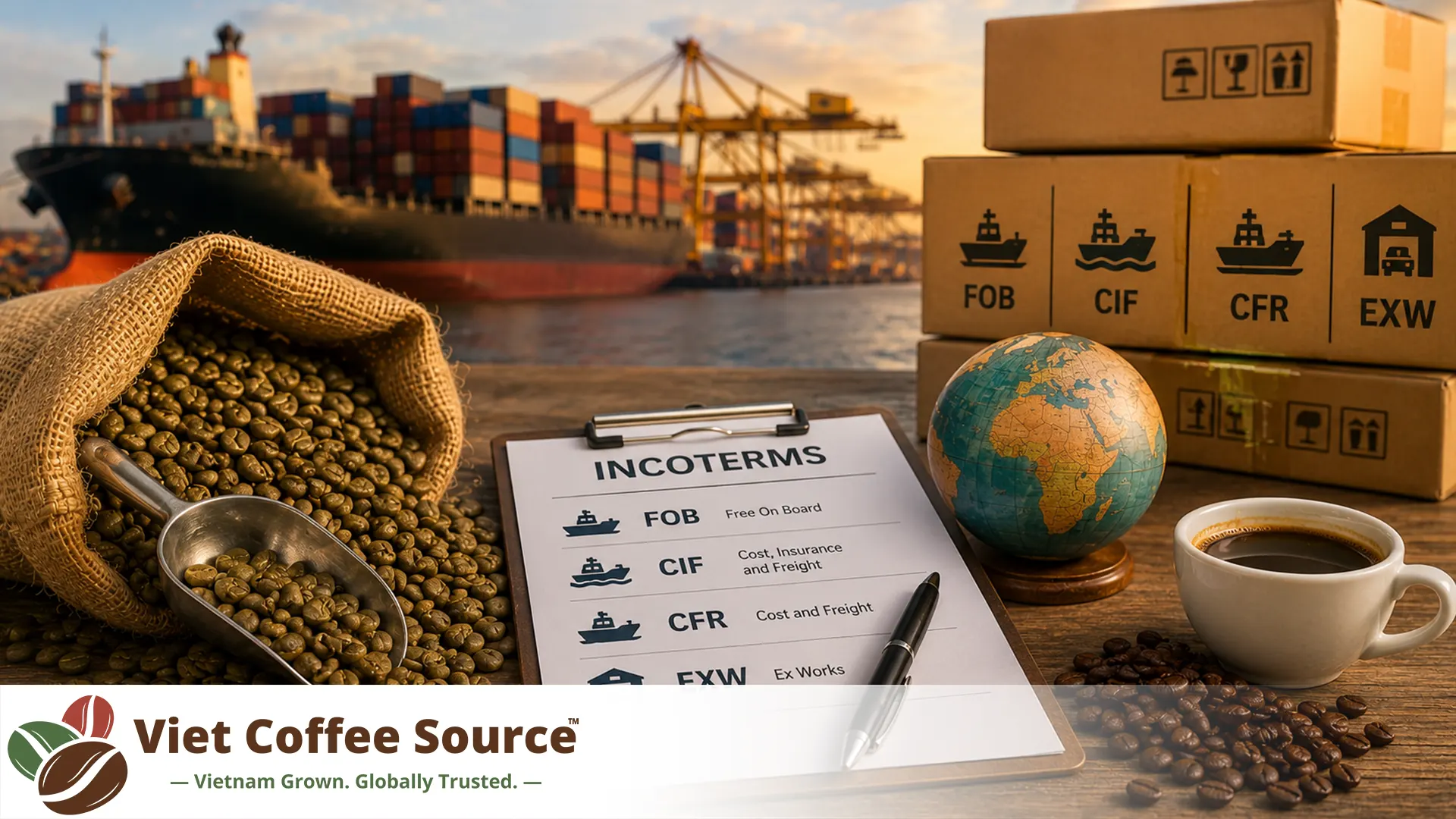
Best Incoterms for Coffee Imports: FOB, CIF, CFR and EXW
The best Incoterm for a coffee import depends on who should control the freight, where risk should transfer, whether cargo insurance is required and how experienced the importer is with international logistics. FOB, CIF, CFR and EXW can all be used in coffee trade, but they distribute responsibilities very differently. FOB gives the importer control of the main ocean freight after the coffee is loaded on board the vessel. CFR requires the exporter to arrange and pay for freight to the destination port, while the cargo risk still transfers at the port of shipment. CIF follows the same basic structure as CFR but also requires the seller to arrange cargo insurance for the buyer’s risk. EXW places the greatest logistical responsibility on the importer from the seller’s premises onward.
For green coffee, roasted coffee and other containerized products, buyers should not select a term only because it produces the lowest quotation. The apparent purchase price may exclude inland transport, terminal charges, documentation, insurance, customs brokerage, destination handling and other costs. A professional comparison must examine the total landed cost, the point of risk transfer and the party controlling each stage of the shipment.
What Are Incoterms?
Incoterms are standardized international trade rules published by the International Chamber of Commerce. They clarify the tasks, costs and risks allocated between the seller and buyer under a contract for the sale of goods. The current edition is Incoterms 2020, and contracts should state the selected rule, the precise named place or port and the applicable edition.
A correct contract description should therefore be more specific than simply writing “FOB” or “CIF.” Examples include “FOB Cat Lai Port, Ho Chi Minh City, Vietnam, Incoterms 2020” or “CIF Port of Hamburg, Germany, Incoterms 2020.” Naming only a country or city may leave uncertainty about the exact delivery or destination point.
Incoterms do not determine every part of the commercial relationship. They do not automatically establish the payment method, transfer of ownership, product quality, price adjustment, inspection procedure, governing law, dispute resolution or consequences of breach. These matters must be addressed separately in the sales contract, purchase order, specification agreement or letter of credit.
FOB, CIF, CFR and EXW at a Glance
| Incoterm | Main Freight Arranged By | Risk Transfers | Insurance Obligation | Typical Buyer Control |
|---|---|---|---|---|
| FOB | Buyer | When goods are loaded on board at the shipment port | No mandatory seller-provided insurance | High control over ocean freight |
| CFR | Seller | When goods are loaded on board at the shipment port | No mandatory seller-provided insurance | Lower control over main freight |
| CIF | Seller | When goods are loaded on board at the shipment port | Seller arranges the required minimum cargo cover | Lower control, with seller-arranged freight and insurance |
| EXW | Buyer | When goods are made available at the named seller location | No mandatory seller-provided insurance | Maximum control and responsibility |
FOB for Coffee Imports
FOB means Free on Board and is intended for sea or inland waterway transport. Under FOB, the seller completes export formalities and delivers the coffee on board the vessel nominated by the buyer at the named port of shipment. The seller bears the costs and risks until the goods have been loaded on board. At that point, the risk transfers to the buyer.
The buyer normally selects or appoints the freight forwarder or carrier, books the ocean freight, pays the international transportation cost and manages the shipment after loading. The importer also arranges cargo insurance when desired and handles import customs clearance, duties, taxes and destination delivery.
Advantages of FOB for Coffee Buyers
- Freight control: The buyer can compare shipping lines, forwarders, schedules and freight quotations.
- Cost transparency: The exporter’s coffee price can be separated from the ocean freight cost.
- Routing control: The buyer can select direct services, transshipment options and preferred destination agents.
- Insurance flexibility: The importer can arrange its own annual or shipment-specific cargo policy.
- Scalability: Experienced importers can consolidate purchasing and negotiate freight across multiple suppliers.
Disadvantages of FOB for Coffee Buyers
- Booking responsibility: The buyer must arrange the vessel and communicate shipping instructions on time.
- Freight volatility: The importer carries the risk of changing freight rates, surcharges and equipment availability.
- Coordination requirements: Poor communication between the buyer’s forwarder and the exporter may cause delays or additional charges.
- Risk after loading: Loss or damage occurring after the coffee is on board is normally the buyer’s risk.
FOB is often commercially attractive for experienced coffee importers that have their own freight agreements or trusted logistics partners. It allows the buyer to control the most expensive and variable transportation stage. However, FOB is not automatically the best option for every container shipment.
Is FOB Technically Appropriate for Containerized Coffee?
FOB is widely used in the coffee trade, but the ICC rules reserve FOB, CFR and CIF for sea or inland waterway shipments in which delivery occurs on board the vessel. Most bagged green coffee and packaged roasted coffee are shipped in containers. The exporter may hand the sealed container to a terminal or carrier several days before the container is loaded onto the vessel.
During that period, the seller may no longer physically control the container even though the risk under FOB has not yet transferred. For containerized shipments, FCA can therefore be a more technically appropriate term because risk can transfer when the container is handed to the carrier at the agreed terminal, depot or seller’s premises.
Despite this distinction, FOB remains common in coffee contracts, particularly when established trade practices, bank documentation or letters of credit require an on-board bill of lading. Buyers and sellers should understand the practical risk gap rather than using FOB automatically. When FCA is selected, the contract should identify the exact delivery point and address any requirement for an on-board bill of lading.
CFR for Coffee Imports
CFR means Cost and Freight and is also intended only for sea or inland waterway transport. Under CFR, the seller delivers the coffee on board the vessel at the shipment port and pays the freight required to transport it to the named destination port.
The most important feature of CFR is that cost and risk do not transfer at the same location. The seller pays the ocean freight to the destination port, but the risk passes to the buyer when the coffee is loaded on board at the origin port. The seller is not responsible for cargo loss merely because it paid for transportation to the destination.
Advantages of CFR for Coffee Buyers
- Simpler freight arrangement: The importer does not need to book the main ocean transport.
- Convenient quotation: The buyer receives a price that includes freight to the named destination port.
- Useful for new importers: Buyers without strong freight relationships can rely on the exporter’s shipping network.
- Planning support: A combined product-and-freight quotation can simplify preliminary budgeting.
Disadvantages of CFR for Coffee Buyers
- Risk transfers at origin: The importer bears transit risk after the coffee is loaded, despite the seller paying the freight.
- No required seller insurance: The buyer must arrange cargo insurance separately if protection is needed.
- Limited freight control: The seller chooses the carrier and service unless the contract states otherwise.
- Destination charges may remain unclear: A CFR price does not necessarily include unloading, terminal handling, customs clearance or inland delivery at destination.
CFR can work for an importer that wants the supplier to arrange freight but already has its own cargo insurance. It may also suit established relationships where the exporter can secure competitive freight. The buyer should still request details of the carrier, route, transshipment points, free time and destination charges.
CIF for Coffee Imports
CIF means Cost, Insurance and Freight. It follows the same general transport and risk structure as CFR: the seller loads the coffee on board at the origin port, risk transfers to the buyer at that point, and the seller pays freight to the named destination port. The additional obligation is that the seller must arrange cargo insurance for the buyer’s transit risk.
Under Incoterms 2020, the default insurance requirement for CIF generally reflects minimum cover under Institute Cargo Clauses C or a similar level. This may not protect against every type of loss relevant to coffee. The parties can agree on broader insurance, but this should be written clearly into the contract.
Advantages of CIF for Coffee Buyers
- Convenience: The seller arranges both the ocean freight and required insurance.
- Simplified purchasing: A less experienced buyer can receive a combined product, freight and insurance quotation.
- Document package: The seller normally provides the agreed transport and insurance documents.
- Useful for some financing structures: CIF documentation may be compatible with certain documentary collection or letter-of-credit arrangements.
Disadvantages of CIF for Coffee Buyers
- Minimum insurance may be insufficient: The policy may cover only specified risks rather than all commercially relevant events.
- The buyer carries transit risk: Risk still transfers when the coffee is loaded at origin, not when it arrives.
- Claims can be complicated: The buyer may need to claim under a policy arranged in another country through the seller or insurer.
- Limited carrier control: The seller may select the cheapest acceptable route rather than the buyer’s preferred service.
- Hidden destination costs: Terminal, documentation, release and local handling charges may not be included.
CIF can be useful for first-time or smaller importers that want a single quotation and do not have freight or insurance arrangements. It should not be interpreted as full delivery to the buyer’s warehouse. The importer remains responsible for import clearance, duties, destination logistics and other costs not allocated to the seller.
Why CIF Insurance Must Be Reviewed Carefully for Coffee
Coffee can be vulnerable to moisture, condensation, water ingress, contamination, odors, container damage, prolonged transit and improper handling. A basic CIF policy may not respond to every cause of deterioration. Coverage should be reviewed for water damage, wetting, theft, shortage, container incidents, handling damage, transshipment and other relevant risks.
Buyers should verify the insured value, insurance period, geographical scope, exclusions, deductible, claims procedure and identity of the insurer. The sales contract can require broader cover than the default CIF obligation. The buyer may also arrange additional insurance through its own broker if the seller-provided policy does not meet internal risk standards.
EXW for Coffee Imports
EXW means Ex Works and can be used with any mode of transport. Under EXW, the seller makes the coffee available at the named premises, such as a warehouse, mill or factory. The seller is generally not responsible for loading the goods onto the buyer’s collecting vehicle or completing export customs clearance.
The buyer assumes responsibility and risk from the agreed collection point. This can include loading, inland transportation, export declarations, terminal handling, freight booking, insurance, international transportation, import clearance and final delivery.
Advantages of EXW for Coffee Buyers
- Maximum logistics control: The buyer can manage the entire transport chain.
- Clear factory-level price: The quotation primarily reflects the goods and agreed packaging.
- Useful for local consolidation: A buyer purchasing from several suppliers can collect and consolidate cargo.
- Suitable for experienced organizations: Importers with operations or logistics representatives in the origin country may manage collection efficiently.
Disadvantages of EXW for Coffee Buyers
- Export clearance difficulty: A foreign buyer may not be legally or practically able to act as exporter of record in the seller’s country.
- Loading risk: Responsibility can pass before the coffee is loaded onto the collecting truck.
- Complex local coordination: The buyer must manage trucking, warehouse appointments, customs and port procedures.
- Potential documentation problems: The seller may need export evidence for tax or regulatory purposes even though EXW gives the buyer responsibility for export formalities.
- High operational burden: Errors in local handling can create delays, penalties, storage and missed sailings.
EXW is frequently requested because it appears simple, but it can be impractical for international coffee imports. FCA at the seller’s premises is often a more workable alternative. Under FCA, the seller can load the collecting vehicle when delivery occurs at its premises and complete export formalities, while the buyer controls the main freight.
Cost Responsibilities in Coffee Shipments
| Cost or Task | FOB | CFR | CIF | EXW |
|---|---|---|---|---|
| Export packaging | Seller | Seller | Seller | Seller |
| Loading at seller’s premises | Normally seller as part of export delivery | Normally seller as part of export delivery | Normally seller as part of export delivery | Normally buyer’s cost and risk |
| Export customs clearance | Seller | Seller | Seller | Buyer |
| Origin inland transport | Seller | Seller | Seller | Buyer |
| Loading on board vessel | Seller | Seller | Seller | Buyer |
| Ocean freight | Buyer | Seller | Seller | Buyer |
| Cargo insurance | Buyer if required | Buyer if required | Seller provides required cover | Buyer if required |
| Import customs clearance | Buyer | Buyer | Buyer | Buyer |
| Import duties and taxes | Buyer | Buyer | Buyer | Buyer |
| Destination delivery | Buyer | Buyer | Buyer | Buyer |
This table provides a general commercial overview. Actual allocations can depend on the named place, port practice, carrier tariff and specific contract. Items such as terminal handling charges, container weighing, documentation fees, fumigation, inspections and certificates should be confirmed separately.
Risk Transfer Is Not the Same as Freight Payment
One of the most common coffee importing mistakes is assuming that the party paying the freight carries the cargo risk for the entire journey. Under CFR and CIF, the seller pays the ocean freight to the destination port, but risk normally transfers to the buyer when the coffee is loaded on board at the origin port.
If a container is damaged during the ocean voyage, the buyer may carry that risk even though the freight was arranged by the seller. Under CIF, the buyer can pursue the applicable insurance claim. Under CFR, the buyer should rely on its own insurance or seek recovery from the responsible carrier when legally possible.
Contracts should distinguish clearly between the delivery point, risk-transfer point, freight-paid destination and final commercial destination.
Which Incoterm Gives the Lowest Coffee Price?
EXW usually produces the lowest supplier quotation because it includes the fewest seller-side logistics obligations. FOB normally costs more than EXW because the seller includes origin transport, export clearance and delivery on board. CFR adds ocean freight, while CIF adds both freight and the required insurance.
The lowest quotation is not necessarily the lowest landed cost. An EXW buyer may face local transport rates, export brokerage, terminal costs and coordination expenses that exceed the seller’s cost. A CIF price may be convenient but include a freight margin or create high destination charges. Buyers should compare complete landed-cost calculations rather than only the invoice value.
Which Incoterm Is Best for a New Coffee Importer?
CIF may be convenient for a new importer because the seller arranges freight and insurance to the named destination port. CFR can also be suitable when the buyer already has cargo insurance. Both terms reduce the buyer’s responsibility for booking the main transport.
However, new importers must still understand destination charges, customs clearance, duties, taxes, food regulations, inspections, container free time, demurrage, detention and inland delivery. CIF does not eliminate these responsibilities. The buyer should obtain a complete destination cost estimate from a local customs broker or forwarder before confirming the purchase.
Which Incoterm Is Best for an Experienced Coffee Importer?
Experienced importers often prefer FOB or FCA because these terms allow greater control over carriers, freight costs, routes, insurance and destination agents. Buyers with strong annual freight volumes may negotiate better transportation terms than an individual exporter.
FOB can remain commercially practical where established coffee trade practices require it, but FCA should be considered for containerized cargo. The choice depends on the physical delivery process, transport documents, bank requirements and the point at which the seller actually hands over control of the coffee.
Which Incoterm Is Best for Small Coffee Orders?
For small commercial orders, the best term depends on whether the coffee travels as a full container, less-than-container load, pallet, parcel or air shipment. FOB, CFR and CIF are intended only for sea or inland waterway transport. They may be unsuitable for air freight, courier shipments or multimodal movement.
FCA, CPT or CIP may be more appropriate for palletized, containerized, air or multimodal shipments. CIP includes seller-arranged transportation and insurance to the named destination, while risk transfers when the goods are handed to the first carrier. Buyers should match the Incoterm to the actual transportation structure instead of using FOB for every international purchase.
Coffee Documents and Incoterms
Incoterms help allocate certain documentation and customs responsibilities, but the sales contract must identify the complete document package required for the coffee and destination market. Depending on the product, origin and importer requirements, documents may include:
- Commercial invoice
- Packing list
- Bill of lading or multimodal transport document
- Certificate of origin
- Phytosanitary certificate when applicable
- Fumigation certificate when required
- Quality, weight or inspection certificate when agreed
- Insurance certificate or policy under CIF
- Food safety, laboratory or product compliance documents when applicable
- Traceability and sustainability information required by the buyer or destination market
The buyer should review quality, documentation and traceability requirements before choosing a shipment term. Incoterms do not replace product specifications or regulatory due diligence.
Destination Charges Under CFR and CIF
A CFR or CIF price normally covers freight to the named destination port, but it does not automatically mean that every destination charge is prepaid. Buyers may still face terminal handling, port security, documentation, delivery order, customs examination, storage, demurrage, detention and inland transportation costs.
The shipping quotation should identify whether freight is prepaid, which destination charges are collect and how much container free time applies. The importer should confirm the destination agent and request an estimate before accepting a CFR or CIF offer. A low ocean freight rate can be offset by unusually high local charges.
Demurrage, Detention and Coffee Imports
Coffee containers may be delayed by customs inspection, food controls, missing documents, payment issues or warehouse scheduling. Demurrage generally relates to keeping a container inside the terminal beyond the permitted free period, while detention generally relates to keeping carrier equipment outside the terminal beyond the free period.
Incoterms do not solve every dispute concerning these charges. The sales contract and logistics instructions should define who bears costs caused by seller documentation errors, buyer clearance delays, carrier schedule changes or government inspections. Buyers should also confirm free-time terms before shipment.
How to Compare FOB, CFR, CIF and EXW Offers
A proper comparison should convert every quotation into the same landed-cost structure. The buyer should add all excluded charges and evaluate the operational risk.
| Comparison Item | Questions to Ask |
|---|---|
| Named place or port | Is the exact warehouse, terminal, loading port or destination port stated? |
| Incoterms edition | Does the contract specify Incoterms 2020? |
| Origin charges | Which trucking, customs, terminal and documentation costs are included? |
| Ocean freight | Who books it, which route is used and how long is the rate valid? |
| Insurance | Who arranges it, what risks are covered and what is the insured value? |
| Destination charges | Which charges are prepaid and which are payable by the importer? |
| Risk transfer | At what exact point does the buyer assume cargo risk? |
| Documents | Which originals, electronic records and certificates will be provided? |
| Free time | How many demurrage and detention-free days are available? |
| Transit plan | Is the service direct or transshipped, and who selects the carrier? |
Common Incoterm Mistakes in Coffee Imports
- Writing only the three-letter term: The exact named place or port and Incoterms edition should be stated.
- Assuming CIF means delivery to the warehouse: CIF normally covers freight and insurance only to the named destination port.
- Confusing freight payment with risk: Under CFR and CIF, risk transfers at origin even though the seller pays freight.
- Using FOB automatically for every container: FCA may better match the actual handover of containerized coffee.
- Accepting minimum CIF insurance without review: Default coverage may not protect against all relevant coffee risks.
- Comparing invoice prices instead of landed costs: Excluded origin and destination charges can change the real result.
- Ignoring export-clearance problems under EXW: A foreign buyer may not be able to complete local export formalities efficiently.
- Leaving documentation undefined: Incoterms do not automatically specify every quality, origin, phytosanitary or compliance certificate.
- Failing to align Incoterms with payment terms: Letters of credit and documentary collections may require specific transport documents.
- Using an outdated or unspecified edition: The contract should clearly reference Incoterms 2020 unless another edition is intentionally agreed.
Recommended Incoterm by Buyer Profile
| Buyer Profile | Potentially Suitable Direction |
|---|---|
| New importer without freight contracts | CIF for convenience, after checking insurance and destination charges |
| Importer with its own cargo insurance | CFR when the seller has competitive freight |
| Experienced importer with freight volume | FOB or preferably FCA for containerized shipments |
| Buyer with an origin-country logistics team | EXW or FCA, depending on export-clearance capability |
| Importer seeking maximum freight control | FOB or FCA |
| Buyer seeking a combined port quotation | CIF or CFR |
| Air, courier or multimodal coffee shipment | FCA, CPT or CIP rather than FOB, CFR or CIF |
How to Request a Coffee Quotation by Incoterm
A professional inquiry should state the coffee type, specification, quantity, packaging, destination and required Incoterm. Instead of requesting only “one container CIF Europe,” the buyer should identify the exact port, container type and expected documentation.
A sourcing request may include species, origin, processing method, screen size, moisture, defect tolerance, crop year, cup profile, bag type, net weight, required certificates, order quantity, loading port, destination port and preferred Incoterm. Buyers can review available coffee export and shipment solutions before finalizing the transport structure.
Professional buyers seeking Vietnamese green coffee, roasted coffee or private-label products can request a tailored wholesale coffee quotation under FOB, CFR, CIF or another mutually agreed Incoterm, subject to shipment method, supplier capability and final contract terms.
Final Recommendation
There is no universally best Incoterm for every coffee import. FOB can be commercially effective for experienced importers that want to control ocean freight, although FCA may be technically more suitable for containerized coffee. CFR is useful when the seller can arrange competitive freight and the buyer has its own insurance. CIF offers convenience because the seller arranges freight and insurance, but the importer must verify the coverage and destination charges. EXW provides maximum buyer control but also creates the greatest operational and export-clearance burden.
The correct decision should be based on total landed cost, logistical capability, insurance strategy, payment method, document requirements and the precise point of risk transfer. Every contract should state the exact named place or port and “Incoterms 2020.” Importers should also confirm coffee specifications, compliance documents, carrier arrangements and destination charges separately because Incoterms alone do not create a complete coffee purchase agreement.