
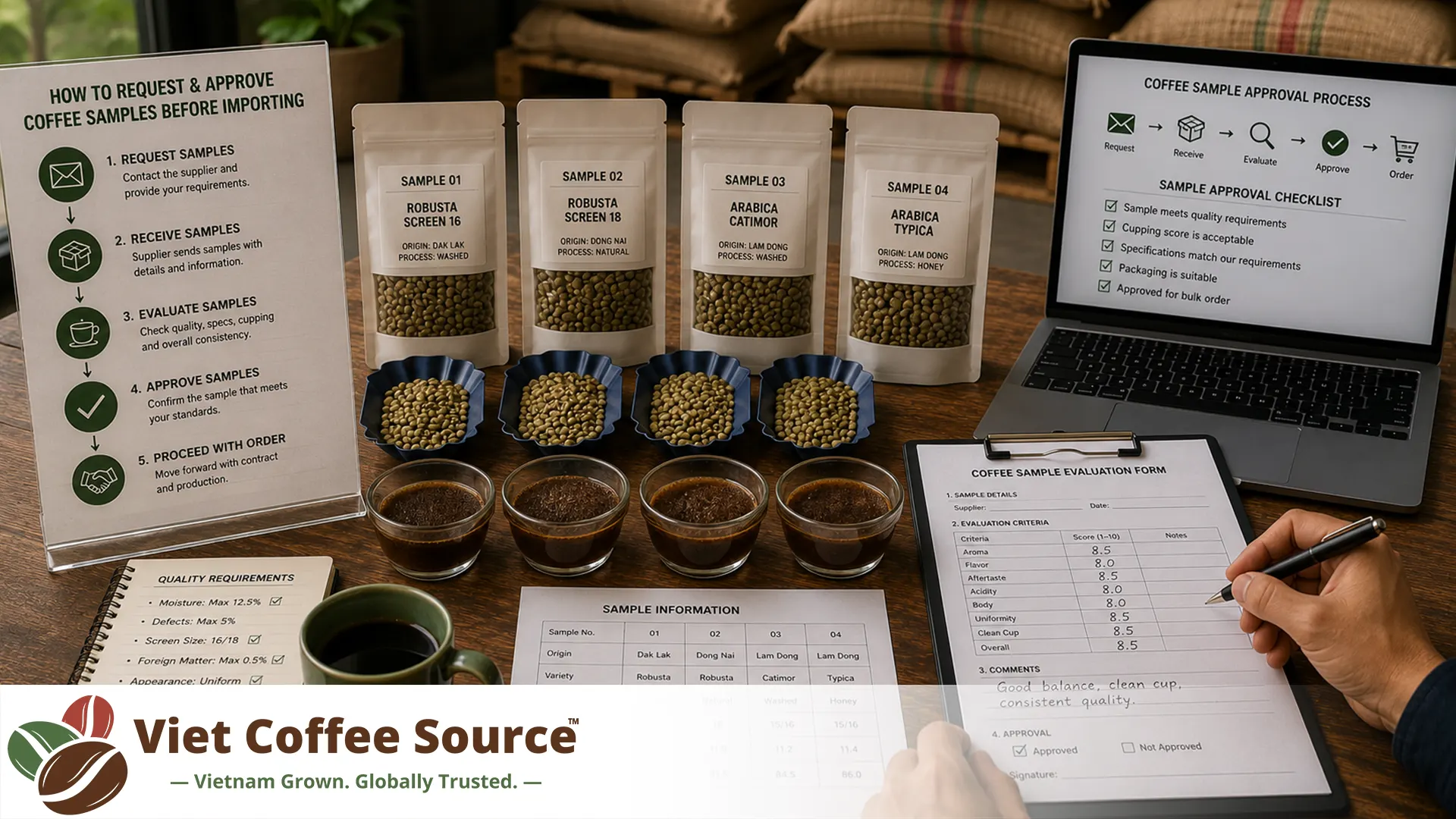
How to Request and Approve Coffee Samples Before Importing
Requesting and approving coffee samples before importing is one of the most important controls in wholesale coffee purchasing. A well-managed sampling process allows the buyer to evaluate quality, verify specifications, compare suppliers, test roasting or production performance and establish a clear reference for the commercial shipment. Without a documented sample-approval procedure, the buyer may approve one product informally and later receive a shipment that differs in screen size, moisture, defect count, cup profile, roast colour, grind, solubility, packaging or freshness.
The purpose of a sample is not merely to decide whether the coffee tastes good. The sample should help determine whether the supplier can deliver a product that matches the buyer’s technical, commercial and operational requirements. The request, preparation, shipment, testing, approval and retention of the sample should therefore follow a repeatable process.
This guide explains how importers, roasters, distributors, private-label brands, food manufacturers and hospitality suppliers can request and approve coffee samples before importing. It covers product specifications, sample types, quantities, shipping arrangements, laboratory checks, cupping, production trials, packaging evaluation, approval records, retained samples and pre-shipment verification.
Define the purpose of the sample before requesting it
The buyer should first determine what decision the sample is intended to support. A sourcing sample, pre-contract sample, production sample and pre-shipment sample do not serve exactly the same purpose.
A sample may be requested to:
- Evaluate a new supplier
- Compare several origins or grades
- Confirm physical specifications
- Assess cup quality
- Develop a roast profile
- Test espresso or filter performance
- Evaluate instant coffee solubility
- Approve an OEM formulation
- Review private-label packaging
- Confirm consistency before shipment
- Investigate a quality complaint
The request should explain the intended use so the supplier can send the correct material. A small green-coffee sample may be suitable for grading and cupping but insufficient for pilot roasting, packaging trials or industrial production tests.
Identify the correct type of coffee sample
Different stages of a purchase may require different sample categories. The buyer should avoid treating every sample as if it represents the final shipment.
| Sample type | Main purpose | Commercial limitation |
|---|---|---|
| Offer sample | Initial evaluation of an available coffee | The lot may change before purchase |
| Type sample | Shows the supplier’s normal product standard | May not come from the exact commercial lot |
| Stock-lot sample | Represents an identified available lot | The lot may be sold unless reserved |
| Production-development sample | Used for roasting, blending, grinding or formulation trials | May be produced on pilot equipment |
| Packaging sample | Used to approve materials, artwork and construction | May not contain final commercial product |
| Pre-shipment sample | Represents coffee prepared for the actual shipment | Must be linked clearly to the shipment batch |
| Retention sample | Preserved as a reference after approval | Must be sealed and stored correctly |
The supplier should state whether the sample comes from the exact lot, a representative stock, a pilot production run or a general reference product.
Prepare a complete sample request
A vague request such as “send your best Robusta” or “send a premium Arabica sample” is unlikely to produce a useful result. The buyer should provide enough information for the supplier to select or prepare the correct product.
A complete request may include:
- Product category
- Coffee species
- Origin or preferred region
- Processing method
- Crop year
- Grade or screen size
- Maximum moisture
- Maximum defect tolerance
- Required cup profile
- Roast level when applicable
- Whole-bean or ground format
- Grind size
- Instant coffee type
- Blend composition when relevant
- Packaging format
- Estimated commercial quantity
- Destination country
- Intended application
Buyers can review the supplier’s Vietnamese coffee origins and growing regions before selecting the most suitable sample categories.
Convert expectations into measurable specifications
Sensory descriptions are useful but should be combined with measurable limits. Terms such as strong, smooth, premium, clean or dark can be interpreted differently by different suppliers.
For green coffee, the sample specification may include:
- Species and variety
- Country and region
- Processing method
- Screen distribution
- Moisture content
- Water activity when required
- Defect count
- Black and broken bean tolerance
- Foreign-matter tolerance
- Density
- Odour requirements
- Cup score or internal sensory standard
- Prohibited cup defects
For roasted or processed coffee, the request may include:
- Blend ratio
- Roast colour
- Roast loss
- Whole-bean appearance
- Grind size and distribution
- Extraction performance
- Solubility
- Bulk density
- Moisture
- Ingredients
- Shelf life
- Pack size
- Seal and valve requirements
Request enough sample quantity for the planned tests
The quantity should match the evaluation programme. Too little coffee can prevent the buyer from repeating tests or comparing results across teams.
| Evaluation activity | Sample quantity consideration |
|---|---|
| Visual grading and moisture testing | A modest but representative green-coffee sample may be sufficient |
| Cupping | Enough material for repeated roasting and multiple bowls |
| Roast development | Several trial batches may be required |
| Espresso testing | Sufficient roasted coffee for grinder adjustment and repeated extraction |
| Retail packaging trial | Enough product to fill, seal, handle and inspect several packs |
| Industrial or food-service test | A larger development quantity may be necessary |
| Instant coffee formulation | Enough material for solubility, sensory and stability trials |
The buyer should also retain part of the sample unopened. Testing the entire sample leaves no reference for later comparison.
Confirm whether the sample is free or chargeable
Suppliers may provide small standard samples without charge while asking the buyer to pay courier costs. Larger development samples, specialty lots, custom roasting, private-label prototypes and repeated revisions may be chargeable.
Before dispatch, both parties should confirm:
- Sample price
- Courier cost
- Customs or import charges
- Payment method
- Whether the cost is refundable
- Whether the cost will be deducted from a commercial order
- Number of revisions included
- Responsibility for failed delivery
A paid sample does not guarantee acceptance. The evaluation criteria should remain independent of whether the supplier charged for preparation.
Use a unique sample code
Every sample should have a unique code that connects the physical material with its specification and correspondence. Product names alone are not sufficient because several samples may have similar descriptions.
The code can identify:
- Supplier
- Origin
- Product type
- Lot or batch
- Preparation date
- Revision number
- Sample sequence
The same code should appear on the outer package, inner bag, sample form, laboratory report, cupping sheet and approval record.
Ask for a sample information sheet
The supplier should send structured information with the sample rather than relying on informal messages.
The sheet may include:
- Sample code
- Supplier name
- Product description
- Origin
- Region
- Crop year
- Processing method
- Lot number
- Available quantity
- Physical specifications
- Sensory description
- Packaging
- Price basis
- Offer validity
- Expected preparation time
- Certification status
The buyer should verify that the information sheet and the physical label match.
Clarify whether the commercial lot is reserved
A buyer may approve a stock-lot sample and later discover that the lot has been sold. Sample approval does not automatically reserve inventory.
The parties should clarify:
- Available commercial quantity
- Reservation period
- Deposit required for reservation
- Expiry of the offer
- Replacement procedure if the lot is sold
- Whether a replacement requires new approval
The buyer should not assume that a similar lot is equivalent to the approved one.
Agree on the sample shipping method
The shipping method should protect the product and comply with courier, customs and destination requirements.
The parties should confirm:
- Courier or postal service
- Tracking number
- Declared description
- Declared value
- Purpose of shipment
- Net and gross weight
- Food-sample restrictions
- Required permits
- Recipient details
- Person responsible for customs clearance
Incorrect declarations can delay the sample or cause customs authorities to reject it.
Pack green coffee samples to preserve their condition
Green coffee samples should be protected from moisture, odours, contamination and loss of identity during courier transport.
Suitable controls include:
- Clean food-compatible inner bag
- Reliable closure
- Moisture-resistant outer protection
- Durable sample label
- Secondary protective envelope or box
- No contact with perfumed or chemical products
- Enough empty space to avoid tearing
- Tamper-evident closure when necessary
A paper bag alone may provide insufficient protection during a long or humid journey.
Protect roasted and instant coffee samples
Roasted and instant coffee are especially sensitive to oxygen, moisture and packaging failure. The sample should be packed in the same or an equivalent barrier structure to the intended commercial product whenever possible.
The buyer should examine:
- Seal integrity
- Valve performance
- Pack inflation or collapse
- Evidence of leakage
- Moisture protection
- Aroma retention
- Lot coding
- Production date
- Best-before information
If the sample uses temporary packaging, the supplier should state that clearly. Approval of the coffee should not be interpreted automatically as approval of the final pack.
Record the sample condition when it arrives
The receiving team should inspect the courier package before opening it. Damage during transport can alter the sample and lead to an incorrect supplier evaluation.
The arrival record should include:
- Date received
- Courier tracking reference
- Condition of the outer package
- Condition of the inner package
- Sample code
- Seal condition
- Visible moisture
- Unusual odour
- Net weight
- Photographs when damaged
If the package is wet, open, contaminated or incorrectly labelled, the buyer should notify the supplier before testing.
Store the sample correctly before evaluation
Samples should not be left in reception areas, vehicles, warm offices or humid rooms. Poor storage after delivery can change the product before testing.
The sample-storage procedure should define:
- Temperature range
- Humidity control
- Protection from light
- Protection from odours
- Maximum time before testing
- Resealing after opening
- Restricted access
- Retention period
Green coffee, roasted coffee and instant coffee may require different storage conditions.
Check the sample identity before testing
Before beginning any evaluation, the buyer should confirm that the sample received is the sample requested.
Verify:
- Sample code
- Product name
- Origin
- Lot number
- Processing method
- Roast or grind format
- Pack size
- Revision number
- Supporting documents
Testing a mislabelled or substituted sample wastes time and may lead to approval of the wrong product.
Perform a physical evaluation of green coffee
The physical examination should follow a consistent internal or contractual method.
Checks may include:
- Sample weight
- Bean appearance
- Colour
- Odour
- Moisture content
- Water activity when required
- Screen-size distribution
- Defect count
- Black and broken beans
- Foreign matter
- Density
- Uniformity
- Evidence of insect damage
- Evidence of mould
The buyer should use the same grading rules for all competing suppliers so the comparison remains fair.
Use calibrated equipment and documented methods
Sample approval should not depend on unverified equipment. Moisture meters, scales, screens, colour instruments and laboratory devices should be checked and maintained.
The evaluation record should state:
- Equipment used
- Calibration status
- Testing method
- Sample preparation
- Operator
- Date
- Results
- Any deviation from the standard method
These controls can be integrated into broader quality, compliance and traceability procedures.
Roast green samples consistently
Cupping results are influenced by sample roasting. Two coffees cannot be compared fairly if they are roasted using substantially different profiles.
The sample-roasting procedure should control:
- Batch weight
- Roaster condition
- Charge temperature
- Roast time
- Development
- Target colour
- Cooling time
- Resting time before cupping
- Cleaning between samples
The roast should reveal the coffee’s quality rather than force every sample into a commercial production profile.
Conduct a structured cupping evaluation
Cupping should be performed using a consistent protocol. The panel should avoid knowing the supplier identity when blind comparison is practical.
The assessment may cover:
- Fragrance and aroma
- Flavour
- Aftertaste
- Acidity
- Body
- Balance
- Sweetness
- Uniformity
- Clean cup
- Defects
- Overall suitability
Commercial suitability should also be considered. A high-scoring coffee may still be unsuitable for the buyer’s intended blend, price point or consumer profile.
Use more than one evaluator when possible
Relying on one person increases the effect of individual preference, fatigue and inconsistency. A small panel provides a stronger approval decision.
The company can define:
- Minimum number of evaluators
- Required experience
- Blind-testing rules
- Scoring method
- Minimum acceptance score
- Method for resolving disagreement
- Rules for retesting
Large differences between panel members should be discussed before final approval.
Test the sample in its intended application
Cupping alone may not predict performance in espresso, filter brewing, vending, extraction, food manufacturing or private-label retail.
Application testing may include:
- Production roasting
- Espresso extraction
- Filter brewing
- Milk-beverage performance
- Cold-brew extraction
- Grinding behaviour
- Vending-machine use
- Solubility testing
- Food formulation
- Consumer tasting
The sample should be evaluated under conditions similar to its intended commercial use.
Perform a pilot roast before approving large volumes
A small sample roaster may not predict exactly how the coffee behaves in a production roaster. For significant purchases, a larger trial can reveal heat-transfer behaviour, roast consistency, chaff levels, weight loss and flavour development.
The pilot record may include:
- Green input weight
- Roasted output weight
- Roast loss
- Roast curve
- Colour
- Development time
- Physical appearance
- Cupping after resting
- Grinding performance
- Recommended production settings
Evaluate roasted coffee under realistic resting conditions
Roasted coffee changes after roasting. Evaluating it immediately may produce a result that differs from the coffee consumed after degassing and distribution.
The buyer may test at several intervals to understand:
- Early aroma development
- Degassing behaviour
- Espresso stability
- Flavour after normal distribution time
- Shelf-life evolution
The intended sale and consumption timeline should guide the evaluation.
Assess instant coffee beyond flavour
Instant coffee samples require physical and functional tests in addition to sensory evaluation.
Checks may include:
- Particle appearance
- Colour
- Aroma
- Moisture
- Bulk density
- Solubility in hot water
- Solubility in cold water when relevant
- Sediment
- Foam
- Caking tendency
- Flowability
- Performance in sachet filling
The buyer should test using the water volume, temperature and preparation method expected in the target market.
Evaluate blends against a defined target
A blend should be compared with an approved benchmark rather than judged only as an isolated cup.
The target may define:
- Flavour intensity
- Bitterness
- Acidity
- Body
- Crema
- Milk compatibility
- Aroma
- Cost range
- Robusta and Arabica balance
- Consistency across roast levels
If the supplier revises the blend, each revision should receive a new sample code.
Separate product approval from packaging approval
The coffee and its packaging should be approved through related but distinct decisions. A buyer may accept the product while rejecting the pouch, valve, carton, label or coding method.
Packaging approval may examine:
- Material structure
- Food-contact suitability
- Moisture and oxygen barrier
- Seal strength
- Valve installation
- Print quality
- Colour accuracy
- Label language
- Barcode readability
- Lot coding
- Date coding
- Carton strength
- Case configuration
The approval form should state clearly which elements have been accepted.
Review certificates and laboratory reports
Depending on the product and destination market, the buyer may request supporting documents with the sample.
These may include:
- Certificate of analysis
- Quality report
- Residue analysis
- Mycotoxin report
- Microbiological results
- Ingredient specification
- Allergen statement
- Food-contact declaration
- Certification documents
- Traceability summary
The buyer should verify that reports identify the same sample or lot and that the laboratory, date and methods are suitable.
Do not assume certification replaces sample testing
Certification can provide useful evidence about a system or claim, but it does not prove that every coffee sample matches the buyer’s sensory and technical requirements.
Sample approval should still confirm:
- Physical quality
- Cup profile
- Product performance
- Packaging suitability
- Commercial consistency
Define acceptance criteria before testing
The buyer should establish pass-and-fail criteria before seeing the final results. Changing the standard after receiving an attractive offer can create inconsistent purchasing decisions.
| Evaluation area | Possible decision rule |
|---|---|
| Physical specification | All mandatory limits must be met |
| Sensory quality | Minimum score and no prohibited defects |
| Application test | Must meet extraction, flavour or production target |
| Packaging | Must pass seal, artwork and handling checks |
| Documentation | Required reports must be complete and consistent |
| Commercial suitability | Quality and cost must fit the intended market |
Record the approval decision formally
Approval should not be communicated only through a casual message. A formal record reduces misunderstanding and creates a reference for the contract and shipment.
The approval document may include:
- Sample code
- Supplier
- Product description
- Lot or revision
- Date received
- Tests completed
- Results
- Approved specification
- Approved packaging
- Permitted tolerances
- Conditions of approval
- Approver name
- Approval date
- Expiry of approval when applicable
The decision should be clearly stated as approved, conditionally approved, revision required or rejected.
Use conditional approval carefully
Conditional approval may be appropriate when the coffee is acceptable but a limited issue must be corrected before production or shipment.
Examples include:
- Minor artwork correction
- Different carton strength
- Adjusted grind size
- Updated ingredient declaration
- Lower moisture requirement
- Revised roast colour
The condition should be measurable, assigned to a responsible party and verified through a revised sample or documented evidence.
Retain sealed reference samples
Both buyer and supplier should retain sealed samples of the approved product. These samples provide a reference if the commercial shipment is disputed.
The retention procedure should define:
- Quantity retained
- Number of sealed units
- Sample code
- Storage conditions
- Security seal
- Retention period
- Access authority
- Disposal procedure
The retained sample should not be repeatedly opened for routine checks. Working samples and reference samples should be separated.
Link the approved sample to the purchase contract
The contract should identify the approved sample code and explain how it relates to the written specification.
The agreement should clarify:
- Whether the sample or written specification takes priority
- Permitted natural variation
- Prohibited defects
- Whether substitution is allowed
- Whether a new lot requires approval
- Pre-shipment sampling requirements
- Remedies for non-conformity
Natural agricultural variation should be recognised, but tolerances must not be so broad that the approved reference loses meaning.
Request a pre-shipment sample from the actual batch
An approved offer sample does not eliminate the need for pre-shipment verification. The buyer should request a sample taken from the coffee actually prepared for loading.
The pre-shipment sample should be linked to:
- Purchase contract
- Production batch
- Warehouse lot
- Quantity prepared
- Packing date
- Container booking
- Shipment reference
The sample must be representative of the commercial batch rather than specially prepared separately.
Define how the pre-shipment sample is collected
The contract or quality agreement should state who takes the sample and how it is obtained.
Possible arrangements include:
- Supplier quality team sampling
- Buyer representative sampling
- Independent inspection company sampling
- Joint sampling
- Sampling during packing
- Sampling from finished warehouse stock
The number of bags, cartons or units sampled should reflect the shipment size and risk.
Allow enough time for approval before loading
The sample should reach the buyer early enough for physical testing, roasting, cupping and written approval. Sending it immediately before the vessel cut-off creates pressure to accept without complete evaluation.
The schedule should include:
- Sampling date
- Courier dispatch
- Expected delivery
- Testing period
- Buyer response deadline
- Correction period
- Loading date
The supplier should not load the coffee before receiving the required written approval unless the contract explicitly permits another arrangement.
Do not treat silence as approval
Unless clearly agreed, the buyer’s failure to respond should not be interpreted as acceptance. Courier delays, customs problems or internal testing schedules may prevent a timely answer.
Approval should be affirmative and documented.
Compare the pre-shipment sample with the retained reference
The buyer should compare the commercial-batch sample against the approved reference using the same methods applied during the original evaluation.
The comparison may cover:
- Physical appearance
- Moisture
- Screen distribution
- Defect level
- Roast behaviour
- Cup profile
- Colour
- Grind
- Solubility
- Packaging
Differences should be evaluated against the agreed tolerance rather than personal memory.
Define actions when the sample fails
The process should explain what happens when a sample does not meet the approved standard.
Possible actions include:
- Additional sampling
- Regrading
- Recleaning
- Resorting
- Reblending
- Repacking
- Roast adjustment
- Replacement batch
- Price adjustment
- Order cancellation
The supplier should not replace the rejected batch with another lot without the buyer’s approval.
Use independent inspection for higher-risk purchases
Independent inspection may be appropriate for first orders, high-value specialty coffee, large shipments, strict specifications or suppliers with limited history.
An inspection company may support:
- Warehouse verification
- Sampling
- Weight checks
- Physical grading
- Moisture testing
- Packaging inspection
- Loading supervision
- Seal verification
The scope, method and responsibility for cost should be agreed before the inspection.
Maintain a sample register
A central register prevents samples, revisions and decisions from becoming confused.
The register may track:
- Sample code
- Supplier
- Product
- Request date
- Dispatch date
- Arrival date
- Lot number
- Tests planned
- Approval status
- Revision history
- Retention location
- Commercial order reference
Digital records should preserve previous versions rather than overwriting them.
Protect confidential product-development samples
OEM blends, formulations, packaging concepts and market-specific prototypes may contain confidential commercial information.
Controls may include:
- Confidentiality agreement
- Restricted access
- Coded labels
- Secure storage
- Controlled disposal
- Prohibition of unauthorised production
- Ownership rules for formulas and artwork
Common mistakes when requesting coffee samples
- Requesting coffee without measurable specifications
- Failing to state the intended application
- Requesting too little material
- Not asking whether the sample represents the actual lot
- Ignoring courier and customs requirements
- Accepting samples without unique codes
- Not checking the condition on arrival
- Testing samples after poor storage
- Using inconsistent roast or cupping methods
- Relying on one evaluator
- Approving coffee without application testing
- Confusing coffee approval with packaging approval
- Not retaining sealed reference samples
- Failing to link approval to the contract
- Skipping the pre-shipment sample
- Allowing loading before written approval
Checklist for requesting and approving coffee samples
- Define the purpose of the sample.
- Select the correct sample type.
- Prepare measurable product specifications.
- State the intended commercial application.
- Request sufficient quantity for all tests.
- Confirm sample and courier costs.
- Assign a unique sample code.
- Request a complete information sheet.
- Confirm whether the commercial lot is reserved.
- Agree on the shipping method.
- Confirm customs requirements.
- Require protective sample packaging.
- Record the condition on arrival.
- Store the sample correctly.
- Verify the sample identity.
- Complete physical testing.
- Use calibrated equipment.
- Apply a consistent sample roast.
- Conduct structured cupping.
- Use more than one evaluator when possible.
- Test the coffee in its intended application.
- Complete a pilot production trial when necessary.
- Evaluate packaging separately.
- Review certificates and laboratory reports.
- Compare results with predefined criteria.
- Record the approval decision formally.
- Verify every conditional approval.
- Retain sealed reference samples.
- Link the approved sample to the contract.
- Request a pre-shipment sample from the actual batch.
- Allow enough time for testing.
- Issue written approval or rejection.
- Define corrective actions for failed samples.
- Use independent inspection when appropriate.
- Maintain a central sample register.
Final assessment
A reliable coffee sample-approval process protects the buyer before money, production capacity and shipping commitments are placed at risk. The process should begin with a precise request, continue through controlled shipping and structured evaluation, and end with formal approval linked to the purchase contract.
The most important distinction is between an attractive introductory sample and a sample that genuinely represents the commercial shipment. Buyers should establish measurable specifications, use consistent physical and sensory methods, test the coffee in its intended application and retain sealed references.
Pre-shipment approval is especially important because coffee is an agricultural product and commercial lots may vary. A sample taken from the actual prepared batch provides the buyer with a final opportunity to identify unacceptable differences before loading.
Businesses sourcing green coffee, roasted coffee, instant coffee, custom blends or private-label products can review available coffee export and supply solutions or submit a customised wholesale coffee inquiry with their sample, specification, quantity, packaging and destination requirements.