
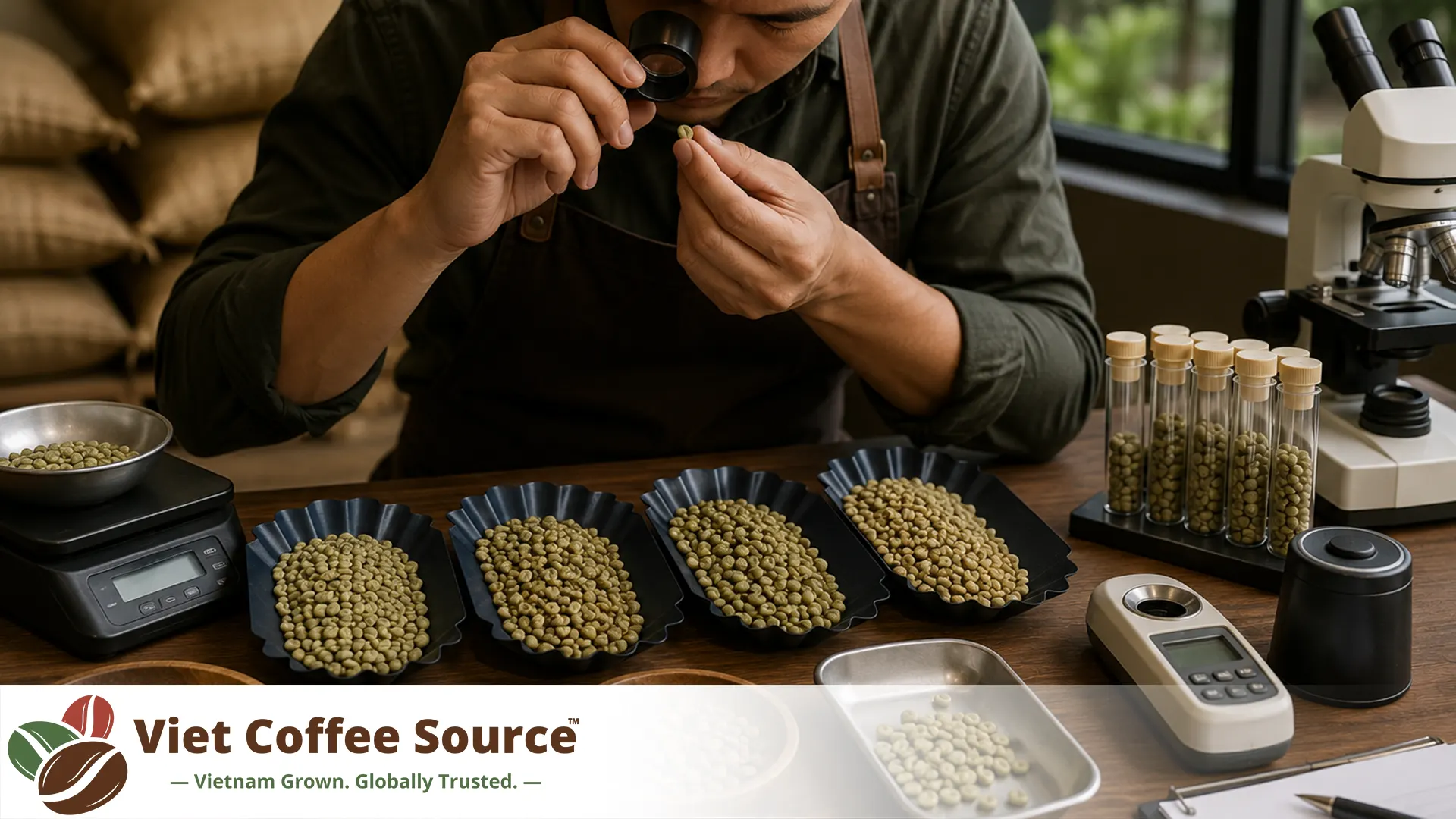
How to Evaluate Green Coffee Quality Before Buying
Evaluating green coffee quality before buying requires a structured review of the physical beans, sensory performance, lot consistency, traceability, storage condition, packaging and supplier controls. A green coffee sample should not be approved only because it looks attractive, carries a recognised origin name or produces one pleasant cup. Professional buyers need evidence that the offered lot meets measurable specifications, performs reliably in the intended roast profile and can be delivered in the agreed condition and quantity.
Quality evaluation should begin before the commercial order is signed. The buyer should define the intended use, request a representative sample, verify the sample identity, conduct physical analysis, roast the sample consistently, cup multiple bowls, compare the results with the target profile and confirm that the final shipment will match the approved reference. For larger, higher-value or first-time purchases, independent inspection may also be appropriate.
This process is relevant to specialty roasters, commercial roasters, espresso-blend manufacturers, instant coffee producers, importers, distributors, food-service suppliers and private-label brands. Although their sensory targets may differ, all buyers benefit from measurable specifications, representative sampling and documented approval procedures.
Why green coffee quality must be evaluated before purchase
Green coffee is an agricultural product. Its quality can vary according to variety, altitude, harvest maturity, processing, fermentation, drying, storage, sorting and transport. Even coffees from the same region or supplier can differ between crop years, production lots and warehouse positions.
Pre-purchase evaluation helps buyers:
- Confirm whether the lot suits the intended product
- Identify physical and sensory defects
- Estimate roasting behaviour
- Compare suppliers on the same basis
- Reduce the risk of shipment rejection
- Create measurable contract specifications
- Establish a reference sample for arrival inspection
- Protect product consistency and brand reputation
A low-priced coffee can become expensive if it creates sorting loss, roast inconsistency, customer complaints or production downtime. Likewise, a high-scoring sample may offer poor commercial value if the supplier cannot reproduce the quality or deliver the required volume.
Step 1: Define the intended use
Green coffee quality should always be evaluated in relation to its final application. A coffee intended for a light-roast single-origin product requires different characteristics from one intended for an espresso blend, dark roast or soluble coffee line.
| Intended use | Main evaluation priorities |
|---|---|
| Specialty filter coffee | Clean cup, sweetness, acidity, complexity, origin character and traceability |
| Espresso blend | Body, crema, sweetness, balance, roast stability and consistency |
| Commercial roasted coffee | Reliable flavour, low defect risk, stable supply and competitive cost |
| Instant coffee | Extract yield, soluble solids, body, consistency and industrial suitability |
| Dark-roast programme | Strong structure, body, defect resistance and tolerance to higher roast development |
| Private-label product | Repeatability, target flavour, documentation, packaging and long-term availability |
The buyer should prepare a written product brief that states the preferred species, origin, processing method, cup profile, roast level, annual volume, packaging and commercial target.
Step 2: Confirm that the sample is representative
A sample is useful only if it accurately represents the lot being offered. Attractive pre-offer samples that have been specially selected may not match the commercial shipment.
The buyer should request:
- A unique sample code
- The related lot number
- Available lot quantity
- Warehouse location
- Crop year
- Date of sampling
- Sampling method
- Confirmation that the sample represents the offered stock
For large lots, a composite sample taken from several bags or warehouse positions is usually more reliable than a single small scoop. When the purchase risk is high, an independent party may collect or supervise the sample.
Step 3: Verify origin and traceability
Origin information should be specific enough to support the product claim and the buyer’s compliance requirements. A country name alone may be insufficient for specialty, sustainability or traceability programmes.
Traceability may include:
- Country
- Province or production region
- District
- Farm or cooperative
- Collection area
- Producer group
- Processing station
- Production lot
- Warehouse lot
Buyers evaluating Vietnamese coffee can review Vietnamese coffee origins and growing regions to compare production areas, altitude ranges and common product types.
Step 4: Confirm species, variety and processing method
The buyer should verify whether the coffee is Arabica, Robusta or another commercial type and whether the stated variety is supported by credible records. Processing method should also be documented because it affects flavour, moisture behaviour and defect risk.
| Processing method | Expected potential | Primary quality risks |
|---|---|---|
| Washed | Clean profile, defined acidity and clear origin expression | Poor fermentation control, incomplete washing or uneven drying |
| Natural | Sweetness, fruit character and fuller body | Over-fermentation, mould, uneven drying and inconsistent fruit maturity |
| Honey | Balanced sweetness, body and acidity | Sticky mucilage, inconsistent drying and fermentation variation |
| Wet-hulled | Heavy body and distinctive regional character | High moisture, unstable storage and physical inconsistency |
| Experimental or anaerobic | Intense and unusual flavour | Repeatability, taints and unstable fermentation outcomes |
The processing name alone does not guarantee quality. The actual physical and sensory results remain more important than the marketing description.
Step 5: Check the crop year and age of the coffee
Crop age can influence colour, aroma, moisture behaviour and cup freshness. New-crop coffee often appears more vibrant, while older coffee may develop faded colour, lower aroma intensity or woody and baggy notes.
The buyer should confirm:
- Harvest start and end dates
- Crop year
- Processing date
- Time spent in storage
- Whether the lot contains mixed crop years
- Whether the coffee is current crop, past crop or carry-over stock
Older coffee may still be commercially usable, especially for some blends or darker roasts, but the age should be transparent and reflected in the price and quality expectation.
Step 6: Inspect the green beans visually
Visual inspection can reveal signs of uneven processing, poor sorting, storage damage and contamination. The sample should be spread under neutral light on a clean tray.
Review the following:
- Overall colour
- Colour uniformity
- Bean size
- Shape consistency
- Broken or chipped beans
- Black or sour beans
- Insect damage
- Immature beans
- Shells and husks
- Foreign matter
- Water staining
- Visible mould
Colour should be interpreted in relation to species, origin, processing method and crop age. Uneven colour may indicate mixed moisture, mixed crop, inconsistent drying or poor lot separation.
Step 7: Measure moisture content
Moisture content is one of the most important physical quality indicators. Excessive moisture increases the risk of mould, deterioration, condensation damage and unstable storage. Very low moisture can make beans brittle and affect heat transfer during roasting.
Many commercial specifications use a moisture range around 10% to 12.5%, although the suitable range depends on origin, product, transport route and contract terms.
The evaluation should document:
- Moisture meter type
- Calibration status
- Number of readings
- Average result
- Highest and lowest result
- Variation between sub-samples
- Temperature of the sample during measurement
A single reading from one small part of the sample may hide significant variation. Multiple measurements provide a more reliable result.
Step 8: Measure water activity when relevant
Water activity indicates how available the moisture is for chemical and microbiological activity. Coffee with acceptable moisture content may still present storage risk if water activity is unusually high or inconsistent.
Water activity can support evaluation of:
- Storage stability
- Mould risk
- Drying uniformity
- Potential shelf life
- Variation within the lot
This test is particularly useful for specialty coffee, long-distance transport, humid destinations and high-value lots.
Step 9: Analyse screen-size distribution
Screen size describes bean dimensions using sieves with standardised openings. Large beans are not automatically higher quality, but a uniform size distribution can support more even roasting.
| Screen factor | Why it matters |
|---|---|
| Main screen size | Supports product classification and roast planning |
| Percentage above target screen | May roast more slowly |
| Percentage below target screen | May roast more quickly |
| Overall distribution | Indicates size uniformity |
| Consistency between lots | Supports repeatable roast profiles |
A specification such as Screen 18 should include the minimum percentage retained on the stated screen and the permitted percentages on neighbouring screens.
Step 10: Evaluate density
Density can provide information about bean structure, maturity, altitude and roast behaviour. Higher-density beans may require more energy or a different heat application than lower-density beans.
Density should not be treated as an independent quality score. It must be interpreted together with origin, variety, moisture, processing and cup quality.
For roasters, density may influence:
- Charge temperature
- Gas application
- Airflow
- Batch size
- Development time
Step 11: Conduct a formal defect analysis
Defect analysis is central to green coffee grading. The sample weight and counting standard must be defined because different systems classify and weight defects differently.
Common defects include:
- Full black beans
- Partial black beans
- Full sour beans
- Partial sour beans
- Dried cherries
- Fungus-damaged beans
- Severe insect damage
- Broken or chipped beans
- Immature beans
- Shells
- Husks
- Foreign matter
The buyer should record both the total defect count and the categories found. Two lots with the same overall count can create different sensory risks depending on the defect types.
Step 12: Verify black and broken percentages
Commercial Robusta and certain other grades are often sold according to maximum black and broken percentages. These values must be supported by a defined testing method.
Clarify whether the figures are:
- Measured by weight or count
- Reported separately or combined
- Based on a representative sample
- Measured before or after final sorting
- Confirmed by an independent report
A description such as “0.1% black and broken” is incomplete if the sampling and calculation method are not stated.
Step 13: Check foreign matter and preparation quality
Foreign matter can damage equipment, create food-safety risks and lead to customer complaints. It may include stones, wood, metal, glass, soil, husk or other non-coffee material.
Professional export preparation may include:
- Pre-cleaning
- Destoning
- Magnetic separation
- Screen grading
- Gravity separation
- Colour sorting
- Manual inspection
The buyer should confirm which preparation stages are included in the offered specification and price.
Step 14: Smell the green sample
Green coffee should have a clean smell consistent with its origin and processing method. Strong or unusual odours may indicate contamination or storage problems.
Warning odours include:
- Mould
- Mustiness
- Chemicals
- Fuel
- Smoke
- Spices
- Excessive fermentation
- Warehouse contamination
Coffee readily absorbs surrounding odours, so the condition of the warehouse, bags and transport container is important.
Step 15: Use a consistent sample-roasting protocol
Physical analysis alone cannot confirm cup quality. The sample must be roasted under controlled and repeatable conditions.
The roasting protocol should define:
- Sample weight
- Roaster model
- Charge temperature
- Total roast time
- First-crack timing
- Development time
- Target colour
- Cooling method
- Resting period before cupping
When samples are roasted differently, the buyer may be comparing roast execution rather than the quality of the green coffee.
Step 16: Cup several bowls
Multiple bowls should be prepared from the same sample to identify uniformity and isolated defects. A single cup is not sufficient for commercial approval.
Cupping should assess:
- Fragrance and aroma
- Flavour
- Acidity
- Body
- Sweetness
- Aftertaste
- Balance
- Uniformity
- Clean cup
- Defect intensity
The buyer should evaluate the coffee according to its intended application. A strong, low-acidity Robusta may perform very well in espresso even if it is not suitable for a delicate filter profile.
Step 17: Identify sensory defects
Sensory defects may not be visible in the green sample. Cupping can reveal processing, drying, storage or contamination problems.
Possible defects include:
- Phenolic character
- Mouldy flavour
- Over-fermented notes
- Potato defect
- Earthiness
- Baggy or woody flavour
- Rubbery notes
- Smoky contamination
- Chemical taint
- Unclean aftertaste
A defect found in one bowl may indicate a localised issue. The same defect appearing in several bowls may indicate a broader lot problem.
Step 18: Test the intended commercial roast
A laboratory sample roast supports comparison, but the coffee should also be tested using the roast profile planned for production.
The buyer should evaluate:
- Heat response
- First-crack behaviour
- Development flexibility
- Colour uniformity
- Weight loss
- Surface scorching or tipping
- Flavour at the target roast level
- Performance after resting
A coffee that performs well in a light sample roast may lose balance in a dark roast, while another coffee may show its best commercial value at a medium or dark development.
Step 19: Test blend compatibility
If the coffee will be used in a blend, it must be tested with the intended components. An isolated cup score does not show how the coffee will contribute to the final product.
Blend evaluation should consider:
- Body contribution
- Acidity balance
- Crema
- Sweetness
- Bitterness
- Aftertaste
- Aroma stability
- Cost contribution
A coffee with a moderate individual score can still be highly valuable if it supplies body, crema or balance to the blend.
Step 20: Check consistency across multiple samples
Consistency is essential for commercial roasting. Buyers should not assume that one small sample represents the entire warehouse lot or future shipments.
Consistency checks may include:
- Samples from multiple bags
- Samples from different warehouse positions
- Repeated moisture measurements
- Repeated defect counts
- Multiple sample roasts
- Several cupping sessions
- Comparison with previous shipments
For ongoing supply programmes, a slightly lower but stable quality may create more commercial value than one exceptional lot that cannot be repeated.
Step 21: Review the supplier’s quality-control system
The quality of the sample must be supported by a supplier capable of preparing and shipping the same product consistently.
Supplier controls may include:
- Documented sampling procedures
- Calibrated moisture meters
- Defect-analysis records
- Cupping facilities
- Lot-separation controls
- Warehouse hygiene
- Pest-control records
- Final cleaning and sorting
- Pre-shipment inspection
- Reference-sample retention
Buyers can review the supplier’s quality, compliance and traceability procedures before approving the purchase.
Step 22: Verify certifications and claims
Organic, sustainability, food-safety and chain-of-custody claims should be verified against current documents. A supplier may hold a certificate without every offered lot being covered.
Check:
- Certified legal entity
- Certificate number
- Scope
- Covered product
- Certified site
- Issue and expiry dates
- Transaction-certificate requirements
- Connection between the certificate and the offered lot
Marketing claims should not replace lot-specific documentation.
Step 23: Review contaminant and residue requirements
The destination market may regulate pesticide residues, mycotoxins, heavy metals and other contaminants. Requirements can vary significantly between countries and customer sectors.
The buyer should confirm:
- Applicable destination-market limits
- Available laboratory reports
- Sampling date
- Sampling method
- Laboratory accreditation
- Whether the report covers the exact lot
Independent laboratory testing may be appropriate for regulated markets or high-risk products.
Step 24: Review storage conditions
Even well-processed coffee can lose quality in poor storage. The buyer should assess how the lot has been stored since processing.
Important warehouse factors include:
- Temperature
- Relative humidity
- Ventilation
- Cleanliness
- Pallet use
- Distance from walls and floors
- Protection from water
- Separation from chemicals and strong odours
- Pest-control programme
- Stock-rotation method
Bags placed directly on a damp floor or near chemicals may absorb moisture or odours even when the beans originally met specification.
Step 25: Evaluate the packaging
Green coffee packaging must protect the lot during storage and international shipment. Packaging should match the coffee’s value, transit time, climate and handling method.
| Packaging type | Main benefit | Main limitation |
|---|---|---|
| Jute sack | Traditional, breathable and widely available | Limited protection from moisture and odours |
| Woven polypropylene sack | Durable and economical | Limited barrier when used without a liner |
| Hermetic liner | Improved moisture, oxygen and odour protection | Additional cost |
| Vacuum packaging | Strong protection for high-value microlots | Higher cost and specialised handling |
| Big bag | Efficient for industrial handling | Requires suitable warehouse and equipment |
The buyer should confirm bag weight, liner type, closure method, markings and pallet configuration.
Step 26: Evaluate shipment protection
Green coffee can be damaged by condensation, water entry, odours, dirty containers and poor stacking during shipment.
Pre-shipment controls may include:
- Clean and dry container
- Container odour inspection
- Floor and wall protection
- Desiccants
- Container liner
- Correct bag stacking
- Container seal verification
- Loading photographs
- Weight confirmation
Structured green coffee export and shipment controls help maintain quality between origin and destination.
Step 27: Request a complete quality report
The sample should be accompanied by a report that allows the buyer to compare lots and suppliers accurately.
The report may include:
- Sample code
- Lot number
- Origin
- Crop year
- Species and variety
- Processing method
- Moisture
- Water activity
- Screen distribution
- Density
- Defect count
- Black and broken percentage
- Cupping results
- Packaging
- Available volume
Reports should identify the test methods and the date on which the analysis was completed.
Step 28: Compare offers on an equal basis
Two coffee prices cannot be compared accurately unless the specifications and commercial conditions are equivalent.
| Comparison factor | Commercial importance |
|---|---|
| Origin and crop year | Influence freshness, availability and flavour |
| Processing method | Influences cup profile and risk |
| Screen distribution | Influences roast consistency |
| Moisture | Influences stability and net value |
| Defect limits | Influence sensory performance and sorting loss |
| Cup specification | Confirms suitability for the intended product |
| Packaging | Influences protection and freight efficiency |
| Incoterm | Defines included logistics costs |
| Payment terms | Influence risk and working capital |
| Available volume | Influences supply continuity |
A cheaper offer may contain older coffee, higher defect levels, weaker preparation or less protective packaging.
Step 29: Calculate the total commercial value
Evaluation should include more than the quoted price per tonne. Buyers should calculate the total landed and production cost.
Relevant costs may include:
- Coffee value
- Origin transport
- Export preparation
- Inspection
- Documentation
- Freight
- Insurance
- Import duty
- Port charges
- Customs clearance
- Domestic delivery
- Financing
- Sorting loss
- Roasting loss
- Quality-claim risk
A slightly more expensive coffee may provide better value if it creates less sorting loss, more consistent roasting and fewer customer complaints.
Step 30: Approve the sample in writing
The approved sample should be clearly linked to the purchase contract. Verbal approval creates unnecessary dispute risk.
The written approval should include:
- Sample code
- Lot number
- Date received
- Physical results
- Cupping results
- Approved specification
- Permitted tolerances
- Requirement that shipment matches the sample
- Requirement for a pre-shipment sample
Both buyer and seller should retain sealed reference samples until the transaction and claim period are complete.
Step 31: Include measurable terms in the contract
The contract should convert the approved quality into objective requirements.
Important terms may include:
- Origin
- Species and variety
- Crop year
- Processing method
- Grade
- Screen-size distribution
- Moisture range
- Water-activity limit when required
- Defect limits
- Black and broken limits
- Foreign-matter limit
- Cup-quality requirement
- Quantity and tolerance
- Packaging
- Incoterm
- Shipment period
- Inspection rights
- Claim procedure
Terms such as “premium quality” or “export grade” are too general unless supported by measurable limits.
Step 32: Consider independent inspection
Independent inspection can reduce risk for first orders, large shipments, unfamiliar suppliers or high-value lots.
The inspection may cover:
- Warehouse verification
- Lot sampling
- Moisture measurement
- Defect analysis
- Screen analysis
- Weight verification
- Bag-count confirmation
- Container inspection
- Loading supervision
- Seal confirmation
The contract should state who appoints the inspector, who pays the cost and whether the inspection result is final or advisory.
Step 33: Inspect the shipment on arrival
Pre-purchase approval does not remove the need for arrival inspection. The buyer should check the shipment before mixing it with general inventory.
Arrival checks may include:
- Container number
- Seal number
- Container condition
- Odour when opened
- Wet or damaged bags
- Bag count
- Random weight checks
- Moisture measurements
- Visual comparison with the reference
- Sample roasting
- Cupping against the approved sample
Potential claims should be documented immediately with photographs, retained samples, survey reports and written notice.
Common mistakes when evaluating green coffee quality
- Approving a sample without confirming the lot number
- Buying mainly on price
- Assuming a famous origin guarantees quality
- Judging quality only by bean size
- Accepting vague grade descriptions
- Taking only one moisture reading
- Ignoring water activity in high-risk lots
- Using inconsistent sample roasts
- Cupping only one bowl
- Ignoring sensory defects in a small number of cups
- Failing to test the production roast
- Not checking blend performance
- Approving a sample without retaining a reference
- Ignoring packaging and container condition
- Comparing offers with different Incoterms
Warning signs in a green coffee offer
- No clear crop-year information
- No identifiable lot number
- Sample data that changes between documents
- Refusal to provide a representative sample
- Unrealistically low price
- No measurable defect specification
- No moisture result
- Unverifiable certification
- No traceability beyond a broad country claim
- Refusal to allow inspection
- Bank account unrelated to the seller
- No pre-shipment quality report
Questions to ask before approving green coffee
- Which exact lot does this sample represent?
- What is the origin and production region?
- What is the crop year?
- Which species and variety are offered?
- What processing method was used?
- What is the moisture range?
- What is the water activity?
- What is the screen-size distribution?
- Which defect standard is used?
- What are the black and broken limits?
- How many bags or tonnes are available?
- How is the lot stored?
- Which preparation steps are included?
- Can a pre-shipment sample be provided?
- Can the lot be independently inspected?
Green coffee quality evaluation checklist
- Define the intended use.
- Prepare a written target specification.
- Request a representative coded sample.
- Confirm the sample lot and available quantity.
- Verify origin and traceability.
- Confirm species and variety.
- Confirm processing method.
- Check crop year and storage age.
- Inspect colour and physical appearance.
- Measure moisture several times.
- Measure water activity when relevant.
- Analyse screen-size distribution.
- Evaluate density.
- Conduct a formal defect count.
- Confirm black and broken percentages.
- Check foreign matter.
- Smell the green sample.
- Use a consistent sample-roasting protocol.
- Cup several bowls.
- Record sensory defects.
- Test the intended commercial roast.
- Evaluate blend compatibility.
- Compare multiple samples for consistency.
- Review supplier quality controls.
- Verify certificates and claims.
- Review contaminant requirements.
- Assess warehouse conditions.
- Check packaging.
- Plan shipment protection.
- Request a complete quality report.
- Compare offers on the same basis.
- Calculate total landed and production cost.
- Approve the sample in writing.
- Include measurable specifications in the contract.
- Arrange independent inspection when necessary.
- Inspect the shipment after arrival.
Final assessment
Green coffee quality should be evaluated through a combination of representative sampling, physical analysis, controlled roasting, cupping, traceability review and commercial verification. No single indicator, including origin, screen size, moisture, defect count or cup score, can provide a complete assessment on its own.
The best lot is not necessarily the one with the largest beans, the highest sample score or the lowest price. It is the coffee that matches the intended product, remains consistent across samples, roasts predictably, arrives in stable condition and complies with the written specification.
Buyers can reduce risk by assigning a unique code to each sample, retaining reference samples, recording physical and sensory results, requiring a pre-shipment comparison and including measurable limits in the purchase contract. Supplier capability, packaging, storage, shipment protection and document accuracy should be evaluated alongside flavour.
Businesses evaluating Vietnamese Robusta, Fine Robusta, Arabica, specialty lots or commercial green coffee can submit a customised green coffee inquiry with the required origin, crop year, processing method, screen size, moisture, defect limits, cup profile, quantity, packaging and destination.