
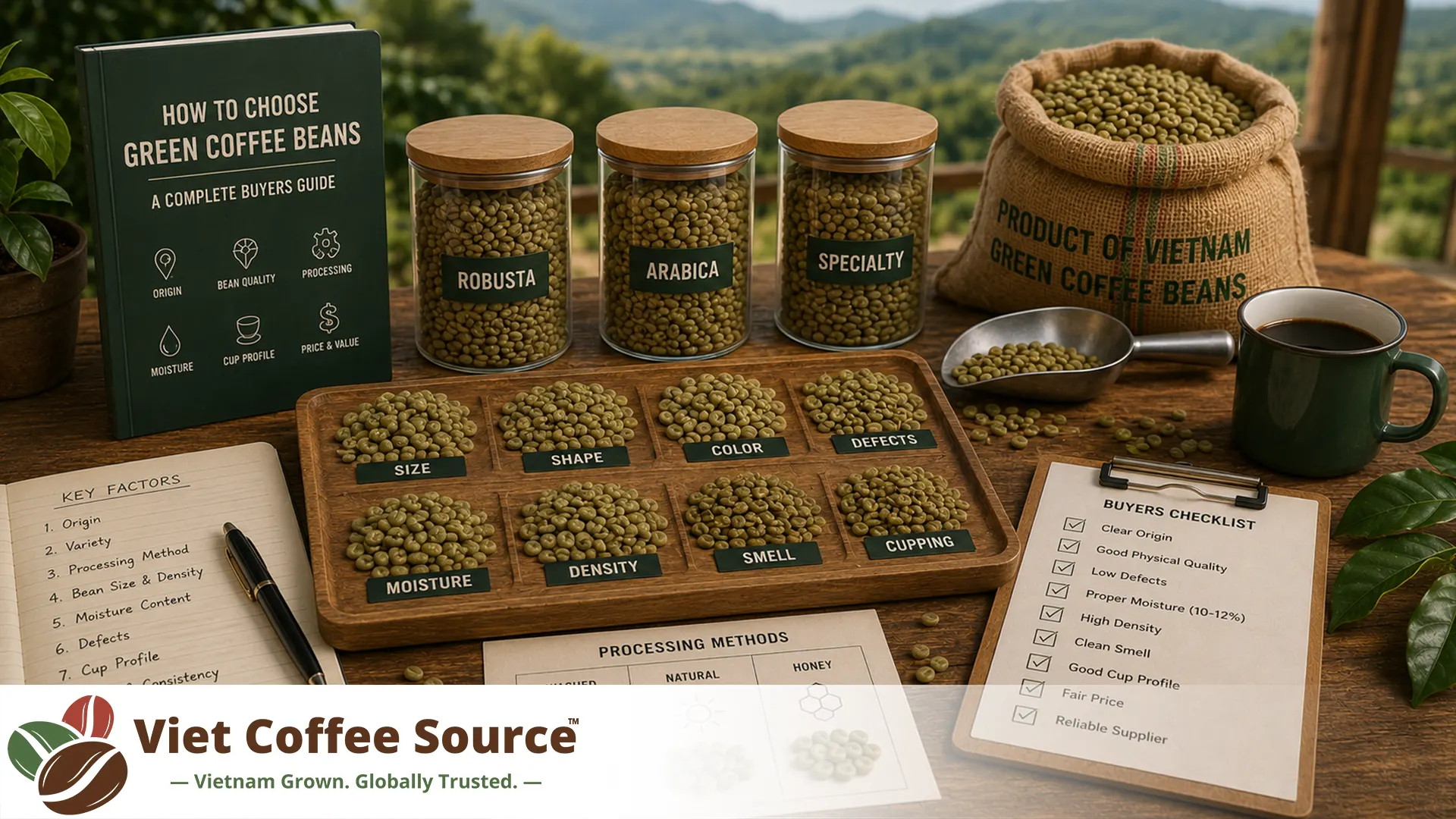
How to Choose Green Coffee Beans: A Complete Buyer’s Guide
Choosing green coffee beans requires much more than selecting an origin, comparing prices or accepting a sample that tastes good once. Professional buyers must evaluate the coffee’s intended use, species, variety, processing method, physical grade, moisture, defect profile, screen size, density, cup quality, traceability, crop age, packaging and shipment condition. The correct green coffee is the one that performs consistently in the buyer’s roasting system, meets the target market’s flavour expectations and can be supplied repeatedly at an acceptable total cost.
Green coffee buyers may include specialty roasters, commercial roasters, instant coffee manufacturers, importers, distributors, private-label producers and industrial beverage companies. Their requirements can differ significantly. A microlot selected for a light-roast filter programme will not be evaluated in the same way as a commercial Robusta intended for espresso blends or soluble coffee production.
A structured buying process should therefore begin with a clear product brief, continue through supplier verification, sample evaluation, physical analysis, roasting and cupping, and conclude with written specifications, shipment controls and arrival inspection. This guide explains the main factors buyers should review before purchasing green coffee beans.
What are green coffee beans?
Green coffee beans are coffee seeds that have been processed and dried but not yet roasted. After coffee cherries are harvested, the fruit is removed or dried around the seeds depending on the processing method. The beans are then dried, hulled, cleaned, graded, sorted and prepared for export.
Green coffee differs from roasted coffee because its commercial quality is assessed through both physical and sensory characteristics. Buyers examine the unroasted beans, roast samples under controlled conditions and cup the resulting coffee before deciding whether it is suitable.
Who buys green coffee beans?
- Specialty coffee roasters
- Commercial coffee roasters
- Espresso blend manufacturers
- Instant coffee producers
- Importers and distributors
- Private-label coffee companies
- Food-service suppliers
- Industrial beverage manufacturers
- Retail brands with contract roasters
The right product depends on how the coffee will be roasted, blended, brewed, marketed and priced.
Step 1: Define the intended use
The buyer should first determine how the coffee will be used. This decision influences every later quality requirement.
| Intended use | Typical priorities |
|---|---|
| Specialty filter coffee | Clean cup, origin character, sweetness, acidity and traceability |
| Espresso blend | Body, crema, sweetness, roast stability and blend consistency |
| Commercial roasted coffee | Reliable flavour, competitive cost and stable supply |
| Instant coffee | Extract yield, soluble solids, body, cost and industrial consistency |
| Private-label coffee | Repeatability, target flavour, pricing and long-term availability |
| Dark-roast programme | Bean structure, body, low defect risk and roast tolerance |
A coffee may perform very well in one application and poorly in another. Buyers should avoid evaluating all green coffee according to a single quality model.
Step 2: Choose between Arabica and Robusta
Arabica and Robusta are the two main commercial coffee species. They differ in flavour, caffeine, growing conditions, physical structure and price.
| Factor | Arabica | Robusta |
|---|---|---|
| Typical flavour | More aromatic, sweet, acidic and complex | Stronger body, lower acidity, earthy, chocolate or nutty notes |
| Caffeine | Lower | Higher |
| Common use | Specialty coffee, filter and premium blends | Espresso blends, commercial coffee and instant coffee |
| Growing conditions | Generally higher elevations and cooler climates | Generally lower elevations and warmer climates |
| Price position | Often higher | Often more competitive |
High-quality Robusta, including Fine Robusta, can offer clean flavour, strong body, sweetness and excellent espresso performance. Buyers should judge the actual lot rather than relying only on species reputation.
Step 3: Evaluate the origin
Origin influences flavour, processing style, crop calendar, availability and logistics. Country information alone may be too broad. Region, altitude, farm system, soil, climate and local processing practices can create important differences.
Origin evaluation may include:
- Country
- Province or region
- District or municipality
- Farm, cooperative or collection area
- Altitude range
- Climate
- Harvest season
- Typical processing methods
- Regional flavour profile
- Export-port access
Buyers interested in Vietnamese supply can review Vietnam’s coffee origins and production regions to understand the characteristics of areas such as Buon Ma Thuot, Dak Nong, Gia Lai and Da Lat.
Step 4: Consider variety and cultivar
Variety can influence yield, bean shape, disease resistance, cup quality and adaptation to local conditions. Common Arabica varieties include Bourbon, Typica, Catimor, Caturra, Mundo Novo, SL28 and Geisha. Robusta may be sold by local clone, selection or regional type rather than the variety names commonly used in specialty Arabica.
Variety information is most useful when it is supported by credible traceability. Buyers should be cautious when a seller makes a premium variety claim without reliable production records.
Step 5: Understand the processing method
The processing method strongly affects flavour, physical appearance and roasting behaviour.
| Processing method | Typical characteristics | Main buyer concern |
|---|---|---|
| Washed | Cleaner flavour, brighter acidity and clearer origin expression | Fermentation control and drying consistency |
| Natural | Fuller body, fruit notes and sweetness | Over-fermentation, uneven drying and mould risk |
| Honey | Balanced sweetness, body and acidity | Mucilage control and drying uniformity |
| Wet-hulled | Heavy body and distinctive earthy or herbal profile | Moisture, appearance and storage stability |
| Anaerobic or experimental | Intense and unusual flavour profile | Repeatability and flavour stability |
Processing names alone do not guarantee quality. Drying, fermentation, storage and lot separation determine whether the method produces a clean and stable result.
Step 6: Check the crop year and harvest timing
Crop year affects freshness, appearance, moisture behaviour and flavour. New-crop coffee may show stronger colour, aroma and cup liveliness. Older coffee may lose intensity, develop woody notes or become less stable during roasting.
The buyer should confirm:
- Harvest start and end dates
- Crop year
- Date of processing
- Time spent in origin storage
- Whether the coffee is current crop, past crop or carry-over stock
- Whether lots from different crop years have been mixed
Older coffee is not automatically unusable, but its age should be transparent and reflected in both evaluation and price.
Step 7: Review the grade
Green coffee grades are not globally standardised. Each origin may use different systems based on defect count, screen size, altitude, preparation or cup quality.
A grade name should therefore be supported by measurable specifications. Buyers should request the actual limits rather than relying only on labels such as Grade 1, Grade 2, Premium, Export Standard or Specialty.
A measurable grade may include:
- Maximum defect count
- Maximum black beans
- Maximum broken beans
- Maximum foreign matter
- Screen-size distribution
- Moisture range
- Maximum insect damage
- Minimum cup standard
Step 8: Inspect the green coffee visually
Visual inspection can reveal important information about processing, sorting, moisture and storage.
Buyers should examine:
- Bean colour
- Uniformity of size
- Shape consistency
- Broken beans
- Black or sour beans
- Insect damage
- Shells and husks
- Foreign matter
- Water damage
- Mould or unusual surface marks
Colour varies by origin, species, process and age. Uneven colour may indicate mixed moisture, mixed crop, inconsistent drying or storage problems.
Step 9: Measure moisture content
Moisture content is one of the most important physical indicators. Excessively high moisture can increase the risk of mould, quality deterioration and shipment damage. Excessively low moisture can make the beans brittle and reduce roasting consistency.
Many commercial green coffee specifications use a moisture range around 10% to 12.5%, but the correct range depends on origin, product and contract requirements.
The buyer should confirm:
- Measurement method
- Calibration of the moisture meter
- Number of samples tested
- Average result
- Variation within the lot
- Whether testing occurs before and after preparation
A single moisture result may not represent a large or uneven lot. Multiple samples provide better information.
Step 10: Consider water activity
Water activity measures how available moisture is for chemical and microbiological activity. Two coffees with similar moisture percentages can behave differently if their water activity differs.
Water activity can help buyers evaluate:
- Storage stability
- Mould risk
- Drying uniformity
- Potential shelf life
- Variation between samples
It is especially useful for specialty buyers, long-distance shipments and quality-sensitive programmes.
Step 11: Review screen size
Screen size describes bean dimensions using sieves with measured openings. Larger beans are not automatically better, but uniform size can improve roasting consistency.
| Screen consideration | Why it matters |
|---|---|
| Average size | Influences roast development and product position |
| Size distribution | Affects uniform heat transfer |
| Small-bean percentage | May roast faster than the main lot |
| Oversized-bean percentage | May roast more slowly |
| Consistency between shipments | Supports repeatable roasting |
Buyers should request screen distribution rather than only a statement such as Screen 18 or Screen 16. A lot may contain beans across several screen sizes.
Step 12: Evaluate density
Density can provide information about bean structure, altitude, development and roasting behaviour. Higher-density beans often require different heat application than lower-density beans.
Density should not be used alone as a quality score. It should be considered together with moisture, variety, process, origin and cup result.
Roasters may use density to adjust:
- Charge temperature
- Heat application
- Airflow
- Development time
- Batch size
Step 13: Count defects
Defect analysis is central to green coffee grading. Defects may affect appearance, roast consistency and cup quality.
Common defects include:
- Full black beans
- Partial black beans
- Full sour beans
- Partial sour beans
- Dried cherry
- Fungus damage
- Foreign matter
- Severe insect damage
- Broken or chipped beans
- Immature beans
- Shells
- Husks
The sampling weight and defect method must be defined. Different standards may count and classify defects differently.
Step 14: Check black and broken percentages
Commercial Robusta and some other grades are often quoted with maximum black and broken percentages. These figures affect both visual quality and cup performance.
The buyer should confirm whether the percentage is:
- Measured by weight or count
- Combined or separated
- Based on representative sampling
- Checked before or after final preparation
- Included in an independent inspection report
Two offers using the same phrase may still differ if the testing method is not defined.
Step 15: Check for foreign matter
Foreign matter may include stones, sticks, metal, glass, husk, soil or other non-coffee material. It can create food-safety, machinery and customer risks.
Professional preparation may include:
- Pre-cleaning
- Destoning
- Magnetic separation
- Screen grading
- Gravity separation
- Colour sorting
- Manual inspection
The buyer should verify which preparation steps are included in the quoted price.
Step 16: Smell the green coffee
Green coffee should have a clean, product-appropriate smell. Unusual odours can indicate storage or contamination problems.
Warning odours may include:
- Mould
- Chemicals
- Fuel
- Smoke
- Spices
- Excessive fermentation
- Mustiness
- Warehouse contamination
Because coffee absorbs odours, the storage environment and container condition are important.
Step 17: Roast the sample consistently
A green coffee sample cannot be evaluated accurately without controlled roasting. The buyer should use a repeatable sample-roasting protocol.
The protocol should define:
- Sample weight
- Roaster model
- Charge temperature
- Roast time
- Development level
- Target colour
- Cooling method
- Resting time before cupping
If multiple samples are roasted differently, the comparison may reflect roast variation rather than green coffee quality.
Step 18: Cup the coffee
Cupping evaluates aroma, flavour, acidity, body, sweetness, aftertaste, balance and defects. Specialty buyers may use formal scoring systems, while commercial buyers may use application-specific tasting.
Important cup attributes include:
- Fragrance and aroma
- Flavour
- Acidity
- Body
- Sweetness
- Aftertaste
- Balance
- Uniformity
- Clean cup
- Defect intensity
The buyer should evaluate whether the coffee suits the intended roast and brew method, not only whether the cup is generally pleasant.
Step 19: Identify cup defects
Physical appearance does not always reveal sensory problems. Cupping may identify defects such as:
- Phenolic flavour
- Mouldy notes
- Fermented flavour
- Potato defect
- Earthiness
- Baggy or woody character
- Rubbery notes
- Smoky contamination
- Chemical taint
A single defective cup may indicate a localised problem, while repeated defects across cups may indicate a lot-wide issue.
Step 20: Test the coffee in the intended roast profile
Sample roasting is useful for comparison, but commercial performance should also be tested using the buyer’s intended roast profile.
The buyer should assess:
- Heat response
- First-crack behaviour
- Development flexibility
- Colour uniformity
- Weight loss
- Surface defects
- Flavour at target roast level
- Performance after resting
A coffee that scores well in a light sample roast may not perform as expected in a dark commercial roast.
Step 21: Evaluate blend compatibility
Many green coffees are purchased for blends rather than as single-origin products. Buyers should test the coffee with the other components.
Blend evaluation may consider:
- Body contribution
- Acidity balance
- Crema performance
- Sweetness
- Bitterness
- Aftertaste
- Cost contribution
- Consistency after substitution
A lower-scoring coffee may still be highly valuable if it performs a specific function in the blend.
Step 22: Evaluate consistency across samples
One attractive sample does not prove lot consistency. Buyers should request multiple samples or a larger composite sample when possible.
Consistency checks may include:
- Multiple sample bags from the same lot
- Samples taken at different warehouse points
- Repeated moisture tests
- Multiple roast batches
- Several cupping cups
- Pre-shipment comparison with the approved sample
For long-term contracts, consistency between shipments is often more important than exceptional quality in one isolated lot.
Step 23: Confirm traceability
Traceability shows where the coffee came from and how it moved through processing and export.
Traceability levels may include:
- Country
- Region
- District
- Cooperative
- Collection area
- Farm
- Producer group
- Specific production lot
The required level depends on the buyer’s market, quality programme and compliance obligations. Buyers can review quality, compliance and traceability systems before approving a supplier.
Step 24: Verify certifications
Some buyers require organic, sustainability, food-safety or chain-of-custody certification. The certificate should be checked carefully.
Verification should include:
- Certified company name
- Certificate number
- Scope
- Covered products
- Certified locations
- Issue and expiry dates
- Transaction-document requirements
- Applicability to the offered lot
A supplier holding a certification does not automatically mean every coffee lot is certified.
Step 25: Review pesticide and contaminant requirements
Destination markets may regulate pesticide residues, mycotoxins, heavy metals and other contaminants. Requirements can differ significantly between countries.
The buyer should confirm:
- Destination-market limits
- Available laboratory reports
- Sampling method
- Testing date
- Laboratory accreditation
- Whether testing applies to the exact lot
High-risk or regulated markets may require independent laboratory testing before shipment.
Step 26: Evaluate supplier capability
Product quality is only part of the buying decision. The supplier must be able to prepare, document and ship the coffee consistently.
Supplier evaluation may include:
- Legal company registration
- Export capability
- Processing facilities
- Warehouse condition
- Quality-control staff
- Sampling procedures
- Lot-separation system
- Document capability
- Shipment history
- Communication speed
- Claim-handling process
Step 27: Request a complete sample report
A professional sample report should contain enough information for the buyer to compare offers accurately.
The report may include:
- Sample code
- Lot number
- Origin
- Crop year
- Species and variety
- Processing method
- Moisture
- Water activity
- Screen distribution
- Defect count
- Black and broken percentage
- Density
- Cupping results
- Packaging
- Available quantity
Step 28: Compare offers on the same basis
Green coffee offers should be compared using identical specifications, quantities and Incoterms.
| Comparison factor | Why it matters |
|---|---|
| Quality specification | Different grades cannot be compared directly |
| Crop year | Freshness and flavour may differ |
| Processing method | Affects flavour and price |
| Screen size | Affects roast uniformity |
| Defect tolerance | Affects cup quality and preparation cost |
| Moisture | Affects stability and net value |
| Packaging | Affects protection and logistics |
| Incoterm | Determines included transport costs |
| Payment terms | Affect risk and working capital |
| Available volume | Determines supply continuity |
A lower price may reflect older crop, higher defects, weaker preparation or less secure packaging.
Step 29: Calculate the total landed cost
The green coffee price is only one part of the buyer’s cost.
Total landed cost may include:
- Coffee value
- Origin inland transport
- Processing and preparation
- Export handling
- Documentation
- Inspection
- Ocean or air freight
- Insurance
- Import duty
- Port charges
- Customs clearance
- Inland delivery
- Financing cost
- Quality loss or shrinkage
The buyer should also consider roast loss, sorting loss and rejection risk.
Step 30: Choose suitable packaging
Green coffee is commonly packed in jute or woven polypropylene sacks, with or without inner liners.
| Packaging type | Main advantage | Main limitation |
|---|---|---|
| Jute sack | Traditional, breathable and widely available | Limited moisture and odour protection |
| Woven polypropylene sack | Durable and cost-effective | Limited barrier when used alone |
| Hermetic liner | Improved moisture, oxygen and odour protection | Additional cost |
| Vacuum pack | Strong protection for high-value lots | Higher cost and specialised handling |
| Big bag | Efficient for industrial handling | Not suitable for every buyer or warehouse |
The packaging should reflect coffee value, transit time, climate and storage conditions.
Step 31: Plan shipment protection
Green coffee can be damaged by moisture, condensation, odours and container contamination during transport.
Shipment controls may include:
- Clean and dry container
- Odour inspection
- Floor and wall protection
- Desiccants
- Container liner
- Correct stacking
- Seal verification
- Loading photographs
- Weight confirmation
Structured green coffee export and shipment procedures help reduce quality loss during international transport.
Step 32: Approve the sample in writing
The approved sample should be linked to the purchase contract.
The approval record should include:
- Sample code
- Date received
- Physical results
- Cupping results
- Approved specification
- Permitted tolerances
- Requirement that shipment match the sample
- Pre-shipment sample requirement
Both buyer and seller should retain reference samples until the transaction and claim period are complete.
Step 33: Include measurable terms in the contract
The contract should clearly define the green coffee rather than relying on general quality descriptions.
Important contract terms include:
- Origin
- Species and variety
- Crop year
- Processing method
- Grade
- Screen distribution
- Moisture range
- Defect limits
- Black and broken limits
- Cup-quality requirement
- Quantity and tolerance
- Packaging
- Incoterm
- Shipment period
- Inspection rights
- Claim procedure
Step 34: Consider independent inspection
Independent inspection can reduce risk for first orders, large quantities or high-value lots.
Inspection may include:
- Warehouse verification
- Lot sampling
- Moisture testing
- Defect analysis
- Screen analysis
- Weight verification
- Bag-count confirmation
- Container inspection
- Loading supervision
- Seal confirmation
The contract should state who appoints the inspector, who pays and how the result will be used.
Step 35: Inspect the coffee after arrival
The buyer should inspect the shipment before releasing the coffee into general stock.
Arrival checks may include:
- Container and seal number
- Container condition
- Odour on opening
- Wet or damaged bags
- Bag count
- Random weight checks
- Moisture testing
- Visual comparison
- Sample roasting
- Cupping against the approved reference
Potential claims should be documented immediately with photographs, samples and inspection records.
Common mistakes when choosing green coffee
- Buying only by price
- Relying only on country of origin
- Assuming large beans are always better
- Ignoring crop year
- Accepting vague grade descriptions
- Failing to test moisture
- Ignoring defect-analysis methods
- Cupping only one cup
- Using inconsistent sample roasts
- Failing to test the intended commercial roast
- Not checking shipment packaging
- Approving a sample without a code
- Failing to retain reference samples
- Comparing different Incoterms directly
- Ignoring total landed cost
Green coffee supplier warning signs
- Unclear company identity
- Inconsistent sample information
- Refusal to provide representative samples
- Unverifiable certificates
- Unrealistically low prices
- No crop-year information
- Vague moisture or defect claims
- Pressure for immediate payment
- Bank account not matching the supplier
- Refusal to allow inspection
- No clear lot-traceability system
- No pre-shipment quality report
How much green coffee should a first-time buyer order?
The first order should balance commercial efficiency with risk control. New buyers should avoid committing to a very large volume only to reduce the unit price.
A prudent strategy may include:
- Approve a representative sample
- Begin with a manageable lot or container
- Use independent inspection
- Retain reference samples
- Evaluate commercial roasting performance
- Inspect immediately after arrival
- Increase volume after successful delivery
Questions to ask a green coffee supplier
- What is the exact origin and region?
- What is the crop year?
- Which species and variety are offered?
- What processing method was used?
- What is the moisture range?
- What is the water activity?
- What is the screen distribution?
- What defect standard is used?
- What are the black and broken limits?
- Can you provide a representative sample?
- Can you provide a cupping report?
- How is the lot stored?
- Which packaging options are available?
- Can the lot be independently inspected?
- How will the coffee be protected during shipment?
Green coffee buying checklist
- Define the intended use.
- Select Arabica, Robusta or a blend component.
- Choose the origin and region.
- Confirm variety or cultivar.
- Select the processing method.
- Confirm crop year.
- Request measurable grade specifications.
- Inspect bean appearance.
- Measure moisture.
- Review water activity when relevant.
- Check screen distribution.
- Evaluate density.
- Count defects.
- Confirm black and broken limits.
- Check foreign matter.
- Smell the green sample.
- Use a consistent sample roast.
- Cup multiple cups.
- Identify sensory defects.
- Test the intended commercial roast.
- Evaluate blend compatibility.
- Check consistency across samples.
- Confirm traceability.
- Verify certifications.
- Review contaminant requirements.
- Evaluate supplier capability.
- Request a complete sample report.
- Compare offers on the same basis.
- Calculate total landed cost.
- Select suitable packaging.
- Plan shipment protection.
- Approve the sample in writing.
- Include measurable terms in the contract.
- Arrange inspection when needed.
- Inspect the coffee after arrival.
Final assessment
To choose green coffee beans successfully, buyers should begin with the intended use and then evaluate the coffee through measurable physical, sensory and commercial criteria. Origin, species, variety and processing method are important, but they do not replace moisture testing, defect analysis, controlled roasting, cupping and lot verification.
The best green coffee is not necessarily the largest bean, the highest-scoring sample or the cheapest offer. It is the coffee that meets the required flavour profile, roasts consistently, arrives in stable condition, complies with the written specification and remains available at the required volume.
Buyers can reduce risk by requesting representative samples, approving them in writing, retaining reference samples, comparing offers on the same basis and using independent inspection when appropriate. Supplier capability, traceability, packaging, shipment protection and document accuracy should be evaluated alongside cup quality.
Businesses looking for Vietnamese Robusta, Fine Robusta, Arabica, specialty coffee or commercial green coffee can submit a customised green coffee inquiry with the required origin, grade, screen size, moisture, processing method, quantity, packaging and destination.