
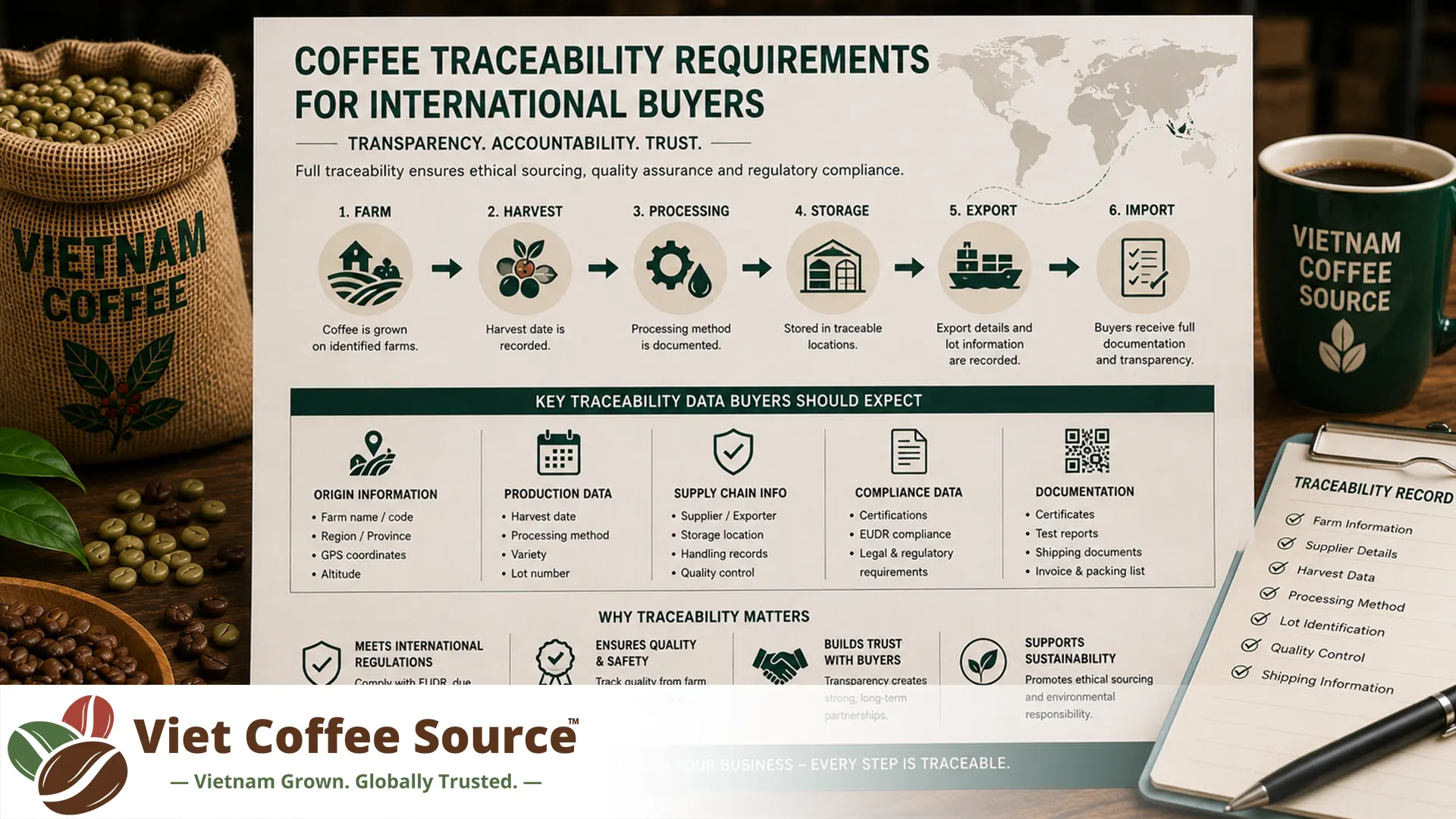
Coffee Traceability Requirements for International Buyers
Coffee traceability requirements for international buyers are designed to connect every purchased lot with its origin, suppliers, processing history, quality records, transport documents and final destination. A reliable traceability system should allow the buyer to move backward from a delivered bag, carton or production batch to the relevant exporter, processor, collection point and farm information, while also allowing the supplier to identify where the same lot was shipped. Traceability is therefore more than a country-of-origin statement or a supplier invoice. It is a structured chain of records linking the physical coffee to verifiable commercial, quality, food-safety and sustainability data.
The exact legal requirements depend on the destination market, product type, buyer role and applicable regulation. Green coffee, roasted coffee, soluble coffee and private-label products may require different levels of traceability. European Union buyers may also need farm geolocation and deforestation due-diligence information for covered coffee products, while United States importers may need supplier-verification and food-safety records even when coffee is not subject to an additional commodity-specific traceability rule.
What does coffee traceability mean?
Coffee traceability is the ability to identify and document the movement and transformation of coffee throughout the supply chain. Depending on the sourcing model, the traceable chain may include:
- Farm or production plot
- Farmer or producer group
- Collection point
- Wet mill or primary processor
- Dry mill
- Warehouse
- Exporter
- Freight forwarder and carrier
- Importer
- Roaster or manufacturer
- Distributor
- Retail or food-service customer
Traceability should remain intact when coffee is aggregated, separated, graded, re-bagged, processed, roasted, blended or packed. Every important transformation must create a documented connection between the incoming lot and the outgoing lot.
Why international coffee buyers require traceability
International buyers use traceability to protect product quality, verify suppliers, satisfy regulations, manage recalls and support sustainability claims. A strong system allows a company to identify which goods may be affected when a quality, food-safety, documentation or compliance problem is discovered.
Traceability can support:
- Origin verification
- Supplier approval
- Quality consistency
- Food-safety investigations
- Product recalls
- Complaint management
- Contract compliance
- Certification claims
- Deforestation due diligence
- Organic integrity
- Customer audits
- Customs and import documentation
- Insurance claims
- ESG and sustainability reporting
Without lot-level traceability, a problem involving one part of a shipment may force the buyer to hold or recall a much larger quantity than necessary.
The basic one-step-back and one-step-forward principle
A common foundation of food traceability is the ability of each business to identify its immediate supplier and its immediate business customer. This is frequently described as one step back and one step forward.
For a coffee importer, this normally means being able to identify:
- The company that supplied each coffee lot
- The date and quantity received
- The lot or shipment reference
- The customers or internal facilities that received the lot
- The date and quantity dispatched
This basic model may be sufficient for certain general food-law obligations, but it may not satisfy farm-level sustainability, certification or deforestation requirements. Buyers should determine whether they need supplier-level, processor-level, farm-level or production-plot-level traceability.
Different levels of coffee traceability
| Traceability level | Typical information available | Suitable for |
|---|---|---|
| Country level | Country of origin only | Basic commercial descriptions where no deeper claim is made |
| Regional level | Province, district or recognised producing area | Regional sourcing and general origin positioning |
| Supplier level | Exporter, processor or cooperative | Commercial supplier control |
| Collection-lot level | Collection station, delivery period and contributing supplier group | Commercial Robusta and aggregated green coffee |
| Farm level | Named farm or registered producer | Certified, specialty and direct-trade supply |
| Plot level | Geolocation of the production plot | Deforestation due diligence and detailed land-origin verification |
| Identity-preserved level | One farm or defined producer lot kept physically separate | Single-farm and premium traceable coffee |
Minimum traceability information buyers should request
A practical minimum data set for a green coffee lot may include:
- Product name
- Species and commercial grade
- Country of origin
- Region, province or district
- Supplier name and address
- Producer, cooperative or collection source where applicable
- Lot number
- Crop year
- Harvest or production period
- Processing method
- Dry mill or processing facility
- Warehouse location
- Number and type of bags
- Net and gross weight
- Container number
- Seal number
- Invoice and contract references
- Bill of lading reference
- Quality inspection reference
- Certificate of Analysis reference
Additional information may be required for certified, organic, deforestation-free, specialty or private-label coffee.
Lot numbers are the foundation of traceability
A lot number is a unique code used to connect physical coffee with its records. The same code, or a clearly linked derivative code, should appear throughout the supply chain.
The lot number may appear on:
- Bags or liners
- Pallet labels
- Warehouse records
- Quality certificates
- Certificates of Analysis
- Commercial invoices
- Packing lists
- Inspection reports
- Production records
- Shipping documents
A reliable lot code should not be reused in a way that creates confusion between crop years, products or production batches.
What makes a good lot coding system?
A lot code may contain information such as origin, processing site, production date, product code and sequence number. However, the code does not need to reveal every detail directly if the company’s database can connect it to complete records.
A suitable system should be:
- Unique
- Consistent
- Readable
- Documented
- Protected against duplicate use
- Connected to incoming and outgoing records
- Retained for the required period
The buyer should be able to provide the supplier with a lot code and receive the corresponding production and shipment information without excessive delay.
Traceability when coffee lots are combined
Commercial coffee frequently combines production from multiple farms, collection points or deliveries. Aggregation does not automatically eliminate traceability, but the system must record every input contributing to the combined lot.
When several incoming lots are combined, the processor should record:
- Each incoming lot code
- Source of every lot
- Quantity contributed by each lot
- Date of combination
- Processing or blending activity
- New outgoing lot code
- Total output quantity
- Processing losses or waste
If a combined lot cannot be connected to its individual inputs, the traceability chain is incomplete.
Traceability when one lot is divided
A large lot may be divided between several containers, customers or production batches. Every new sub-lot should remain linked to the original lot.
The records should show:
- Original lot code
- New sub-lot codes
- Quantity assigned to each sub-lot
- Customer or destination
- Dispatch date
- Container and seal details
This allows the buyer and supplier to identify which destinations received the affected coffee if a later problem is discovered.
Traceability through processing and transformation
Processing changes the physical identity of coffee and normally requires the creation of a new lot or batch reference. Examples include:
- Removing parchment
- Cleaning and sorting
- Screen grading
- Polishing
- Blending
- Roasting
- Grinding
- Extraction
- Spray drying
- Freeze drying
- Agglomeration
- Mixing three-in-one coffee
- Retail packing
The manufacturer should record the relationship between all input lots and the resulting output batch.
Mass balance, segregation and identity preservation
| Chain-of-custody model | How it works | Traceability strength |
|---|---|---|
| Mass balance | Eligible and non-eligible material may be physically mixed while equivalent volumes are controlled administratively | Supports volume claims but may not identify the exact physical origin of every bean |
| Segregated | Eligible coffee is kept separate from non-eligible coffee but may contain several approved origins | Strong claim integrity with aggregated approved sources |
| Identity preserved | Coffee from one defined source remains physically separate | Highest physical traceability to a named source |
Buyers must understand which model applies before making claims about farm identity, certification or sustainability.
Traceability documents for green coffee
A green coffee traceability package may contain:
- Farmer or supplier register
- Collection receipts
- Weighing records
- Processing records
- Dry mill intake and output records
- Warehouse stock cards
- Quality inspection report
- Certificate of Analysis
- Fumigation record where applicable
- Packing list
- Commercial invoice
- Certificate of Origin
- Phytosanitary certificate where required
- Bill of lading
- Container loading report
Buyers sourcing from different areas can review the main Vietnam coffee origins and production regions when designing region- and supplier-level traceability requirements.
Traceability requirements for roasted coffee
Roasted coffee traceability should connect each finished production batch with the green coffee lots, packaging materials and manufacturing conditions used.
Relevant records may include:
- Green coffee input lot numbers
- Blend formulation
- Roasting date and time
- Roasting line
- Roast profile reference
- Finished batch code
- Packaging-material lots
- Valve and film references
- Quality-control results
- Quantity produced
- Quantity released
- Customer shipments
If several green coffee lots are used in one blend, all contributing inputs must be recorded.
Traceability requirements for instant coffee
Instant coffee production involves several processing stages and may combine coffee from multiple sources. The traceability system should connect raw material intake with extraction, concentration, drying, agglomeration and packing batches.
Important records can include:
- Green or roasted coffee input lots
- Extraction batch
- Concentration batch
- Drying line and date
- Agglomeration batch where applicable
- Bulk storage silo
- Packing batch
- Packaging-material lots
- Laboratory release results
- Finished-goods destinations
Traceability requirements for three-in-one coffee
Three-in-one coffee requires traceability for every ingredient, not only the coffee component. Records may need to connect the finished batch with:
- Instant coffee lot
- Sugar lot
- Creamer lot
- Milk-derived ingredient lot
- Flavour and additive lots
- Packaging film lot
- Production date and line
- Finished batch code
- Allergen-control records
A recall may be caused by a non-coffee ingredient, making complete formulation traceability essential.
European Union general food traceability
Food businesses placing coffee on the European Union market generally need records that identify immediate suppliers and immediate business customers. Importers should be able to connect imported goods with the overseas exporter and subsequent recipients.
Practical records normally include:
- Supplier identity
- Customer identity
- Product description
- Lot or consignment reference
- Quantity
- Receipt date
- Dispatch date
- Relevant transport documents
More detailed obligations may apply under product-specific rules, deforestation legislation, organic rules or certification programmes.
EUDR requirements for coffee buyers
Coffee is one of the commodities covered by the European Union Deforestation Regulation. For relevant coffee products within the regulation’s product scope, the responsible operator must be able to demonstrate that the commodity is deforestation-free, produced in accordance with relevant legislation in the country of production and covered by the required due-diligence process.
The traceability package may need to include:
- Product description
- Quantity
- Country of production
- Production date or production period
- Geolocation of all relevant production plots
- Supplier information
- Customer information
- Evidence supporting deforestation-free status
- Evidence of legal production
- Risk-assessment records
- Risk-mitigation records where necessary
- Due diligence statement or applicable simplified declaration reference
Under the current implementation schedule, the main EUDR obligations are expected to apply from 30 December 2026 for large and medium operators and from 30 June 2027 for qualifying micro and small operators. Buyers should verify their legal role, company category, customs classification and the most recent rules before shipment because responsibility may differ between operators, traders and downstream businesses.
Plot geolocation under EUDR
Farm-level identification alone may not satisfy the geolocation requirement. The data should identify the plot or plots where the relevant coffee was produced.
Depending on plot size and applicable technical requirements, information may include:
- Latitude and longitude coordinates
- Polygon boundaries
- Farm or plot identifier
- Producer name
- Administrative region
- Production period
- Connection to the commercial lot
If a coffee lot contains production from many farms, the buyer may need geolocation for every contributing production plot.
Why country-level origin is insufficient for EUDR
A statement such as “Product of Vietnam” does not identify the production plots and does not independently prove that the coffee is deforestation-free or legally produced. Country, province or district information may support risk assessment, but it cannot replace the required connection between the commercial lot and the relevant land.
Risk assessment and risk mitigation
Collecting documents is only one part of due diligence. The responsible business must also evaluate whether there is a risk that the coffee fails the relevant requirements.
Risk indicators may include:
- Incomplete geolocation
- Conflicting farm records
- Unexplained volume increases
- Land-use change
- Weak legal documentation
- High-risk sourcing areas
- Mixing with unverified coffee
- Supplier resistance to disclosure
- Documents that cannot be authenticated
Possible mitigation measures include additional documentation, satellite review, independent audit, expanded supplier checks, field verification or exclusion of an uncertain source.
United States traceability considerations
United States importers are generally responsible for verifying that imported food meets applicable U.S. safety requirements through the Foreign Supplier Verification Programs framework unless an exemption or modified requirement applies.
FSVP-related records may include:
- Hazard analysis
- Supplier evaluation
- Approved supplier procedures
- Supplier verification activities
- Audit reports
- Sampling and testing records
- Corrective actions
- Importer identification
- Periodic supplier re-evaluation
Coffee itself does not currently appear as a named product on the FDA Food Traceability List, so the additional FSMA traceability records designed specifically for listed high-risk foods are not generally triggered by coffee alone. However, general food records, FSVP responsibilities, recall capability and buyer traceability procedures still remain important. Formulated coffee products containing other ingredients should be assessed separately.
Certified and sustainability-claimed coffee
Certification schemes may impose traceability rules that go beyond basic legal requirements. Depending on the programme, buyers may need:
- Valid supplier certification
- Transaction certificates
- Volume reconciliation
- Chain-of-custody records
- Certified lot identification
- Approved subcontractor records
- Claim approval
- Logo-use authorization
The buyer should confirm whether the supply model is identity preserved, segregated or mass balance before describing the final product.
Organic coffee traceability
Organic traceability should demonstrate that certified coffee remained identifiable and protected against substitution or contamination throughout handling, storage, transport and processing.
Relevant records may include:
- Organic certificate
- Scope of certification
- Producer or operator list
- Transaction certificate where required
- Organic lot code
- Warehouse segregation records
- Cleaning records
- Input and output reconciliation
- Organic import documentation
An organic certificate belonging to a supplier does not automatically prove that every delivered lot is organic.
Traceability and quality documentation
Traceability should connect commercial identity with quality results. The Certificate of Analysis, cupping report and physical inspection should all refer to the same lot.
Buyers should compare:
- Lot number on the bags
- Lot number on the COA
- Lot number on the quality certificate
- Lot number on the invoice and packing list
- Container and seal details
- Sample approval reference
Broader requirements can be defined through documented coffee quality, compliance and traceability controls.
Quantity reconciliation
A traceability system should account for the quantity entering, leaving and remaining in stock. This is especially important when coffee is combined, divided or processed.
A basic reconciliation can compare:
- Opening stock
- Quantity received
- Quantity processed
- Normal processing loss
- Quantity packed
- Quantity dispatched
- Closing stock
Unexplained output exceeding verified input can indicate record errors, mixing or false claims.
Traceability in warehouses
Warehouse procedures should maintain physical and documentary separation between lots.
Good practices include:
- Clear bag and pallet labels
- Defined storage locations
- Stock-movement records
- Controlled re-bagging
- Recorded lot combinations
- Separate handling of certified coffee
- Regular stock counts
- Protection against label loss
If damaged bags are replaced, the new bag must retain the original lot identity.
Traceability during container loading
The loading record should connect the warehouse lot with the export shipment.
Useful records include:
- Loading date
- Warehouse location
- Lot numbers loaded
- Bag count
- Net weight
- Container number
- Seal number
- Vehicle details
- Photographs
- Inspector name
- Bill of lading reference
A container containing several lots should have a clear loading map or quantity breakdown.
Digital traceability systems
Traceability may be managed with spreadsheets, ERP software, warehouse systems, supplier platforms or specialised geolocation databases. The technology matters less than the accuracy, security and accessibility of the records.
A suitable system should provide:
- Unique lot identification
- Controlled user access
- Change history
- Document storage
- Input-output links
- Searchable supplier records
- Backup and recovery
- Exportable reports
- Protection against unauthorized alteration
Can blockchain guarantee coffee traceability?
Blockchain or distributed-ledger systems can help preserve a sequence of recorded transactions, but they do not guarantee that the original information was correct. Incorrect farm coordinates, false quantities or misidentified coffee can still be entered into a technically secure system.
Digital tools should therefore be supported by:
- Supplier verification
- Field checks
- Document authentication
- Volume reconciliation
- Independent audits
- Physical lot controls
Data accuracy and supplier verification
Buyers should not accept traceability information without checking its reliability. Verification can include:
- Comparing supplier registers with invoices
- Checking farm IDs against geolocation
- Reviewing production capacity
- Comparing purchased quantities with expected yield
- Confirming certification scope
- Inspecting warehouse segregation
- Reviewing previous non-conformities
- Conducting remote or onsite audits
Protecting confidential supplier data
Farm, processor and commercial data may be sensitive. Buyers should define who may access detailed traceability information and how it will be protected.
Data-management rules may cover:
- User access permissions
- Confidentiality agreements
- Data-transfer methods
- Secure storage
- Retention periods
- Customer disclosure limits
- Regulatory disclosure procedures
Confidentiality should not be used to prevent the responsible operator or authority from accessing legally required information.
How long should traceability records be retained?
The retention period depends on the destination regulation, product type, customer contract, certification scheme and shelf life. Buyers should define the applicable minimum period in the purchase agreement and ensure that records remain readable and accessible.
Longer retention may be appropriate when:
- The coffee has a long commercial life
- The product is used in manufactured goods
- A sustainability claim may be audited later
- A regulation prescribes a specific period
- The supplier has experienced previous traceability failures
Traceability test and mock recall
A company should test its system rather than waiting for an actual problem. A mock recall selects a finished lot and attempts to identify all inputs, records, stock locations and customers within a defined period.
The exercise should measure:
- Time required to retrieve records
- Percentage of quantity accounted for
- Ability to identify suppliers
- Ability to identify customers
- Accuracy of lot links
- Availability of contact information
- Effectiveness of internal communication
Missing quantities or slow record retrieval should lead to corrective action.
Common traceability failures
- Country of origin recorded without lot-level information
- Lot numbers missing from bags
- COA and packing list using different lot codes
- Aggregated coffee with no record of contributing sources
- New lot numbers created without links to previous lots
- Incorrect or incomplete farm coordinates
- Quantities exceeding verified production capacity
- Certified and non-certified coffee stored together without control
- Spreadsheet records that can be altered without history
- Shipping records not linked to warehouse stock
- Supplier certificates expired or outside their approved scope
Warning signs for international buyers
A buyer should investigate when:
- The supplier refuses to provide lot numbers
- Every shipment uses the same generic code
- Farm information changes after questions are raised
- Coordinates point to towns, roads or unsuitable land
- Production volume appears unrealistic
- Different documents show conflicting origins
- The COA predates the production lot
- Certified claims are unsupported by transaction records
- The exporter cannot complete a backward trace
What should be written into the purchase contract?
The contract should define traceability obligations before the order is confirmed.
Important clauses may include:
- Required traceability level
- Mandatory lot coding
- Farm or plot information where applicable
- Chain-of-custody model
- Required certificates and records
- Data-delivery format
- Deadline for providing documents
- Record-retention period
- Audit rights
- Right to request supporting evidence
- Procedure for non-conforming data
- Right to suspend or reject affected lots
Questions buyers should ask suppliers
- Can every delivered lot be traced to its processing source?
- Can aggregated lots be connected to all contributing inputs?
- How are lot numbers created and controlled?
- Are farm or plot records available?
- How are coordinates verified?
- How are certified and conventional lots separated?
- How are quantities reconciled?
- What happens when bags are re-packed?
- How quickly can the supplier complete a traceability exercise?
- Which digital or paper system stores the records?
- How long are records retained?
- Can the buyer conduct an audit?
International buyer traceability checklist
- Product scope confirmed
- Destination regulations reviewed
- Buyer’s legal role identified
- Required traceability level defined
- Supplier and processor identities verified
- Unique lot number assigned
- Country and region recorded
- Farm or plot data collected where required
- Harvest and processing period recorded
- Input-output quantity reconciliation completed
- COA and quality certificate linked to the lot
- Container and seal recorded
- Customer distribution records maintained
- Certification claims verified
- Record-retention period established
- Mock recall completed
Recommended traceability workflow
- Determine destination-market and customer requirements.
- Classify the product and define the required traceability depth.
- Approve suppliers and processing facilities.
- Establish unique lot coding rules.
- Collect source, farm or plot information before shipment.
- Connect quality and laboratory records to the lot.
- Reconcile incoming, processed and outgoing quantities.
- Verify warehouse and container records.
- Review the complete document package before approval.
- Maintain customer-distribution records.
- Test the system through a mock recall.
- Investigate and correct every traceability gap.
Final assessment
Coffee traceability for international buyers should provide a continuous, verifiable connection between the physical product and its origin, lot history, processing records, quality documents, shipment and customer destination. Basic supplier and customer records may satisfy general traceability expectations, but farm-level, plot-level, organic, certification or deforestation requirements can demand significantly deeper documentation.
The strongest system combines unique lot numbers, representative records, quantity reconciliation, verified supplier data, warehouse controls, shipment references and rapid record retrieval. Buyers should also distinguish clearly between mass balance, segregated and identity-preserved coffee before making origin or sustainability claims.
Companies sourcing coffee from Vietnam should establish their required traceability level before confirming the order. Viet Coffee Source can support structured lot identification, quality documentation, export records and buyer-specific information through its coffee export and documentation services. Buyers can also submit a customized wholesale coffee inquiry with the product, quantity, destination, certification and traceability requirements.