
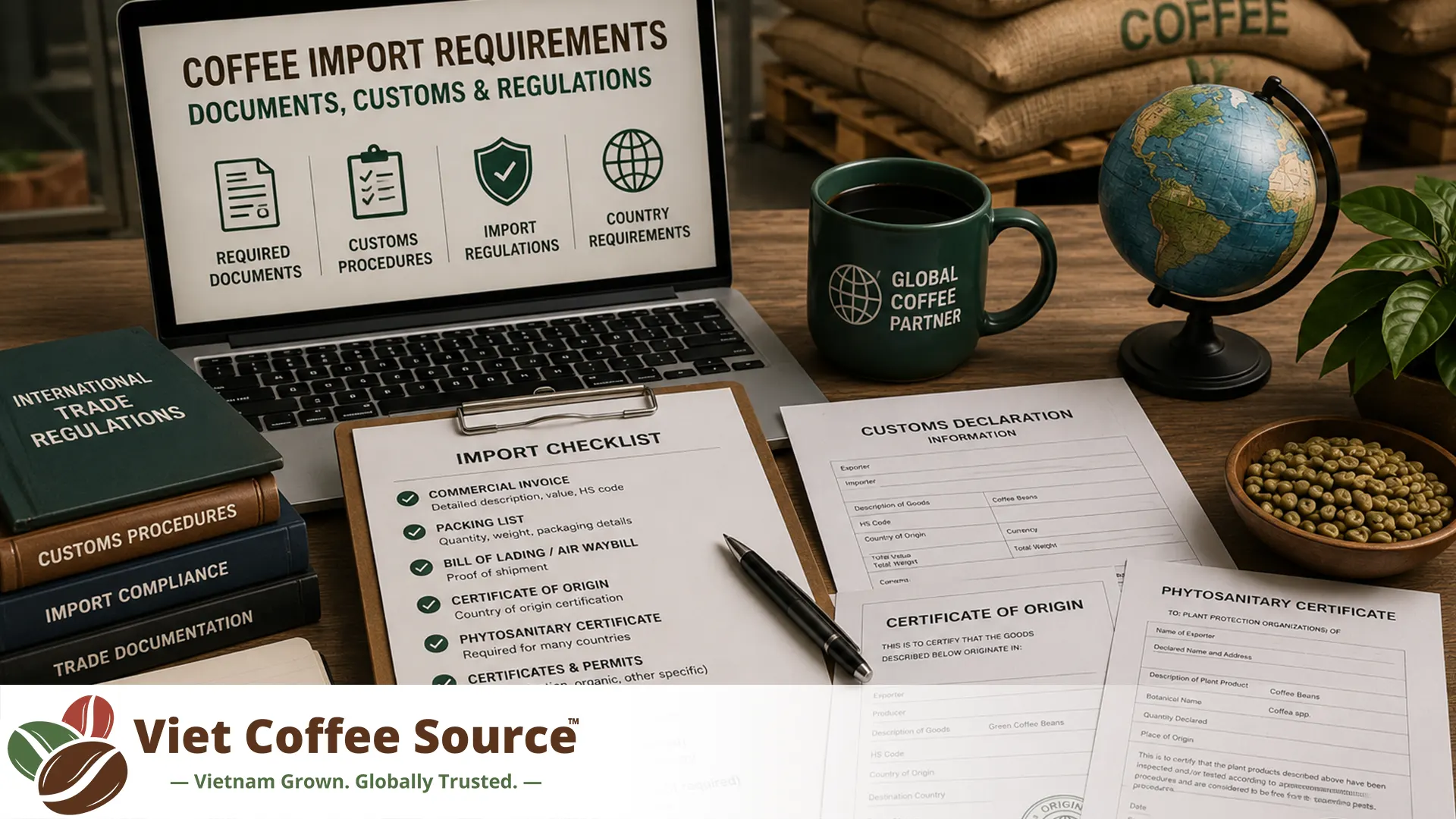
Coffee Import Requirements: Documents, Customs and Regulations
Coffee import requirements cover the documents, customs procedures, product rules and regulatory approvals needed before green, roasted, soluble or prepared coffee can legally enter a destination market. The exact requirements depend on the product type, country of origin, destination country, tariff classification, packaging format, ingredients, intended use and importer status. A shipment can be commercially correct yet still face delays, inspections, storage charges or rejection if the documents and regulatory conditions are incomplete.
Importers should verify requirements before production and shipment rather than waiting until the coffee reaches the port. Product specifications, labels, certificates, customs values and origin information should be reviewed together because inconsistencies between documents are a common cause of clearance problems.
What are coffee import requirements?
Coffee import requirements are the legal, customs, food-safety and documentary conditions that must be satisfied for coffee to enter a market. They can include:
- Importer registration
- Customs registration
- Import license where required
- Correct HS classification
- Commercial invoice
- Packing list
- Transport document
- Certificate of Origin
- Phytosanitary certificate when applicable
- Fumigation certificate where required
- Food-safety documentation
- Product specification
- Ingredient declaration
- Label compliance
- Laboratory test reports
- Customs valuation records
- Insurance documents
- Preferential-origin proof
- Packaging and environmental registrations
Not every document applies to every shipment. Green coffee beans, roasted retail coffee, pure instant coffee and three-in-one preparations can have different requirements even when they are supplied by the same exporter.
Main categories of coffee import requirements
| Requirement category | Main purpose | Typical responsible party |
|---|---|---|
| Commercial documents | Describe the transaction, value, quantity and delivery terms | Exporter and importer |
| Customs documents | Support classification, origin, valuation and declaration | Importer and customs broker |
| Food and agricultural documents | Demonstrate compliance with product and plant-health rules | Exporter, producer and importer |
| Transport documents | Confirm carriage, routing and cargo control | Carrier, forwarder and exporter |
| Product compliance records | Support safety, composition, labeling and quality claims | Producer, exporter and importer |
Importer registration
Many countries require the importing company to be registered with customs, tax authorities, food agencies or agricultural authorities before the first shipment arrives. Registration can involve:
- Customs identification number
- Tax number
- Food-business registration
- Importer-of-record authorization
- Import license
- Product-category registration
- Electronic customs-account setup
- Customs bond or financial guarantee
A foreign supplier cannot assume that it can act as importer of record in every destination. The importer should confirm legal responsibility before agreeing to DDP or other arrangements that include import clearance.
Importer of record
The importer of record is usually the party legally responsible for the customs declaration and compliance of the imported goods. Responsibilities can include:
- Providing the correct tariff code
- Declaring the customs value
- Paying duty and import taxes
- Maintaining import records
- Providing origin evidence
- Responding to customs questions
- Ensuring food and label compliance
- Managing post-entry corrections
The name on the customs entry, tax registration and supporting documents should be consistent. An unclear importer structure can delay clearance and prevent recovery of import VAT.
Commercial invoice
The commercial invoice is one of the most important import documents. It should describe the transaction accurately and contain sufficient detail for customs classification, valuation and payment review.
A coffee commercial invoice should generally include:
- Exporter’s legal name and address
- Importer’s legal name and address
- Invoice number and date
- Purchase-order or contract reference
- Detailed product description
- Quantity and unit of measure
- Net and gross weight
- Unit price
- Total invoice value
- Currency
- Incoterm and named place
- Country of origin
- Country of export
- Proposed HS code
- Packaging type
- Payment terms
- Freight and insurance amounts when separately stated
Descriptions such as “coffee,” “food product” or “samples” are often too vague. The invoice should identify whether the product is green coffee, roasted whole bean, ground coffee, spray-dried instant coffee, freeze-dried coffee or a formulated preparation.
Packing list
The packing list explains how the shipment is physically packed. It should match the invoice and transport document.
Typical packing-list details include:
- Number of bags, cartons, drums, jars or pallets
- Package identification marks
- Net weight per package
- Gross weight per package
- Total net and gross weight
- Package dimensions
- Pallet count
- Container number
- Seal number
- Lot or batch references
Differences between the packing list, invoice and Bill of Lading can cause physical inspection or document correction.
Bill of Lading and Air Waybill
The transport document confirms the carriage of the coffee. Sea shipments normally use a Bill of Lading, while air shipments use an Air Waybill.
The transport document can show:
- Shipper
- Consignee
- Notify party
- Port or airport of loading
- Port or airport of discharge
- Final destination
- Number and type of packages
- Gross weight
- Container and seal numbers
- Freight-payment status
- Vessel or flight information
The consignee structure must reflect the chosen payment and customs arrangement. Errors in the Bill of Lading can prevent the buyer from obtaining delivery authorization.
Certificate of Origin
A Certificate of Origin identifies the country in which the coffee originates under the applicable origin rules. It may be required for customs, trade statistics, buyer compliance or preferential tariff treatment.
The document should normally correspond with:
- Exporter
- Importer or consignee
- Product description
- HS code
- Quantity and weight
- Invoice number
- Transport details
- Origin criterion where applicable
The country from which coffee is shipped is not automatically the country of origin. Coffee grown in Vietnam and re-exported through another country can still retain Vietnamese origin depending on the applicable rules.
Preferential-origin documents
When a trade agreement provides a reduced or zero tariff, the importer must present the correct proof of preferential origin. This may be:
- Preferential Certificate of Origin
- Invoice declaration
- Statement on origin
- Registered-exporter statement
- Self-certification
- Electronic origin record
The exporter should not issue preferential-origin statements without confirming that the product meets the relevant rule. Roasted coffee, instant coffee and three-in-one preparations made from imported ingredients may have more complex origin requirements than unprocessed green coffee.
Phytosanitary certificate
A phytosanitary certificate may be required for certain green coffee shipments because unroasted coffee is an agricultural product. Requirements depend on the destination country, processing status, pest-risk rules and treatment of the beans.
The certificate may confirm that:
- The shipment has been inspected
- The product meets plant-health requirements
- No regulated pests were found
- Specified treatments were completed
- Additional declarations are satisfied
Roasted and highly processed coffee may not require the same phytosanitary documentation, but the importer should confirm the destination rule before shipment.
Fumigation certificate
Some buyers, ports or authorities request a fumigation certificate for coffee, wooden packaging or containers. The requirement can depend on:
- Destination-country rules
- Type of packaging
- Pest-control program
- Wooden pallets or dunnage
- Contractual buyer requirements
The treatment method, chemical, dosage, exposure period and date should be accurately recorded. Fumigation should not be performed automatically when it is not required because unnecessary treatment can create safety, residue or quality concerns.
ISPM 15 requirements for wooden packaging
Wooden pallets, crates and dunnage used in international trade may need to comply with ISPM 15. Compliant wood packaging is normally treated and marked with an approved stamp.
Importers should verify:
- Whether wooden packaging is used
- Whether the mark is visible and valid
- Whether repaired pallets remain compliant
- Whether untreated wood is present inside the container
Non-compliant wooden packaging can lead to treatment, destruction, re-export or delayed release of the entire shipment.
Product specification sheet
A detailed product specification helps customs brokers, food authorities and buyers understand the imported coffee. The required information depends on the product format.
A green coffee specification may include:
- Species and variety
- Origin and region
- Crop year
- Processing method
- Screen distribution
- Moisture
- Defect count
- Foreign matter
- Density
- Cup profile
- Packaging
A roasted or soluble coffee specification may include:
- Ingredient composition
- Roast level
- Grinding size
- Moisture
- Bulk density
- Solubility
- Caffeine status
- Shelf life
- Storage conditions
- Packaging material
Buyers can review structured coffee quality and compliance procedures when defining the technical documentation required for each product.
Certificate of Analysis
A Certificate of Analysis reports the results of agreed laboratory or quality tests. It may be issued by the producer, an accredited laboratory or an independent inspection company.
Depending on the coffee product, the certificate can include:
- Moisture
- Water activity
- Caffeine
- Bulk density
- Solubility
- Particle size
- Microbiological results
- Mycotoxins
- Pesticide residues
- Heavy metals
- Sensory evaluation
- Foreign matter
The tests should reflect the destination regulations and the buyer’s contract. A generic certificate does not replace product-specific compliance.
Food-safety certificates
Importers may request or legally require evidence of the manufacturer’s food-safety system. Common documents can include:
- HACCP certificate
- ISO 22000 certificate
- FSSC 22000 certificate
- BRCGS certificate
- IFS certificate
- GMP declaration
- Sanitary certificate
- Health certificate
- Factory registration
The certificate should be valid, cover the correct production site and include the relevant product scope. A certificate issued for one factory should not be used for goods made at another location.
Health and sanitary certificates
Some countries require an official health or sanitary certificate for processed foods. The certificate may confirm that the product was manufactured under approved conditions and is fit for human consumption.
The wording may need to follow a destination-specific model. Exporters should obtain the exact required format before production because authorities may reject general statements that do not include mandatory declarations.
Ingredient declaration
An ingredient declaration is essential for soluble coffee preparations, flavored coffee, three-in-one products and ready-to-drink beverages. Customs and food authorities can use the formula to determine:
- Tariff classification
- Allergen requirements
- Nutrition labeling
- Milk or dairy controls
- Sugar-related taxes
- Additive compliance
- Product identity
The formula should list ingredients in descending order by weight and identify percentages where required for classification or labeling.
Allergen declaration
Pure green, roasted and instant coffee may have limited allergen concerns, but prepared products can contain milk, soy or other regulated allergens.
The importer should confirm:
- Intentional allergens
- Cross-contact risks
- Shared production lines
- Required precautionary statements
- Local allergen naming rules
- Language requirements
An allergen statement prepared for one market may not automatically comply with another market’s mandatory wording.
Nutrition information
Retail coffee preparations may require a nutrition panel. Pure coffee can be exempt or treated differently in some markets, while sweetened, milk-based or flavored products usually require full nutrition data.
Nutrition documentation may include:
- Energy
- Fat
- Saturated fat
- Carbohydrate
- Sugars
- Protein
- Salt or sodium
- Serving size
- Number of servings
Values may be based on laboratory analysis, validated calculation or both, depending on local rules.
Retail label requirements
Retail labels must comply with the law of the destination market. Required elements can include:
- Legal product name
- Ingredient list
- Allergen declaration
- Net quantity
- Nutrition information
- Country of origin
- Importer name and address
- Manufacturer details
- Lot or batch code
- Best-before or expiry date
- Storage instructions
- Preparation instructions
- Language required by law
- Recycling or packaging symbols
Labels should be approved before mass production. Correcting labels after arrival can require customs permission, supervised relabeling, warehouse labor and additional inspection.
Country-of-origin marking
The destination country may require the retail package, outer carton or both to show the country of origin. The wording should not mislead the buyer about where the coffee was grown, roasted, blended or packed.
Statements such as “Vietnamese coffee,” “packed in Vietnam” and “made from Vietnamese coffee beans” can have different meanings. The label should reflect the actual product history and local marking rules.
Language requirements
Mandatory information often needs to appear in the official language or languages of the destination market. Stickers may be permitted in some jurisdictions if they are applied before retail sale and do not cover mandatory original information.
The importer should confirm:
- Required language
- Minimum font size
- Translation accuracy
- Placement of mandatory statements
- Whether multilingual labels are permitted
Product registration and pre-market approval
Some countries require imported food products to be registered before the first shipment. Registration may involve:
- Submitting the product formula
- Providing label artwork
- Submitting laboratory reports
- Providing factory certificates
- Paying a registration fee
- Appointing a local representative
- Receiving an approval or notification number
Approval can be specific to the importer, product, factory, package size or formula. A change in supplier or ingredients may require a new application.
Import permits and licenses
Depending on the country and product, a general or shipment-specific import permit may be required. Permits can apply to:
- Agricultural commodities
- Plant products
- Processed food
- Dairy-containing preparations
- Organic products
- Products subject to quotas
The permit should be obtained before shipment when the regulations require prior approval. Goods dispatched without a valid permit may be held or re-exported.
Organic coffee documentation
Coffee marketed as organic must comply with the organic rules of the destination country. Requirements may include:
- Valid organic certification
- Approved certification body
- Transaction certificate
- Import certificate
- Lot traceability
- Organic label approval
- Separation from non-organic product
An organic certificate valid in the exporting country may not be automatically accepted in the destination market.
Sustainability and certification claims
Claims such as Fairtrade, Rainforest Alliance, organic, deforestation-free or carbon-neutral require supporting records and must follow the relevant scheme and local consumer law.
Importers should verify:
- Certificate validity
- Chain-of-custody status
- Certified volume
- Correct trademark use
- Claim wording
- Mass-balance or identity-preserved conditions
Traceability requirements
Traceability documents connect the imported coffee to its producer, processing site, lot and shipment. Depending on the product and market, records can include:
- Farm or producer information
- Mill or factory details
- Lot number
- Harvest period
- Processing records
- Warehouse movements
- Container stuffing records
- Supplier invoices
- Batch transformation records
Buyers sourcing from Vietnam can use the main Vietnam coffee-origin framework to organize regional and lot information consistently.
Deforestation-related due diligence
Some markets require due diligence for agricultural commodities linked to deforestation risk. Coffee importers may need geolocation, production dates, supplier information, risk assessments and evidence that the product meets relevant land-use rules.
Potential records include:
- Farm geolocation
- Plot boundaries
- Production period
- Supplier declarations
- Risk assessment
- Mitigation records
- Due-diligence statement
These requirements should be integrated into sourcing before shipment because missing farm-level data may be difficult to reconstruct later.
Customs classification
The importer must determine the complete national tariff code. Common international coffee classifications include:
| Product | Typical HS code |
|---|---|
| Green coffee, not decaffeinated | 0901.11 |
| Green coffee, decaffeinated | 0901.12 |
| Roasted coffee, not decaffeinated | 0901.21 |
| Roasted coffee, decaffeinated | 0901.22 |
| Coffee extracts and pure instant coffee | 2101.11 |
| Preparations based on coffee or coffee extracts | 2101.12 |
The six-digit code is only the international base. The destination country may require additional digits and may distinguish packaging, formulation, flavoring or other characteristics.
Customs valuation
The customs value is the basis for duty calculation in many jurisdictions. It can include more than the invoice price.
Potential additions include:
- Freight to the import border
- Insurance
- Packing costs
- Assists supplied by the buyer
- Specified royalties
- Selling commissions
The importer should keep records explaining how the customs value was calculated. Under-declaration can lead to reassessment, penalties and increased inspection.
Customs declaration
The customs declaration normally contains:
- Importer and exporter information
- Tariff code
- Customs procedure
- Country of origin
- Country of dispatch
- Quantity and weight
- Customs value
- Duty rate
- Tax calculation
- Preference code
- Transport information
- Supporting-document references
The declaration should be reviewed before submission because errors can affect duty, tax, statistics and future customs audits.
Customs inspections
Customs or food authorities may select the shipment for:
- Documentary review
- Seal verification
- Container scanning
- Physical inspection
- Sampling
- Laboratory analysis
- Label review
- Origin verification
The importer may have to pay inspection, handling, storage and container-movement costs. Accurate documentation reduces avoidable problems but does not guarantee inspection-free clearance.
Laboratory testing
Coffee can be tested for regulatory or contractual parameters. Possible analyses include:
- Ochratoxin A
- Pesticide residues
- Microbiology
- Heavy metals
- Acrylamide in roasted products
- Caffeine
- Moisture
- Mycotoxins
- Food additives
- Milk components in preparations
The applicable limits depend on the destination and product. A test report from the exporter may support clearance, but authorities can still take official samples.
Sampling plans
The buyer and supplier should agree how samples are selected. A representative sampling plan can define:
- Number of packages sampled
- Sampling point
- Composite sample method
- Sample size
- Sealing and identification
- Retention sample period
- Approved laboratory
Testing a non-representative sample can create false confidence about the commercial shipment.
Packaging requirements
Packaging must protect the coffee and meet food-contact, transport and environmental rules. Requirements can cover:
- Food-contact material compliance
- Migration limits
- Ink and adhesive suitability
- Barrier performance
- Seal integrity
- Valve suitability
- Recycled-content rules
- Packaging registration
- Recycling labeling
Green coffee bags, retail pouches, glass jars and instant-coffee sachets can each be subject to different documentation.
Food-contact declarations
Importers of retail products may request declarations confirming that pouches, jars, lids, valves, liners and other components are suitable for food contact.
Supporting records can include:
- Declaration of compliance
- Migration test report
- Material specification
- Supplier certificate
- Composition statement
- Intended-use conditions
Shelf-life documentation
The stated shelf life should be supported by product stability, packaging performance and storage conditions. Importers may request:
- Shelf-life study
- Accelerated stability study
- Packaging integrity results
- Sensory evaluation
- Moisture and microbiological records
The remaining shelf life at arrival can also be a contractual requirement.
Lot coding and recall readiness
Every retail or bulk lot should be identifiable through a batch code. The coding system should connect the shipment to:
- Production date
- Factory
- Production line
- Raw-material lots
- Packaging lots
- Quality-control results
- Distribution records
Importers should maintain a recall procedure and be able to identify customers who received each lot.
Special requirements for green coffee
Green coffee import controls can focus on:
- Plant-health status
- Insect infestation
- Foreign matter
- Moisture
- Mycotoxins
- Pesticide residues
- Bag condition
- Wood-packaging compliance
Some countries distinguish coffee intended for roasting from coffee intended for planting. Seed coffee can face significantly stricter plant-health controls.
Special requirements for roasted coffee
Roasted coffee import requirements can include:
- Retail label review
- Food-business registration
- Acrylamide compliance where applicable
- Flavoring and additive review
- Packaging compliance
- Shelf-life evidence
- Nutrition information
Ground coffee may also require clear identification to distinguish it from coffee preparations or blends containing non-coffee ingredients.
Special requirements for instant coffee
Pure instant coffee documentation can include:
- Production method
- Ingredient declaration
- Moisture
- Bulk density
- Solubility
- Caffeine status
- Microbiological analysis
- Packaging declaration
Spray-dried, freeze-dried and agglomerated products may share a broad tariff heading but have different commercial specifications.
Special requirements for three-in-one coffee
Three-in-one coffee is a formulated food product rather than only pure coffee. Requirements may include:
- Complete ingredient percentages
- Allergen declaration
- Milk-product documentation
- Nutrition panel
- Additive compliance
- Sugar-tax review
- Tariff-classification analysis
- Retail label approval
Classification should be confirmed from the actual formula rather than the marketing name.
Special requirements for decaffeinated coffee
Decaffeinated coffee has separate international tariff subheadings. Importers may also request:
- Residual caffeine result
- Decaffeination method
- Solvent-residue analysis where relevant
- Product labeling support
Customs broker review
An experienced customs broker can review:
- Tariff classification
- Customs value
- Origin treatment
- Duty and tax calculation
- Required permits
- Entry documents
- Inspection procedures
The broker should receive product specifications and ingredients before shipment, not only the invoice after arrival.
Binding tariff rulings
A binding tariff ruling may be useful when classification is uncertain, particularly for:
- Three-in-one coffee
- Flavored coffee
- Coffee extracts
- Concentrated liquid products
- Products containing cocoa or dairy ingredients
- Fortified preparations
A ruling can provide greater certainty for repeated imports, although the product must match the description submitted to the authority.
Pre-shipment document review
Before shipment, the importer should compare:
- Commercial invoice
- Packing list
- Certificate of Origin
- Bill of Lading draft
- Product specification
- Health or phytosanitary certificate
- Certificate of Analysis
- Label artwork
- Import permit
Names, addresses, product descriptions, weights, invoice numbers, lot numbers and origin details should match.
Document legalization and electronic certificates
Some destinations may require original documents, electronic verification, consular legalization, chamber certification or apostille procedures. The required form should be confirmed before issuing documents.
Courier time for originals must be included in the shipping schedule when paper documents are still required.
Recordkeeping
Importers should retain:
- Customs declarations
- Invoices
- Origin documents
- Freight and insurance records
- Product specifications
- Laboratory reports
- Correspondence supporting classification
- Payment records
- Import permits
- Distribution records
Retention periods differ by country and may extend for several years after import.
Common documentation mistakes
- Using inconsistent product descriptions
- Showing different weights across documents
- Listing the wrong country of origin
- Using an incomplete HS code
- Submitting an expired certificate
- Missing invoice references
- Using the wrong consignee
- Failing to declare ingredients
- Omitting freight or insurance from valuation records
- Shipping before the import permit is approved
- Using labels that do not meet destination-language rules
Possible consequences of non-compliance
- Customs hold
- Additional document requests
- Physical inspection
- Laboratory testing
- Storage and demurrage
- Relabeling
- Repacking
- Duty reassessment
- Penalties
- Product destruction
- Re-export
- Suspension of importer registration
How Incoterms affect import responsibilities
Incoterms do not determine whether a product complies with import law, but they affect which party arranges and initially pays for specific activities.
| Incoterm | Typical import responsibility |
|---|---|
| EXW | Buyer controls most export, transport and import procedures |
| FOB | Buyer usually controls freight and import clearance |
| CIF | Seller arranges freight and insurance, while buyer generally handles import clearance |
| DAP | Seller transports to destination, while buyer generally handles import formalities and taxes |
| DDP | Seller assumes broad import obligations where legally possible |
The contract should identify who provides each certificate, who approves labels and who pays costs caused by incorrect supplier information.
Questions to ask the coffee supplier
- What is the exact product description?
- What HS code is proposed?
- What is the country of origin?
- Which certificates can be provided?
- Is a phytosanitary certificate available?
- Can preferential-origin proof be issued?
- What laboratory tests are completed?
- What food-safety certification covers the factory?
- What is the complete ingredient formula?
- Can label artwork be reviewed before production?
- What lot-traceability records are available?
- Which documents are included in the price?
Questions to ask the customs broker
- What is the full national tariff code?
- What duty and tax rates apply?
- Which documents are mandatory?
- Is an import permit required?
- Is a phytosanitary certificate required?
- What origin proof is accepted?
- Is product registration required?
- Are official tests likely?
- What label information is mandatory?
- Should a binding ruling be requested?
Coffee import document checklist
- Importer registration confirmed
- Import license confirmed
- Commercial invoice prepared
- Packing list prepared
- Transport document reviewed
- HS code confirmed
- Country of origin verified
- Certificate of Origin prepared
- Preferential-origin document validated
- Phytosanitary requirement checked
- Fumigation requirement checked
- Product specification approved
- Certificate of Analysis approved
- Food-safety certificates validated
- Ingredient declaration reviewed
- Allergen statement reviewed
- Retail label approved
- Packaging compliance checked
- Import permit received
- Customs value calculated
- Pre-shipment document review completed
Recommended import process
- Identify the exact coffee product and intended use.
- Confirm the importer’s registration and legal status.
- Determine the full national tariff code.
- Check duty, tax and origin treatment.
- Identify all food, plant-health and labeling rules.
- Confirm required documents with the customs broker.
- Approve product specifications and label artwork.
- Obtain import permits or product registration.
- Confirm laboratory and certification requirements.
- Review draft shipment documents before departure.
- Submit pre-arrival customs or food notifications.
- Prepare for inspection and final delivery.
Final assessment
Coffee import requirements depend on the exact product, destination market, customs classification, origin, ingredients, packaging and intended use. Green coffee, roasted coffee, instant coffee and coffee preparations should not be managed under a single generic document checklist. Each category can involve different plant-health, food-safety, labeling, tariff and registration obligations.
Buyers should confirm importer registration, HS classification, customs value, origin documents, certificates, product specifications, laboratory reports, permits and labels before shipment. All documents should use consistent descriptions, quantities, weights, lot references and origin information.
A structured pre-shipment review reduces the risk of customs holds, inspections, storage charges, relabeling, penalties and re-export. Buyers seeking Vietnamese coffee with organized specifications, quality records and export documentation can review available coffee export and documentation support or submit a customized wholesale coffee inquiry with the product, quantity, destination and required certifications.