
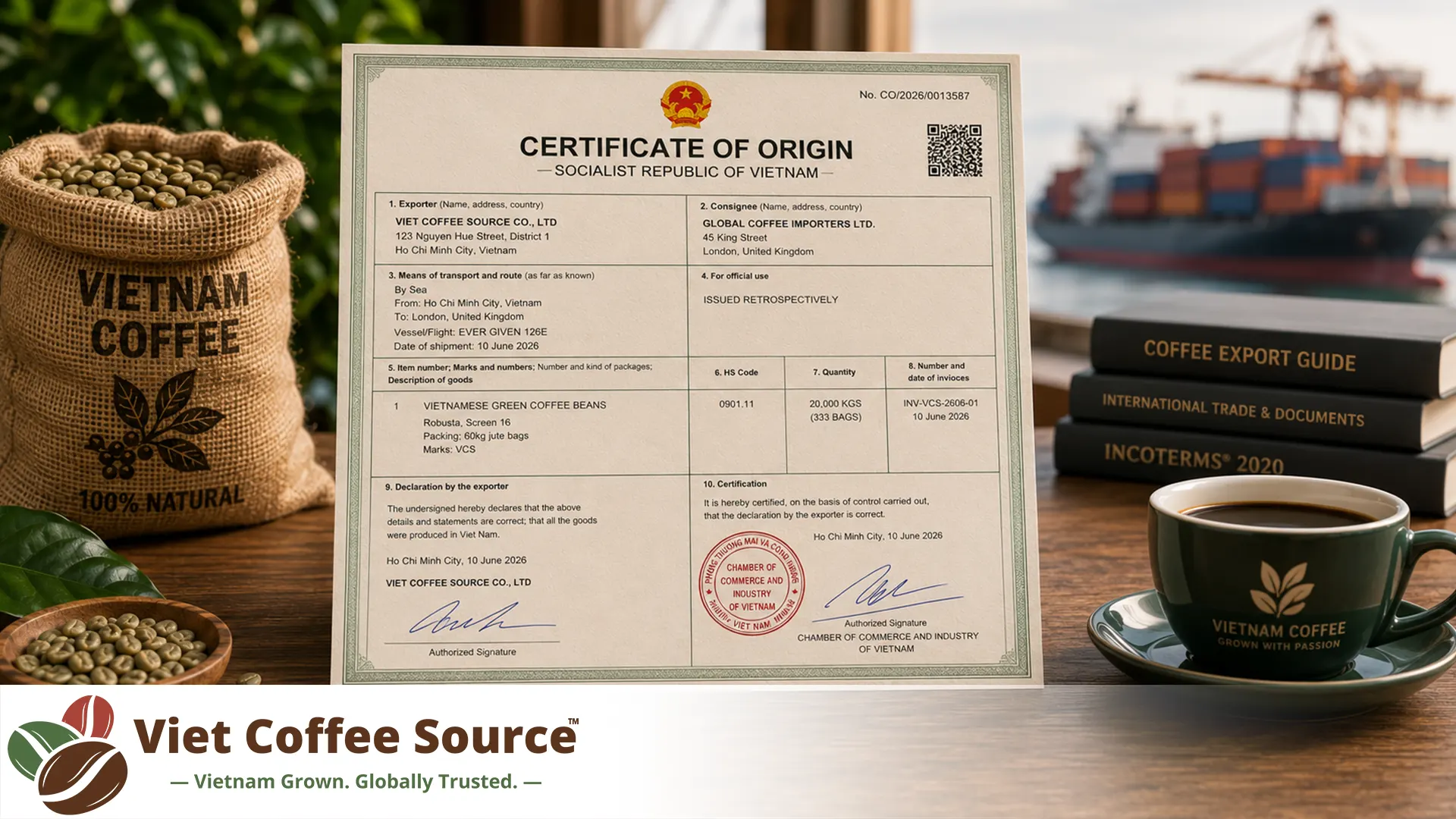
Certificate of Origin for Coffee Exports: Complete Guide
A Certificate of Origin is a trade document used to identify the country in which exported coffee was produced, obtained or sufficiently processed under the applicable origin rules. It may be requested by customs authorities, banks, importers, trade-finance providers or other parties involved in an international coffee transaction. Depending on the destination market and the trade arrangement, the document can support customs clearance, preferential tariff treatment, documentary payment, product traceability and verification of contractual origin.
Coffee exporters and buyers should not treat the Certificate of Origin as a routine form that can be prepared after the vessel has departed. The correct certificate type, origin rule, issuing authority, consignee details, transport information, product description, tariff classification, quantity, weight and invoice reference should be confirmed before shipment. Errors can lead to loss of tariff preference, customs delays, document discrepancies, amendment costs, demurrage or rejection by a bank under a letter of credit.
What is a Certificate of Origin?
A Certificate of Origin, commonly abbreviated as CO or C/O, is a document declaring the country of origin of goods in an export shipment. For coffee, it may state that the green coffee beans, roasted coffee, instant coffee or another coffee product originate in Vietnam or another named country under the relevant legal rules.
The country of origin is not always the same as the country of export, shipment or invoicing. Coffee can be produced in one country, processed or blended in another country and exported from a third location. The applicable origin rules determine which country may legally be declared as the origin.
A Certificate of Origin generally supports one or more of the following purposes:
- Customs clearance: Confirms the declared origin of imported coffee.
- Preferential tariff treatment: Supports a claim for reduced or zero customs duty under an eligible trade agreement.
- Non-preferential trade requirements: Confirms origin for normal customs, statistical, quota, trade-remedy or commercial purposes.
- Documentary payment: May be required under a letter of credit or documentary collection.
- Buyer verification: Supports contractual confirmation of the agreed coffee origin.
- Traceability records: Can form part of a broader origin and supply-chain documentation package.
Why is the Certificate of Origin important for coffee exports?
Origin can affect import duty, market access, labeling, trade statistics, anti-dumping measures, quota treatment and buyer acceptance. Coffee buyers may also use origin information when designing blends, marketing single-origin products, managing sourcing risk or meeting internal procurement requirements.
For Vietnamese coffee, the Certificate of Origin may be especially important when the destination country grants preferential treatment under a bilateral, regional or multilateral trade arrangement. The importer may need a specific certificate format, origin declaration or electronic record to claim the benefit.
| Business function | Importance for the coffee buyer or exporter |
|---|---|
| Customs declaration | Supports the country-of-origin information submitted to the importing authority |
| Tariff preference | May reduce import duty when the coffee meets the applicable origin rules |
| Contract compliance | Confirms that the shipment matches the origin stated in the purchase agreement |
| Banking documents | May be examined under a letter of credit or documentary collection |
| Product positioning | Supports origin-based commercial claims when used with appropriate traceability |
| Risk control | Helps identify inconsistencies between invoice, packing list, transport document and customs records |
Preferential and non-preferential Certificates of Origin
The first major distinction is between preferential and non-preferential origin documents.
Preferential Certificate of Origin
A preferential Certificate of Origin is used when the exporter or importer seeks reduced or zero customs duty under a trade agreement. The coffee must satisfy the specific origin rules of that agreement, and the document must be completed in the required format.
Eligibility depends on factors such as product classification, production location, processing activities, direct-transport requirements, documentary evidence and the relationship between the exporting and importing countries.
Non-preferential Certificate of Origin
A non-preferential Certificate of Origin confirms the origin of goods without claiming a tariff preference. It may be required for customs statistics, commercial documentation, quotas, government procurement, trade controls or buyer requirements.
A non-preferential certificate does not automatically provide reduced duty. Buyers should not assume that any document containing the words “Certificate of Origin” is sufficient for preferential treatment.
| Certificate type | Main purpose | Buyer consideration |
|---|---|---|
| Preferential Certificate of Origin | Claim reduced or zero duty under a trade agreement | Confirm agreement eligibility, correct form and exact origin rule |
| Non-preferential Certificate of Origin | Confirm origin for normal customs or commercial purposes | Do not use it as evidence of tariff preference unless legally accepted |
| Origin declaration | Exporter statement placed on an invoice or commercial document | Check value limits, authorization requirements and required wording |
| Electronic origin record | Digital issuance or transmission through an approved system | Confirm acceptance by the destination customs authority and buyer |
Country of origin versus country of export
The country of origin is where the coffee legally originates under the applicable rules. The country of export is the country from which the shipment is dispatched. These may be different.
For example, Vietnamese green coffee shipped directly from Vietnam will normally identify Vietnam as both origin and export country. However, coffee grown in another country and merely stored, repacked or re-exported from Vietnam may retain its original country of origin if the activities performed in Vietnam do not constitute sufficient transformation.
Similarly, Vietnamese green coffee roasted, blended or converted into instant coffee in another country may be subject to a different origin analysis. The final origin depends on the product-specific rule and the level of processing performed.
How origin is determined for green coffee
Green coffee is an agricultural product. In many origin systems, coffee beans harvested in a country are considered wholly obtained in that country. Coffee grown and harvested in Vietnam will therefore generally qualify as Vietnamese origin, subject to the exact wording of the applicable rules.
Normal post-harvest operations such as pulping, washing, drying, hulling, grading, screening, polishing, sorting and packing usually support preparation of the coffee for export but may not change the agricultural origin.
The exporter should maintain evidence showing where the coffee was cultivated and collected. Depending on the required traceability level, this can include farmer records, collection documents, warehouse receipts, processing records, lot numbers, purchase contracts and supplier declarations.
Origin rules for roasted and processed coffee
Determining origin can be more complex for roasted, ground, soluble, blended or flavored coffee. The applicable rule may use one or more of the following tests:
- Wholly obtained test: Used mainly for agricultural goods produced entirely in one country.
- Change in tariff classification: Requires the non-originating materials to move into a different tariff heading or subheading after processing.
- Regional value content: Requires a minimum percentage of the product’s value to originate within eligible countries.
- Specific processing rule: Requires a named manufacturing operation to occur in the exporting country.
- Maximum non-originating material rule: Limits the value or quantity of foreign materials used.
Roasting imported green coffee does not automatically create origin in every trade agreement. Blending Vietnamese coffee with beans from another country can also affect eligibility. Exporters of processed products should check the product-specific rule before making an origin claim.
Common forms of origin documentation
The exact name and structure of the document depend on the destination, trade agreement and customs procedure. Common formats include:
- Certificate issued by a chamber of commerce or competent authority
- Preferential Certificate of Origin in a prescribed form
- Exporter declaration on the commercial invoice
- Statement on origin by an approved or registered exporter
- Electronic Certificate of Origin transmitted through a customs platform
- Supplier declaration supporting a later origin claim
The buyer should specify the required form before the exporter prepares the shipping documents. A certificate issued under the wrong scheme may be rejected even if the coffee genuinely originates in Vietnam.
Main information shown on a Certificate of Origin
Certificate formats vary, but the following information is commonly required:
| Field | What should be verified |
|---|---|
| Exporter | Correct legal name, address and registration details |
| Consignee | Correct importer, buyer, bank or permitted wording |
| Country of origin | Country supported by the applicable origin rules |
| Country of destination | Correct importing country |
| Transport details | Vessel, flight, route or other details when required |
| Invoice number and date | Exact match with the commercial invoice |
| Description of goods | Accurate description of green, roasted, ground or soluble coffee |
| Tariff classification | Correct HS code at the required digit level |
| Quantity and weight | Consistency with invoice, packing list and transport documents |
| Package marks and numbers | Correct bag, pallet, carton or container references |
| Origin criterion | Correct code or rule demonstrating eligibility |
| Certification | Valid signature, stamp, digital authorization or issuing record |
Exporter information
The exporter name should match the commercial invoice and the entity legally responsible for the origin application. If a trader exports coffee obtained from farmers, cooperatives or processors, the exporter may need supporting documents from the upstream suppliers.
Differences in abbreviations, legal suffixes, addresses or registration numbers can cause customs or banking questions. The legal identity should be consistent throughout the document package.
Consignee information
The consignee may be the importer, buyer, bank or another permitted party depending on the transaction. The details should correspond with the invoice, transport document and letter of credit when applicable.
Some forms permit “to order” or another standardized wording, while others require the full importer information. Buyers should provide written instructions before the certificate application is submitted.
Description of the coffee
The product description should be clear enough to identify the goods without introducing unnecessary discrepancies. Depending on the shipment, it may state:
- Vietnam Robusta green coffee beans
- Vietnam Arabica green coffee beans
- Roasted coffee beans
- Ground roasted coffee
- Spray-dried instant coffee
- Freeze-dried instant coffee
- Coffee preparations or private-label coffee products
The wording should remain consistent with the commercial invoice, packing list, contract and customs classification. Detailed quality parameters such as screen size, moisture, defect count or cup profile may be included only when required and should not create conflicts with other documents.
HS codes for coffee products
Coffee is generally classified within Chapter 09 or Chapter 21 of the Harmonized System, depending on the product. Green coffee, roasted coffee, coffee substitutes and coffee extracts may fall under different headings and subheadings.
The correct classification matters because preferential origin rules are normally product-specific. An origin rule applicable to green coffee may not apply to instant coffee or a three-in-one beverage preparation.
The exporter and importer should confirm the tariff code with a qualified customs specialist when classification is uncertain. The code should be consistent across the Certificate of Origin, invoice and customs declarations.
Origin criteria and origin codes
Preferential certificates often contain a field identifying how the goods qualify as originating. The certificate may use a letter, number or abbreviation representing criteria such as wholly obtained, produced exclusively from originating materials, tariff transformation or regional value content.
Using the wrong criterion can invalidate the preference claim. Exporters should not select a code merely because it was used on a previous shipment. The correct criterion depends on the current product, inputs and agreement.
Direct consignment and transport requirements
Some preferential arrangements require goods to be transported directly between eligible countries or to remain under customs control during transit through a third country. Transshipment may be allowed if the coffee is not altered beyond unloading, reloading, storage or operations necessary to preserve it.
The importer may need supporting documents such as a through Bill of Lading, customs transit record, non-manipulation certificate or warehouse evidence. Buyers should review routing before shipment when the vessel will call at or transship through a third country.
Certificate of Origin and Incoterms
Incoterms do not determine the legal origin of the coffee. They allocate certain costs, responsibilities and risks between buyer and seller. The contract should separately state which party must obtain and provide the Certificate of Origin.
Under FOB, CFR or CIF, the seller commonly prepares export documents, but the precise requirement should appear in the purchase contract. Under EXW, the buyer may control more of the logistics, yet the exporter or producer may still need to provide origin evidence that the buyer cannot independently create.
Buyers can review available coffee export and documentation solutions before confirming the Incoterm and document package.
Certificate of Origin and the commercial invoice
The Certificate of Origin should normally match the commercial invoice in exporter, consignee, invoice number, date, goods description, quantity, weight and destination. Differences can cause customs delays or banking discrepancies.
If the final invoice changes after the certificate has been issued, the exporter should confirm whether the certificate requires amendment, cancellation and reissuance or another approved correction procedure.
Certificate of Origin and packing list
The packing list provides detailed information about bags, cartons, pallets, net weight and gross weight. The Certificate of Origin may contain less detail, but the total quantity and package structure should remain consistent.
For green coffee, the document package may identify the number of bags and total net or gross weight. For private-label or instant coffee, it may identify cartons, jars, sachets, pallets or other commercial units.
Certificate of Origin and Bill of Lading
The transport document records the shipment route, shipper, consignee, ports, packages, weight and cargo description. The Certificate of Origin should be checked against the final Bill of Lading to prevent inconsistencies.
Common differences include an incorrect consignee, different package count, changed vessel, revised port, inaccurate weight or mismatched goods description. The buyer should approve the draft documentation before the final documents are issued.
Certificate of Origin under a letter of credit
When payment is made under a letter of credit, the bank examines the documents rather than the physical coffee. The Certificate of Origin must therefore comply with the wording of the credit and the applicable documentary rules.
A letter of credit may specify:
- The exact certificate title
- The issuing authority
- The required number of originals and copies
- The country of origin statement
- The consignee or applicant details
- The required goods description
- Whether the document must be legalized or certified
- The presentation deadline
An authentic certificate can still be discrepant if it does not match the credit. The buyer and seller should review the documentary requirements before shipment.
Who issues a Certificate of Origin?
The issuing party depends on the destination market and the applicable trade scheme. It may be a chamber of commerce, customs authority, ministry, government-authorized organization or another competent body.
Some systems permit approved exporters, registered exporters or producers to issue origin declarations without obtaining a separate stamped certificate for every shipment. Eligibility may depend on shipment value, registration status, recordkeeping and authorization.
Exporters should use only an authority or procedure accepted under the relevant trade arrangement. A certificate issued by an unauthorized organization may not be valid for customs preference.
Documents commonly required for the application
An exporter applying for a Certificate of Origin may need to submit supporting records such as:
- Commercial invoice
- Packing list
- Export customs declaration
- Purchase contracts or supplier invoices
- Production or processing records
- Farmer, cooperative or collection documents
- Warehouse receipts
- Transport booking or Bill of Lading draft
- Product specification and HS classification
- Supplier origin declarations
- Cost statement or bill of materials for processed coffee
- Registration or business-license documents
The required evidence will be simpler for wholly obtained green coffee than for a blended or processed product using imported materials.
Supporting origin records for Vietnamese green coffee
For green coffee declared as Vietnamese origin, the exporter should be able to connect the export lot to domestic production. A practical traceability file can include:
- Supplier identity and location
- Province, district or collection area
- Harvest period or crop year
- Purchase date and quantity
- Lot or warehouse reference
- Processing facility and production records
- Bagging and container-loading records
- Internal stock movement records
- Sample and quality-control references
The level of detail depends on the certificate scheme, buyer requirement and regulatory purpose. Buyers can examine coffee quality, traceability and compliance considerations when defining the required evidence.
Common Certificate of Origin errors
- Wrong certificate form: The document does not correspond to the applicable trade agreement.
- Incorrect origin criterion: The selected code does not match the product’s production history.
- Exporter mismatch: The exporter name differs from the invoice or customs declaration.
- Consignee error: The importer or bank details are incomplete or incorrect.
- Invoice discrepancy: The invoice number or date does not match.
- Incorrect HS code: The tariff classification differs from the customs declaration.
- Quantity or weight mismatch: The figures conflict with the invoice, packing list or Bill of Lading.
- Vague goods description: The product cannot be clearly identified.
- Incorrect destination: The importing country or route is wrong.
- Missing signature or validation: The document lacks the required stamp, signature or digital authentication.
- Late issuance: The certificate is obtained after a deadline without permitted retrospective treatment.
- Unsupported origin claim: The exporter lacks sufficient production or supplier evidence.
Can a Certificate of Origin be issued after shipment?
Some schemes allow retrospective issuance when the certificate was not issued at the time of export because of an error, omission or exceptional circumstance. The certificate may need a specific endorsement indicating that it was issued retrospectively.
Other schemes impose strict deadlines or may not permit retrospective issuance. The importer should not assume that a late certificate will be accepted for tariff preference. The rules should be checked before shipment.
Amending a Certificate of Origin
If an error is discovered, the exporter should contact the issuing authority or follow the approved electronic correction procedure. Depending on the system, corrections may involve amendment, cancellation, replacement or issuance of a new certificate.
Handwritten changes, erasures or unapproved alterations can invalidate the document. The original and replacement records should be controlled carefully to prevent duplicate use.
Electronic Certificates of Origin
Many trade systems increasingly use electronic issuance, digital signatures, online verification or direct exchange between authorities. An electronic Certificate of Origin can reduce courier delays, improve verification and simplify amendment tracking.
However, acceptance depends on the destination customs system, agreement rules and technical compatibility. A PDF sent by email is not automatically equivalent to an officially issued electronic certificate.
The buyer should confirm whether customs will verify the certificate through a reference number, QR code, digital platform or government data exchange.
Exporter declarations and self-certification
Some trade agreements permit exporters to certify origin through a statement on the invoice or another commercial document. The statement may require exact prescribed wording and may be limited to approved exporters or shipments below a certain value.
Self-certification does not reduce the exporter’s responsibility. The exporter must retain evidence showing that the coffee qualifies and may be audited after the shipment.
Verification by importing customs
Customs authorities can verify the authenticity or accuracy of an origin claim after importation. Verification may involve contacting the issuing authority, requesting records from the exporter, examining production documents or conducting an audit.
If the claim cannot be supported, customs may deny the tariff preference, collect additional duty, impose interest or penalties and increase scrutiny of future shipments. Exporters should retain origin records for the required legal period.
Certificate of Origin and traceability claims
A Certificate of Origin confirms legal national origin under the applicable rules. It does not automatically prove farm-level traceability, sustainability certification, deforestation compliance, organic status, quality grade or single-estate production.
These claims require additional evidence. A shipment can legally qualify as Vietnamese origin while containing coffee collected from multiple farms or provinces. Buyers requiring district, cooperative or farm-level identification should define that requirement separately.
Certificate of Origin and product labeling
Customs origin and consumer-label origin are related but may be governed by different rules. A product that qualifies for customs origin in one country may still be subject to separate food-labeling or marketing requirements at destination.
Private-label buyers should confirm whether the packaging can state “Product of Vietnam,” “Vietnamese Coffee,” “Roasted in Vietnam” or another origin phrase. The statement should accurately reflect production, processing and destination-market regulations.
Certificate of Origin for blended coffee
Blended coffee creates additional complexity when beans from several countries are mixed. The exporter must determine whether the final blend qualifies as originating under the applicable rule and whether the label or commercial documents must disclose multiple origins.
Simply blending Vietnamese and non-Vietnamese coffee may not create Vietnamese preferential origin. The answer depends on tariff classification, value content, processing and agreement-specific provisions.
Lot records should identify the quantity and origin of each component. Buyers should request a clear blend specification and origin statement before approving the commercial product.
Certificate of Origin for instant coffee
Instant coffee production may involve roasting, grinding, extraction, concentration, drying and agglomeration. The origin analysis can consider where these operations occur and whether imported green coffee or other materials are used.
Three-in-one coffee products may contain sugar, creamer, flavors or other ingredients from different countries. Their tariff classification and origin rule may differ substantially from those of pure coffee extract.
Manufacturers should maintain a bill of materials, supplier declarations, production records and cost calculations where required.
Certificate of Origin checklist for coffee exporters
- Confirm the destination country and applicable trade agreement.
- Determine whether preferential or non-preferential origin is required.
- Verify the correct certificate form or declaration wording.
- Confirm the coffee’s HS classification.
- Identify the product-specific origin rule.
- Collect supporting farm, supplier or manufacturing records.
- Check exporter and consignee legal details.
- Match the invoice number, date, quantity and weight.
- Use a consistent goods description across all documents.
- Confirm transport and destination information.
- Select the correct origin criterion code.
- Obtain approval or issuance before the applicable deadline.
- Review the certificate against the letter of credit when relevant.
- Retain the supporting documents for future verification.
Certificate of Origin checklist for coffee buyers
- Tell the supplier which certificate or declaration is required.
- Confirm whether the document supports tariff preference.
- Verify that the declared origin matches the contract.
- Check the exporter, consignee and destination.
- Compare the certificate with the invoice, packing list and Bill of Lading.
- Confirm the HS code with the import customs adviser.
- Verify the origin criterion when preferential treatment is claimed.
- Check the validity of the issuing authority or electronic record.
- Confirm that the document will be available before customs clearance.
- Retain copies for customs, finance and compliance records.
How to define origin-document requirements in a coffee contract
The purchase contract should state the exact document required rather than using only the phrase “Certificate of Origin.” A clear clause can identify:
- Preferential or non-preferential status
- Required certificate form or origin declaration
- Issuing authority or exporter qualification
- Number of originals and copies
- Required consignee wording
- Country-of-origin statement
- Required HS code
- Deadline for issuance and delivery
- Responsibility for amendment costs
- Consequence if preferential treatment is denied because of supplier error
The parties should also define whether scanned documents are acceptable before originals arrive and whether an electronic certificate can replace paper.
How buyers should request a coffee export quotation
A professional inquiry should include the origin and document requirements together with the product specification. The buyer can provide:
- Coffee type and processing method
- Required origin or producing region
- Screen size, moisture and defect tolerance
- Crop year and cup profile
- Packaging and quantity
- Destination country and port
- Preferred Incoterm
- Required Certificate of Origin type
- Letter-of-credit wording when applicable
- Traceability and sustainability requirements
- Target shipment period
Professional importers, roasters and distributors can submit a tailored wholesale coffee inquiry with the required origin, specification, document package, quantity and destination.
Final recommendation
A Certificate of Origin should be treated as a controlled customs and commercial document, not as a simple statement that the coffee came from a particular country. The exporter must determine the correct origin rule, maintain supporting records, use the required certificate format and ensure that every field matches the commercial and transport documents.
For green coffee grown and harvested in Vietnam, establishing national origin is generally more straightforward than for roasted, blended, soluble or three-in-one products. Processed coffee may require tariff-transformation analysis, value calculations, supplier declarations or manufacturing evidence.
The most important controls are the certificate type, issuing authority, exporter, consignee, origin country, destination, invoice reference, HS code, goods description, quantity, weight, origin criterion and validation. Buyers should confirm these requirements before the order is shipped. A correctly prepared Certificate of Origin can support smoother customs clearance, valid tariff preference, reliable documentary payment and stronger confidence in the coffee supply chain.