
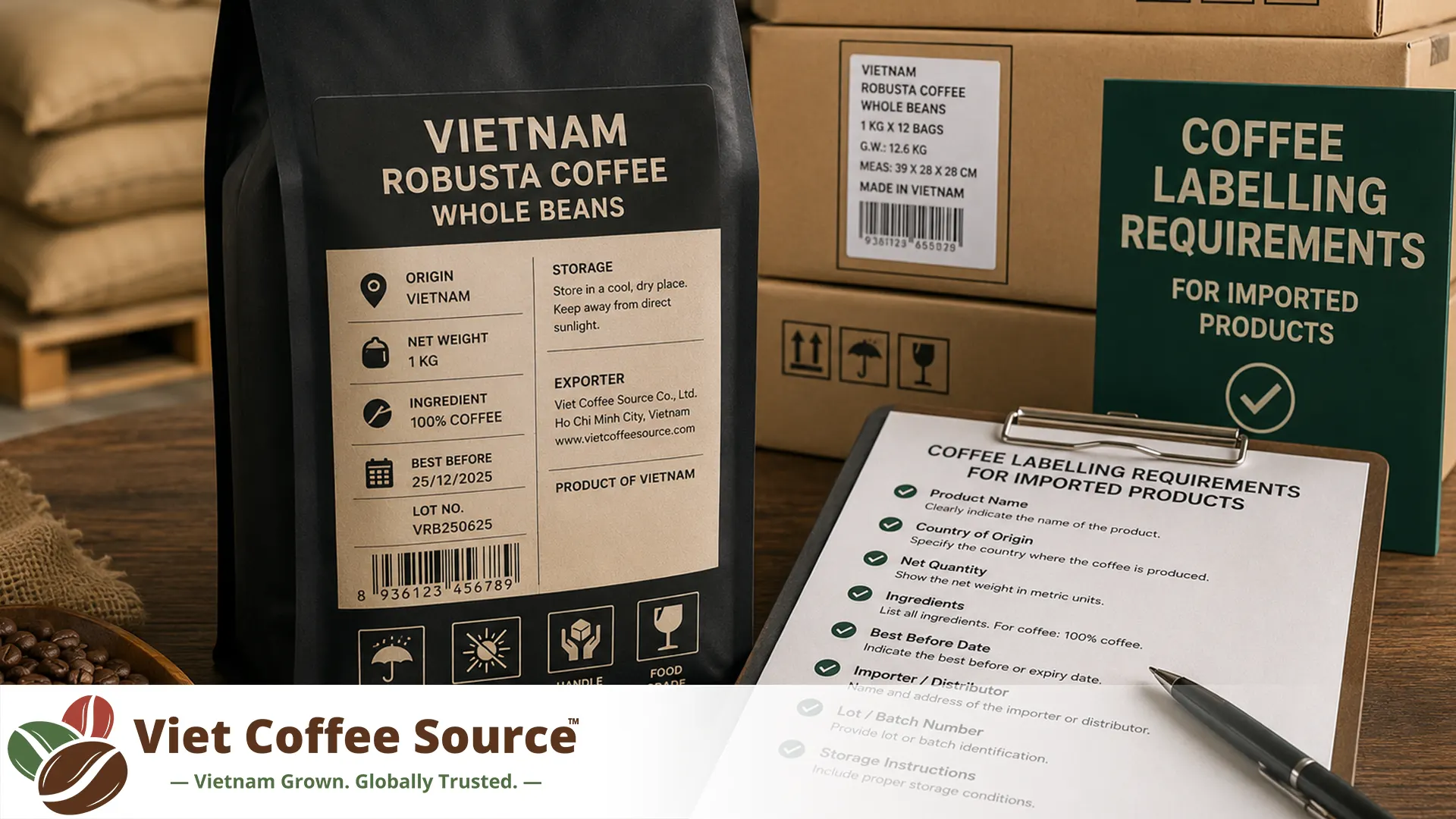
Coffee Labelling Requirements for Imported Products
Coffee labelling requirements for imported products determine what information must appear on retail packs, outer cartons and, in some cases, accompanying documents before the coffee can be sold in the destination market. The exact obligations depend on the country, product category, ingredients, packaging format, claims, sales channel and intended consumer. Green coffee supplied to a roaster, roasted coffee sold in retail bags, pure instant coffee, three-in-one sachets and ready-to-drink coffee beverages should not be managed under the same generic label template.
An attractive package is not necessarily a compliant package. Imported coffee can be delayed, detained, relabelled, recalled or refused when mandatory information is missing, inaccurate, translated incorrectly or presented in an unacceptable format. Importers should therefore approve the complete label artwork before mass production and before the goods leave the exporting country.
What are coffee labelling requirements?
Coffee labelling requirements are the legal rules governing the information displayed on a coffee product and its packaging. These rules help customs authorities, food regulators, distributors and consumers identify the product, understand its composition, trace its origin and use it safely.
Depending on the destination market, mandatory information may include:
- Legal product name
- Ingredient list
- Allergen declaration
- Net quantity
- Nutrition information
- Country-of-origin statement
- Name and address of the importer
- Name or address of the manufacturer
- Lot or batch code
- Best-before or expiry date
- Storage instructions
- Preparation instructions
- Required language
- Recycling and packaging information
- Special warnings
- Certification or traceability references
The label should be reviewed against the laws of the destination country rather than only the rules of the country where the coffee is manufactured.
Why imported coffee labels require special attention
Imported products pass through several control points. Customs authorities may review the product description and origin, food authorities may inspect ingredients and claims, while retailers may require additional commercial information.
Common risks include:
- Using a product name that does not match the actual composition
- Missing importer details
- Incorrect country-of-origin wording
- Untranslated mandatory information
- Incomplete allergen declarations
- Nutrition values shown in the wrong format
- Unsupported organic or sustainability claims
- Incorrect date coding
- Labels that cover required original information
- Conflicts between the label, invoice and customs declaration
A structured label review should therefore involve the supplier, importer, regulatory adviser and customs broker before printing begins.
Main coffee product categories and labelling differences
| Product category | Typical labelling focus | Common risk |
|---|---|---|
| Green coffee | Product identity, origin, lot, weight and intended use | Confusion between roasting material and planting seed |
| Roasted whole-bean coffee | Legal name, net weight, origin, date and storage | Misleading origin or roast claims |
| Ground coffee | Product identity, grind description and preparation | Confusion with blends containing non-coffee ingredients |
| Pure instant coffee | Product name, net quantity, preparation and nutrition treatment | Incorrect classification as a coffee preparation |
| Three-in-one coffee | Ingredients, allergens, nutrition and preparation | Missing milk, soy or sugar information |
| Flavoured coffee | Flavour description, ingredients and additives | Using “natural” or flavour claims without support |
| Ready-to-drink coffee | Full beverage labelling, nutrition, allergens and storage | Incorrect beverage name or missing refrigeration instructions |
Legal product name
The legal product name tells the consumer what the product actually is. It should be specific enough to distinguish the coffee from other foods and should reflect the real composition.
Examples may include:
- Roasted coffee beans
- Ground roasted coffee
- Instant coffee
- Freeze-dried instant coffee
- Coffee beverage powder with sugar and creamer
- Flavoured roasted coffee
- Ready-to-drink milk coffee beverage
A brand name, marketing phrase or product series name does not normally replace the legal name. The product identity should be visible and understandable without requiring the consumer to interpret promotional language.
Product names for pure coffee and preparations
Pure coffee products and formulated coffee preparations must be clearly distinguished. A three-in-one product should not be labelled only as “instant coffee” when most of the formulation consists of sugar and creamer.
The legal name may need to indicate:
- Whether the coffee is roasted or unroasted
- Whether it is whole bean or ground
- Whether it is soluble or an extract
- Whether it is decaffeinated
- Whether flavours have been added
- Whether it contains milk, sugar or other ingredients
- Whether it is a beverage powder or ready-to-drink product
The marketing name should never conceal the actual nature of the product.
Ingredient list
Pure roasted coffee and pure instant coffee may not require a complex ingredient list in some markets because they contain a single ingredient. Formulated products generally require a complete ingredient declaration.
Ingredients are commonly listed in descending order by weight at the time of manufacture. A three-in-one coffee formula may include:
- Sugar
- Non-dairy creamer
- Instant coffee
- Milk solids
- Vegetable fat
- Emulsifiers
- Stabilizers
- Anti-caking agents
- Flavourings
- Salt
The ingredient declaration must match the actual production formula. Substituting a creamer, flavour, sweetener or emulsifier may require the label to be updated before the next production run.
Compound ingredients
A compound ingredient is an ingredient made from several sub-ingredients. Coffee creamer, chocolate powder, flavour preparations and milk mixes may all contain multiple components.
The label may need to disclose the sub-ingredients of:
- Non-dairy creamer
- Milk powder blends
- Chocolate or cocoa mixtures
- Flavouring preparations
- Sweetener blends
- Vitamin or mineral premixes
The supplier should provide a complete formula rather than only commercial ingredient names.
Allergen declaration
Pure coffee normally presents limited allergen concerns, but prepared coffee products may contain regulated allergens. Milk and soy are common examples in coffee creamers and premixes.
The importer should verify:
- Allergens intentionally added to the product
- Allergens contained within compound ingredients
- Cross-contact risks from shared equipment
- Required allergen emphasis in the ingredient list
- Mandatory “contains” statements
- Rules for precautionary warnings
Allergen terminology differs between markets. A declaration accepted in one country may require different wording, emphasis or placement in another.
Precautionary allergen statements
Statements such as “may contain” should be based on a documented cross-contact risk assessment. They should not be used automatically as a substitute for effective allergen controls.
The manufacturer should be able to explain:
- Which allergens are handled on shared lines
- How cleaning is validated
- Whether dedicated storage is used
- How raw materials are controlled
- Why a precautionary statement is necessary
Net quantity
The label must show the net quantity of coffee excluding the packaging. The required unit depends on the destination market and may use grams, kilograms, ounces, fluid millilitres or another permitted unit.
Net quantity information should be:
- Accurate
- Easy to locate
- Clearly legible
- Shown in the legally required unit
- Consistent with the commercial invoice and packing list
Multi-pack products may need to show both the number of units and the net quantity of each unit, such as 20 sachets × 18 grams.
Nutrition information
Nutrition labelling obligations depend strongly on the product. Pure coffee may be exempt from full nutrition labelling in some markets, particularly when no nutrients or health claims are made. Sweetened, milk-based, flavoured or ready-to-drink products generally require a nutrition panel.
The panel may need to state:
- Energy
- Total fat
- Saturated fat
- Trans fat where required
- Carbohydrate
- Total sugars
- Added sugars where required
- Protein
- Salt or sodium
- Fibre where required
- Serving size
- Servings per pack
The required order, units, rounding rules and reference values differ between countries.
Nutrition values per 100 grams and per serving
Some markets require values per 100 grams or 100 millilitres, while others emphasize values per serving. Certain markets require both formats.
The importer should confirm:
- Mandatory reporting basis
- Permitted serving size
- Whether the product is assessed as sold or prepared
- Rounding rules
- Daily-value or reference-intake percentages
- Rules for very small packages
For coffee powder prepared with water, the label may need to explain whether nutrition values refer to dry powder or the prepared beverage.
Nutrition data sources
Nutrition values can be supported by laboratory analysis, validated calculation from ingredient data or a combination of both. The chosen method should reflect the complexity of the formulation and destination requirements.
The importer should retain:
- Laboratory reports
- Ingredient specifications
- Supplier nutrition data
- Calculation worksheets
- Recipe versions
- Rounding records
When the formula changes, the nutrition panel should be reassessed.
Country-of-origin labelling
Country-of-origin statements must accurately describe where the coffee was grown, processed or manufactured. The correct wording depends on the product and local law.
Possible statements include:
- Product of Vietnam
- Vietnamese coffee
- Made in Vietnam
- Roasted and packed in Vietnam
- Made with Vietnamese coffee beans
- Blended and packed in Vietnam using imported ingredients
These statements do not have identical meanings. The importer should ensure the claim matches the product’s actual supply chain and applicable origin rules.
Origin statements for blended coffee
Coffee blends can contain beans from more than one country. A label should not imply single-country origin unless the product and supporting records justify that claim.
Possible approaches may include:
- Blend of coffees from multiple origins
- Produced using Vietnamese and other origin coffees
- Origin information stated by percentage where required
- Specific origin identified by lot documentation
Buyers can review the main Vietnam coffee origins and production regions when developing accurate origin statements for Vietnamese products.
Manufacturer and importer information
Imported retail coffee often needs to identify the responsible business in the destination market. The label may require:
- Manufacturer’s legal name
- Manufacturer’s address
- Importer’s legal name
- Importer’s address
- Distributor details
- Local representative
- Customer-contact information
The responsible party should be clearly identified. A website or brand name alone may not satisfy the requirement for a legal business name and physical address.
Lot and batch coding
Every product should be traceable to a defined production lot. The lot code connects the retail pack to production, raw materials, packaging and quality-control records.
A reliable coding system may identify:
- Production date
- Factory
- Production line
- Shift
- Raw-material lots
- Packaging lots
- Quality-release status
The code must remain legible throughout the product’s shelf life. It should not be placed on an area likely to be removed when the package is opened.
Best-before and expiry dates
Coffee commonly uses a best-before date because quality gradually declines rather than becoming unsafe immediately after a specific day. However, the required date terminology and format depend on the destination market and product.
The label review should confirm:
- Whether a best-before or use-by date is required
- Permitted date format
- Month and year requirements
- Minimum remaining shelf life at import
- Whether the production date must also be shown
- Whether the date location must be referenced elsewhere on the pack
Ambiguous formats should be avoided. A numeric date such as 05/07/2027 may be interpreted differently across markets.
Shelf-life support
The declared shelf life should be supported by product stability and packaging performance. Importers may request:
- Real-time shelf-life study
- Accelerated stability data
- Sensory results
- Moisture results
- Microbiological data
- Packaging seal tests
- Oxygen and moisture barrier information
A shelf-life claim copied from another product may be unreliable when the roast level, grind, formulation or packaging structure differs.
Storage instructions
Storage instructions should reflect the actual needs of the coffee. Common wording may address:
- Cool and dry storage
- Protection from direct sunlight
- Closing the package after opening
- Refrigeration after opening for liquid products
- Use within a specified period after opening
- Protection from strong odours
The instructions should be practical and supported by the product’s shelf-life assessment.
Preparation instructions
Instant coffee, three-in-one sachets, filter coffee and concentrates may require preparation instructions. Instructions should be clear enough for the consumer to use the product correctly.
They may specify:
- Amount of product
- Water volume
- Water temperature
- Brewing time
- Number of servings
- Mixing or shaking instructions
- Serving suggestions
Preparation instructions should also match the serving size used in the nutrition panel.
Language requirements
Mandatory information generally needs to appear in the official language or languages required by the destination country. English-only packaging may not be sufficient.
The importer should confirm:
- Mandatory language
- Whether bilingual or multilingual labels are permitted
- Whether translations must be officially approved
- Minimum font size
- Character and accent requirements
- Placement of translated information
Machine translation should not be used without review by a qualified native-language specialist familiar with food terminology.
Use of supplementary labels
Some countries permit an importer to apply a supplementary sticker containing required local information. Other markets require the final compliant label before shipment.
A supplementary label should:
- Be securely attached
- Remain legible
- Not cover mandatory original information
- Match the actual product
- Use the required language
- Include importer details where required
- Be applied before retail sale
Relabelling after arrival can create warehouse, inspection and customs costs, so pre-approval remains preferable.
Minimum font size and legibility
Mandatory information must usually be clear, visible and readable. Certain markets define minimum character heights or specific contrast requirements.
Common problems include:
- Text that is too small
- Low contrast between text and background
- Printing over complex images
- Reflective surfaces that reduce readability
- Curved packaging that distorts text
- Ink that rubs off during transport
The final physical package should be reviewed, not only the digital artwork displayed on a large computer screen.
Placement of mandatory information
Some information may need to appear in the principal display panel, while other details can be placed on the back or side panel. Net quantity and legal product name often require prominent placement.
The importer should verify:
- Which panel is considered the main display panel
- Required proximity between product name and net quantity
- Location of allergen information
- Location of importer details
- Whether the date code can appear on the seal or base
- Whether mandatory information may be placed beneath a peel-back label
Claims and marketing statements
Claims can create additional legal obligations. Coffee packaging may use statements such as:
- Single origin
- Specialty coffee
- Premium
- Organic
- Natural
- No added sugar
- Sugar free
- Low caffeine
- Decaffeinated
- High in antioxidants
- Sustainable
- Deforestation free
- Fair trade
Every claim should be supported by evidence and reviewed against destination-market definitions. Promotional wording should not mislead consumers about composition, origin, quality or environmental impact.
Organic coffee labelling
Coffee labelled as organic must comply with the organic certification and logo rules of the destination market. The label may require:
- Recognized organic logo
- Certification-body code
- Origin statement for agricultural ingredients
- Importer or operator identification
- Approved organic claim wording
- Lot traceability
An organic certificate issued in the exporting country may not automatically authorize use of the organic logo in the importing country.
Sustainability certification labels
Fairtrade, Rainforest Alliance and other certification marks are controlled trademarks. The coffee and every business using the mark may need to meet the scheme’s licensing and chain-of-custody conditions.
The importer should confirm:
- Certificate validity
- Certified product volume
- Chain-of-custody approval
- Logo artwork approval
- Permitted claim wording
- License or royalty obligations
Single-origin claims
A single-origin statement should be supported by purchasing, production and traceability records. The claim may refer to a country, region, province, cooperative, estate or farm.
Controls should demonstrate:
- Segregation from other origins
- Accurate lot records
- Consistent supplier documents
- No undeclared blending
- Correct geographic wording
A product should not be labelled with a specific Vietnamese region if the shipment contains coffee from multiple undisclosed origins.
Decaffeinated coffee labelling
Decaffeinated coffee may need to meet a legal residual-caffeine threshold. The label should use the correct permitted term and be supported by laboratory or production records.
Supporting documents may include:
- Decaffeination method
- Residual caffeine result
- Solvent-residue test where relevant
- Production specification
- Certificate of Analysis
Flavoured coffee labelling
Flavoured coffee should disclose flavourings in accordance with local ingredient rules. The use of terms such as “vanilla,” “natural vanilla flavour” and “vanilla flavoured” may have different legal meanings.
The importer should confirm:
- Type of flavouring
- Carrier ingredients
- Allergens within the flavour
- Natural or artificial classification
- Permitted product name
- Image-use restrictions
No-added-sugar and sugar-free claims
These claims are especially relevant to coffee premixes and ready-to-drink beverages. “No added sugar” does not necessarily mean the product contains no sugars, while “sugar free” may require the product to remain below a defined threshold.
The formulation, nutrition panel and claim must be consistent. Sweeteners may also require additional declarations or warnings.
Caffeine statements and warnings
Some products may require caffeine disclosure or warnings, especially concentrated beverages, energy-style coffee products or items marketed to children or pregnant consumers.
The importer should verify:
- Whether caffeine content must be declared
- Required unit of measurement
- Whether a warning is mandatory
- Whether the warning must appear near the product name
- Whether serving limits must be stated
Ready-to-drink coffee labels
Ready-to-drink coffee is typically regulated as a beverage rather than as roasted or soluble coffee. The label may need to address:
- Complete ingredient list
- Milk and allergen declarations
- Nutrition panel
- Added sugar
- Caffeine content
- Storage before and after opening
- Pasteurization or sterilization status
- Deposit or recycling scheme
- Beverage-specific taxes
Three-in-one coffee labels
Three-in-one coffee generally requires more detailed labelling than pure coffee because it contains multiple ingredients.
Key elements commonly include:
- Accurate legal product name
- Complete ingredient list
- Milk or soy allergen declaration
- Nutrition table
- Net quantity and sachet count
- Preparation instructions
- Serving size
- Storage instructions
- Importer details
- Lot and date coding
Buyers should also ensure the actual formula matches the customs classification and commercial documents.
Pure instant coffee labels
Pure instant coffee may have simpler ingredient information, but the label should still clearly identify the product and preparation method.
Potential information includes:
- Instant coffee or soluble coffee name
- Freeze-dried, spray-dried or agglomerated description
- Net quantity
- Preparation instructions
- Best-before date
- Lot code
- Origin
- Importer information
Roasted coffee labels
Roasted coffee packaging commonly includes:
- Roasted coffee beans or ground coffee name
- Net quantity
- Roast information where used
- Origin claim where justified
- Best-before date
- Lot code
- Storage instructions
- Importer details
- Preparation guidance
Roast-level descriptions such as light, medium or dark are generally commercial terms, but they should remain consistent with the product delivered.
Green coffee labels and markings
Green coffee sold business to business may use sack markings, pallet labels and shipment documents rather than consumer-style retail labels.
Information may include:
- Product name
- Species or variety
- Country and region of origin
- Crop year
- Processing method
- Grade or screen
- Net weight
- Lot number
- Exporter or producer
- Intended use
The markings should match the specification, Certificate of Origin, packing list and customs declaration.
Packaging and recycling information
Many markets require packaging symbols, material codes, recycling instructions or extended producer-responsibility information.
Requirements may apply to:
- Plastic pouches
- Aluminium laminates
- Paper cartons
- Glass jars
- Metal tins
- Caps and valves
- Outer shipping cartons
The importer may also need to register packaging volumes and pay environmental contributions even when the package itself carries no special symbol.
Food-contact packaging declarations
The label artwork and packaging structure should be supported by documentation showing that the materials are suitable for food contact.
Relevant records can include:
- Declaration of compliance
- Migration test report
- Ink and adhesive declaration
- Material specification
- Intended-use statement
- Temperature and storage conditions
Buyers can review broader coffee quality and compliance requirements when preparing packaging and product documentation.
Barcode requirements
Retailers may require a valid barcode even when it is not a direct food-labelling obligation. The barcode should correspond to the correct product, package size and market unit.
The buyer should verify:
- Barcode ownership
- Correct GTIN
- Package-level assignment
- Print size
- Quiet-zone requirements
- Contrast and scan quality
- Outer-carton codes
Online product information
Coffee sold through e-commerce channels may need mandatory food information to be available before purchase. The online listing should remain consistent with the physical label.
Information may include:
- Legal product name
- Ingredients
- Allergens
- Net quantity
- Nutrition information
- Storage instructions
- Responsible business details
- Origin where mandatory
Outer carton labelling
Outer shipping cartons may require separate commercial, logistics and regulatory information.
Typical carton markings include:
- Product name
- Quantity of retail units
- Net and gross weight
- Lot number
- Production and best-before dates
- Country of origin
- Importer or consignee reference
- Storage conditions
- Handling symbols
- Carton barcode
Carton data should match the retail packs, packing list and warehouse records.
Label consistency with customs documents
The product name, origin, ingredients and responsible business shown on the label should not conflict with the commercial invoice, packing list, Certificate of Origin or customs declaration.
Examples of problematic inconsistencies include:
- Invoice states instant coffee while the label states coffee beverage powder
- Label claims Vietnamese origin while origin documents identify another country
- Label lists milk ingredients that are absent from the customs description
- Declared net weight differs from the retail package
- Manufacturer name differs across certificates
Label artwork approval process
A structured approval process can reduce expensive corrections. A typical workflow is:
- Confirm the exact product formula.
- Identify the destination market.
- Determine the legal product name.
- Prepare ingredient and allergen declarations.
- Calculate or test nutrition values.
- Confirm origin wording.
- Add importer and manufacturer information.
- Confirm date and lot coding.
- Translate mandatory information.
- Review claims and certification marks.
- Check packaging and recycling obligations.
- Approve the final print proof.
Pre-print label checklist
- Product formula approved
- Legal product name confirmed
- Ingredient list verified
- Compound ingredients disclosed
- Allergens correctly emphasized
- Net quantity correct
- Nutrition panel validated
- Origin statement supported
- Importer details confirmed
- Manufacturer details confirmed
- Lot code format approved
- Date format approved
- Storage instructions reviewed
- Preparation instructions reviewed
- Mandatory language confirmed
- Font size checked
- Claims substantiated
- Certification logos approved
- Packaging symbols verified
- Barcode tested
Pre-shipment label inspection
After printing and packing, the importer or quality team should inspect actual production samples rather than relying only on the approved digital artwork.
The inspection should check:
- Print clarity
- Correct language version
- Correct product variant
- Barcode readability
- Date and lot coding
- Net quantity statement
- Seal placement
- Label adhesion
- Carton consistency
- Absence of unauthorized claims
Relabelling imported coffee after arrival
Relabelling may be possible in some markets when goods arrive with incomplete labels, but it should be treated as a corrective measure rather than a normal process.
Relabelling can involve:
- Customs authorization
- Food-authority approval
- Bonded or supervised warehouse work
- Sticker printing
- Manual labour
- Additional inspection
- Storage charges
- Delayed retail launch
Some errors, such as an incorrect product name, unsupported origin claim or missing allergen information, may be more difficult to correct than a missing importer address.
Consequences of non-compliant coffee labels
- Customs hold
- Food-authority detention
- Document requests
- Laboratory testing
- Relabelling
- Repacking
- Storage and demurrage
- Retail rejection
- Product recall
- Financial penalties
- Destruction
- Re-export
- Suspension of product registration
Common coffee labelling mistakes
- Using only a marketing name
- Failing to distinguish pure coffee from a preparation
- Omitting compound ingredient details
- Missing milk or soy allergens
- Using unsupported single-origin claims
- Incorrect translation
- Using the wrong nutrition format
- Printing the date in an ambiguous format
- Missing importer information
- Using certification logos without authorization
- Applying labels that are too small to read
- Changing the formula without updating the artwork
Documents supporting coffee labels
- Approved product specification
- Complete ingredient formula
- Allergen declaration
- Nutrition report
- Certificate of Analysis
- Certificate of Origin
- Organic certificate
- Sustainability certification
- Packaging declaration of compliance
- Shelf-life study
- Trademark authorization
- Final approved artwork
Questions to ask the coffee supplier
- What is the complete product formula?
- Are any compound ingredients used?
- Which allergens are present?
- What nutrition data are available?
- What is the exact country of origin?
- Which factory produces the product?
- What shelf life is supported?
- Which claims can be documented?
- Which certificates cover the product?
- Can the final artwork be approved before printing?
- Can production samples be inspected before shipment?
Questions to ask the importer or regulatory adviser
- What is the required legal product name?
- Which language must be used?
- Is a nutrition panel mandatory?
- How must allergens be displayed?
- What origin statement is permitted?
- Must importer details appear on the retail pack?
- What date format is required?
- Are supplementary labels permitted?
- Which packaging symbols are mandatory?
- Do claims require pre-approval?
- Is product registration necessary?
Final assessment
Coffee labelling requirements for imported products depend on the exact coffee category, formulation, destination market, packaging format, claims and intended sales channel. Pure roasted coffee may require a relatively simple label, while three-in-one coffee, flavoured coffee and ready-to-drink beverages can require detailed ingredient, allergen, nutrition and preparation information.
Buyers should approve the legal product name, ingredients, allergens, net quantity, nutrition panel, origin statement, importer details, date coding, storage instructions, language and marketing claims before packaging is printed. The final label must also remain consistent with the product specification, commercial invoice, customs declaration and supporting certificates.
A disciplined artwork and pre-shipment review reduces the risk of customs holds, relabelling, retailer rejection, recalls and regulatory penalties. Buyers seeking Vietnamese coffee with coordinated specifications, packaging and export documentation can review available coffee export and documentation support or submit a customized wholesale coffee inquiry with the product type, target market, packaging format and required label language.